

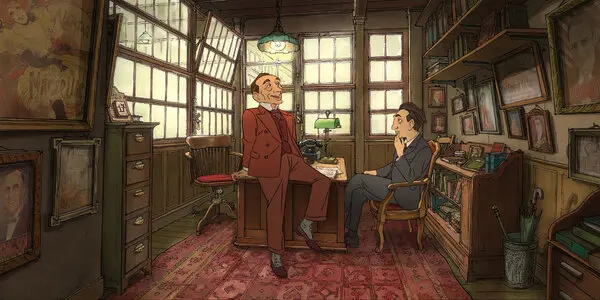

The third animated feature from French writer/director Sylvain Chomet, A Magnificent Life doesn’t quite reach the emotional impact or narrative innovation of his previous masterpieces, The Triplets of Belleville and The Illusionist. While the 2D animation is undeniably exquisite, the writing feels slight, leaving the central drama feeling emotionally torpid and so much of it becomes dull.
The film chronicles the life of the legendary French filmmaker and playwright Marcel Pagnol. The saga begins in 1956 Paris, where an aging, 61-year-old Pagnol (Laurent Lafitte) is enduring an existential crisis, feeling his work has faded into obscurity. When the editor-in-chief of Elle magazine suggests he write a memoir, Pagnol is visited by the ghost of his younger self. This childhood apparition helps him navigate lost memories and find the inspiration to recount his past.
Chomet employs a non-linear structure heavy on flashbacks, starting with Pagnol’s childhood in Marseille and the profound impact of his relationship with his mother. We watch him grow from a schoolteacher into a Parisian playwright, eventually pivoting to cinema after a trip to London. Upon witnessing the birth of the “talkies,” Pagnol realizes that film is the future of drama. Chomet skillfully shifts visual styles to match each era, even utilizing a silent film aesthetic with title cards to capture the energy of the 1920s.

Courtesy Sony Pictures Classic
The film’s most clever stretch is a satirical sequence at Paramount Studios. As Pagnol takes a walking tour, Chomet provides biting commentary on the industry—from out-of-touch executives to script consultants who have never written a screenplay in their lives. Sadly, as the story shifts toward personal tragedy—including the death of Pagnol’s young daughter and the Nazi occupation of France—the momentum stalls. Pagnol is eventually approached by a Nazi film commissioner to produce propaganda, a request he bravely declines, yet even this high-stakes conflict feels strangely muted.
While A Magnificent Life holds immense potential, it never fully ignites. The narrative often feels like a series of bullet points pulled from a Wikipedia page rather than a cohesive story. It fails to tap into Pagnol’s emotional complexity, and the various tonal pieces don’t connect well enough to offer the audience a satisfying reward.
Because Chomet’s films are released so rarely, there is an inherent joy in seeing his craftsmanship on screen again. However, the characters here feel less rounded than those in his previous works, and the dialogue can feel stilted. Chomet has previously explored the lives of “faded artists” with great success, but A Magnificent Life lacks the radiance of its predecessors. It is an admirable effort with breathtaking visuals, but it never quite captures the “magnificent” soul it aims for.
A Magnificent Life is now playing in theaters





Leave A Comment