

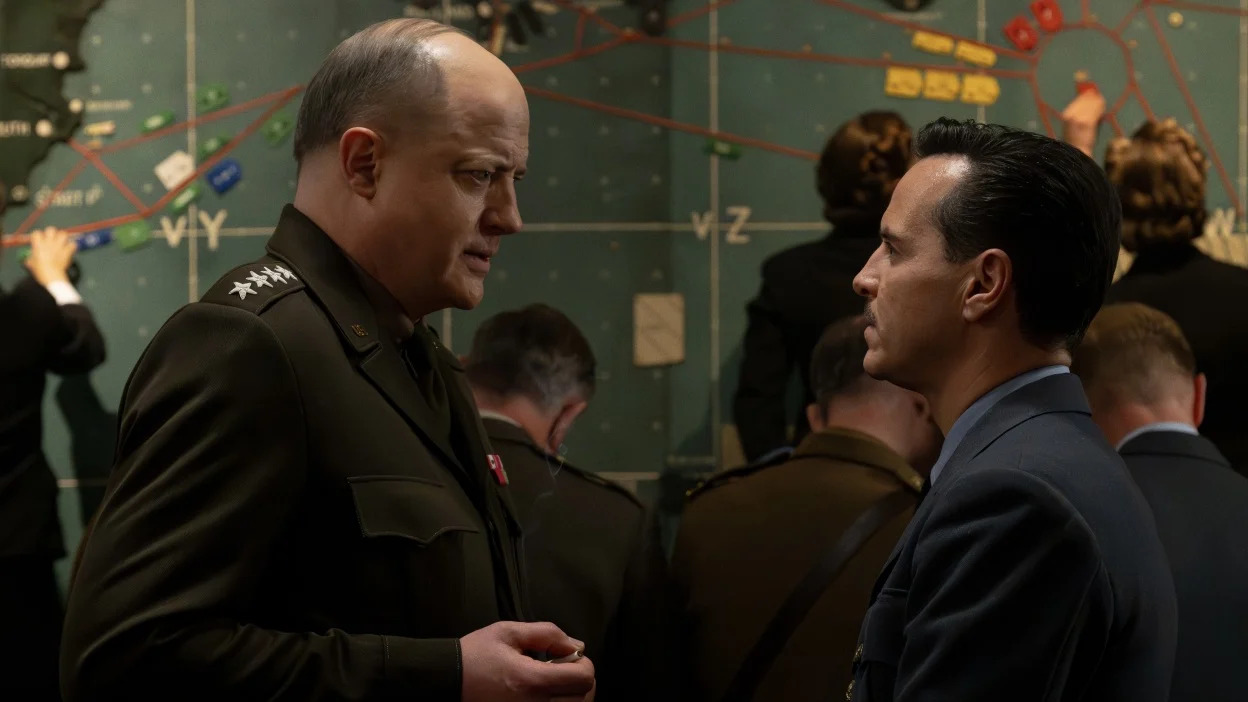

There have been many films about war and many about the Second World War. A seeming majority of those have centered on either combat or rescue missions. Pressure is in neither camp, instead concerning itself with the decision to invade France. This decision, according to history, was dependent on the weather, and so it is that this film tracks the agonizing and excruciatingly detailed ways in which that team of meteorologists arrived at their recommendations for D-Day. It is a subject about which books, papers and documentaries have been made but not, to this viewer’s knowledge, a feature film.
Courtesy Focus Features
Brendan Fraser plays General Dwight David Eisenhower. Andrew Scott plays James Stagg, a Scottish meteorologist recommended by Churchill, who is now in charge of the final word from his department. As the film begins, he leaves behind a very pregnant wife in order to take over from Eisenhower’s trusted long-time man, Irving P. Krick, played by Chris Messina. The always capable Damien Lewis plays Bernard Montgomery, shown here as the blustery, somewhat bloodthirsty and possibly too eager for the moment commander of the British forces. Each actor gets some moments to shine, but it is really Scott, alongside Kerry Condon as Kay Summersby, assistant to Eisenhower, who form the center of the film. Condon, in many ways, plays the film’s most interesting character, a woman who has proven her value to all and risen in the ranks to become vital in the most critical moment of the war.
This is a movie with a lot of talking, and it makes sense, as it began life as a stage play, brought to life by director Anthony Maras, who co-wrote the screenplay with the play’s original author, David Haig. Here, the makers have opened up the setting, though we still get a lot of people talking in rooms with maps. Yet, the camera is active, and the actors are allowed to breathe, because this is a film that takes the subject seriously without becoming a tomb. It is not a film that goes for cheap laughs but it does understand the gravity of the events it details.
Courtesy Focus Features
When this writer says it has a light touch, that is to say that the film is not heavy handed, or self certain. It does not lack confidence, and does a fine job explaining the who, what, why, where and when of this pivotal moment in history. The above cast is, without a doubt, the key asset and reason for the success of the film. Scott has a grim determination, able to go toe to toe with Fraser’s imposing Eisenhower. He does not match Fraser in terms of raw energy, but rather meets him with a steely resolve and belief in his data. This is not about anything but numbers and science, and it certainly is not about gut feelings or brand loyalty.
The film does lack a traditional villain, but that is as it should be. People clash, have differences of opinion and approach. There are arguments, debates and more, but never is there felt a time where the men and women are working in opposition to one another. Ultimately, they want to see the same effect, but the how, why and when are quite different.

Courtesy Focus Features
As such, the film eschews battlefield heroics for victories of a quieter nature, about logic and reason, of data and analysis, over anything else. While the film does veer just a little into the “grand allied victory” mode in its final act, that is at it should be. It was a crowning achievement for all involved and they had every reason to be proud, to feel some relief and to reflect on the cost to those on the ground. This is in no way an earth shattering work, and will not be seen in the future as some sort of model, like Saving Private Ryan, Platoon or even Paths of Glory. But it is extremely capable, entertaining and worth the time to see it. Sometimes, the real heroes sport a degree in science and brandish only a sharp intellect and supreme confidence in their methods.
Pressure opens in theaters on May 29th.





Leave A Comment