


Warning: In order to adequately compare this adaptation to the source material, I will be discussing spoilers from both the text and the film.
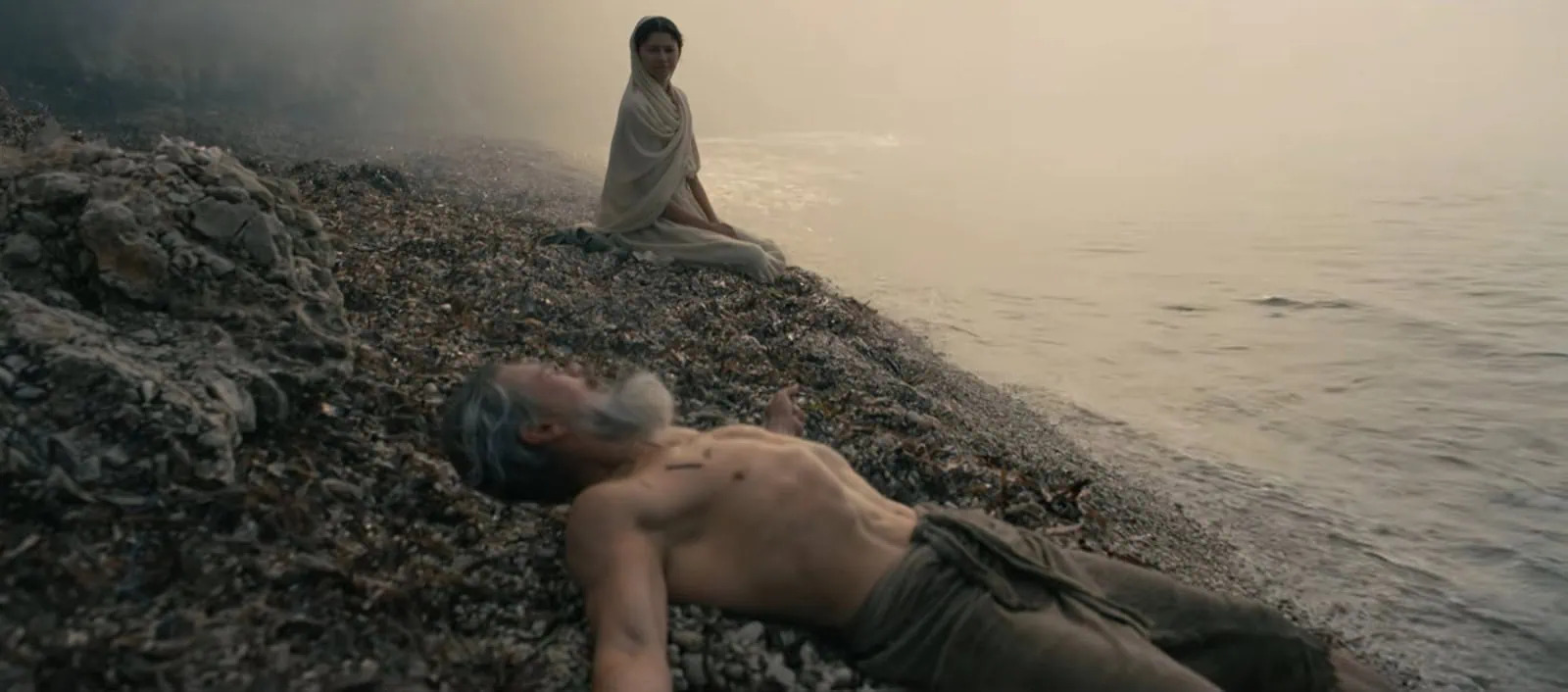
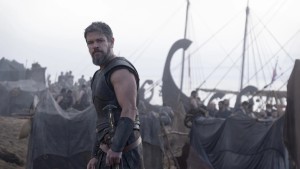
A story like Homer’s The Odyssey – and its brutal “prequel”/older brother The Iliad – survives the ages because its archetypal power and structure exists in our unconscious as much as anywhere. It is all of us. Our unconscious also houses the material of our dreams, and this combined with the aesthetic and narrative tastes of director Christopher Nolan is why his explosive, gritty, and at times alarming new adaptation unfolds like an operatic fever dream nightmare. And just as archetypes are timeless, this adaptation seems not to exist in a specific time period; no details are given to orient the audience besides several mentions of the Bronze Age (likely not to be clearly oriented in the mental timelines of most audience members), and characters talk about the fall of the age and civilization rising again in the future. But what is falling and what is rising? It does not concern itself with over-explaining each of the characters that Odysseus and his men encounter on their ten-year journey home; it confronts the audience with them up close, urgently, and quickly. Even with this, Nolan of course had to excise whole episodes and combine several into one, and he does this to mostly powerful effect. Scholars and lovers of the poem will of course lament the excisions, but the larger phantasmagoric tableau is what matters most here and how it serves the reunion of the family unit and thus the functioning society of Ithaca and by extension the Greek world itself. Matt Damon as Odysseus, Anne Hathaway as Penelope, and Tom Holland as their son Telemachus hold the backbone and heart of the film ably, giving it the emotional center in an otherwise largely visceral and, typical for Nolan, cerebral experience.
Courtesy Universal
There are two schools of thought regarding The Odyssey of the Greeks: It’s literal and historical laced with mythology. Or it’s all an abstract ancient fable about the trials and tribulations of being human. Nolan chooses to literalize much of the poem, taking a look at what all this would have looked like in “real life”: For example, the men hiding in the Trojan horse would have defecated and urinated all over each other. Is this warranted or missing the point? Was the Trojan horse episode never meant to be taken as history but just another archetypal image symbolizing something deeper? Injecting mythological elements into this realism has a variety of effects, to me mostly positive, but I wonder if to a modern audience these two facets merging is disorienting, while a reader of Homer can comfortably assimilate to the marriage of the two. Whether it works for the viewer or not, Nolan succeeds in imbuing his version with an authentic archaic patina, even if that patina is not strictly Homer or his Greece.
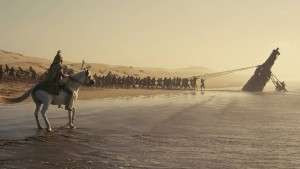
Homer is famous for his non-linearity in The Odyssey, and we meet Odysseus’ son and wife Telemachus and Penelope first, several chapters before we ever see our main man. From there, the text bounces around in a very postmodern style, almost cinematic in itself, giving us various perspectives and narrators, most of whom are unreliable. Nolan himself follows this structure though opens in a different place, and we are not led into this vast universe with gentle hands. His entire filmography has played with structure, time, and memory, all fundamental aspects of the epic poem. Home is also a theme that has obsessed, if not plagued, Nolan, and he may have found the apotheosis of this in filming the story to end all stories. Ever since childhood, what has struck me deeply about The Odyssey is the sea, and Nolan has captured it in stunning fullness and effect here, especially in IMAX, where viewers feel right on the roiling Ionian and Aegean seas with Odysseus and his men, riding the cresting waves and suffering the pummeling of Zeus’s rage.
For those familiar with the source material, the heavy exposition in the opening of the film might be a lot to sit through, anxious to get to the meat of the story. Unfortunately, when adapting historical and mythological material laden with cultural, social, political, and religious differences to our times, exposition is unavoidable. But how it is achieved is what matters. Yes, some of the initial dialogue is a bit pedantic, inelegant, and extensive, but I imagine it helped acclimate much of the audience to this foreign world. Once we reach about the halfway point of the first act, this largely dissipates and we start to experience what we came for.
Courtesy Universal
The film opens with the telling caption: “In a time of apparent magic.” That adjective gives away instantly Nolan’s sensibility and approach. While the gods are inseparable from the source, here they are left to your interpretation. Except they’re not. As will be examined, Nolan chooses to include scenes of blatant acts of the gods/goddesses and literal magic, while largely skirting the majority of its depiction by Homer. Nolan does as good a job as any could in treading the line of merging the past sensibilities with modern ones while inserting selective interferences by the gods, and for the most part, modernity never overtakes the adaptation (accents, language, and scholarly quibbles aside). His near-constant references to Zeus’ law of hospitality (otherwise known as xenia, which in the ancient world served as protection to the seafaring Greeks in a pre-policed world of superstition: the stranger may be a god in disguise) seems to be his foreshadowed setup for a brand new ending, nowhere to be found in Homer or other retellings.
Odysseus is, depending on which translation you read, a man “of twists and turns” (Robert Fagles), “of many roundabout ways” (Daniel Mendelsohn) and, in the most contemporarily controversial and discussed translation, “a complicated man” (Emily Wilson). He is a trickster, a liar, a spinner of tales, as much as a warrior and expert bowman. However, Damon is given very little of these traits in the script, focusing almost solely on his physical capabilities in taking down Troy and then finding his way through an endless onslaught of crises. Here and there we glimpse his ingenuity and trickery, but it has been played down in favor of strength and competence. What emanates from Damon’s Odysseus overall is affability and endurance. His problematic, selfish, boastful, and edgy sides are nowhere really to be found. Whether or not Odysseus is a hero is a matter of constant discourse; after all, what kind of hero manages to get zero of his men home alive? And his decisions as the film goes on leave his men increasingly questioning his commands, articulated both in the poem and the film by his second-in-command Eurylochus (Himesh Patel).
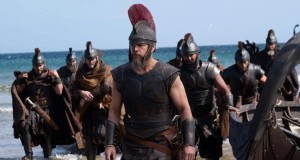
The most famous encounter from the poem, that of the Cyclops’ cave, comes to startling life here. Nolan uses a combination of actor, puppet, and CGI to achieve the terrifying colossal presence of the one-eyed shepherd who traps the men in his cave. Missing from this Cyclops depiction is not only his name, Polyphemus, which elevates him beyond a voiceless mindless monster, but the witty wordplay between him and Odysseus that saves Odysseus and most of his men. (When asked his name, Odysseus says “I am Nobody.” After the men stab out the Cyclops’ eye, his screams bring his neighbors to the closed cave to ask who is harming him, to which the Cyclops responds “Nobody is harming me” and they walk away.) Speaking of Zeus’ law, a conversation on the questionable ethics of Odysseus and his man could fill an entire review. (They violate Polyphemus’ home and eat his cheese, then they blind him and escape; but Polyphemus himself eats several of his “visitors,” also a horrendous violation of the law). Odysseus acts rashly as they escape in a way that brings unnecessary extra danger to his men, but he excuses it by claiming he was avenging the cannibalistic deaths of several of his men by the Cyclops, while in the text he screams out boasts to the Cyclops from the sea as they sail away, resulting in the Cyclops hurling boulders into the water and waylaying the warriors. Impulsive actions are not to be admired in a leader, but it is this complex texture to Odysseus that enriches the poem – and prolongs the journey home.
Courtesy Universal
On the heels of the men’s narrow, harrowing escape from the Cyclops is a stop at another island where armored giants materialize out of the trees and chase the men back to their boats. It is to be assumed that these are the Laestrygonians from the poem, but it is never explored and ultimately repetitive and redundant after the previous episode of a giant chasing the men to the boat. A perfect example of something working on paper but not in the narrative confines and limitations of cinema. I would have removed this altogether and expanded other existing moments that could have benefited from more.
A great majority of Odysseus’ experiences are told by him in the poem to the Phaeacians, a people in whose kingdom he finds himself after being stranded at sea and losing the last of his men to the multi-headed monster Scylla, the whirlpool Charybdis, and Zeus’ wrath after they eat the cattle of the Sun God. In the film, the Phaeacians are cut and this role is assumed by Calypso (Charlize Theron), a nymph who holds Odysseus on her island for seven years. For audiences unfamiliar with the story, the exact identity of Calypso is never articulated here, because this adaptation is, again, largely godless. In his narrative economy, Nolan not only assigns Calypso as the receiver of Odysseus’ memories and experiences, but she also becomes the proxy for the lotus-eaters, a people who give Odysseus and his men a drug that allows them to temporarily forget their PTSD and relax in the sun. Confusingly, here Calypso simultaneously wants him to forget AND remember what he has endured and where he comes from: who is his wife, his son, his home? The poem depicts her as a lonely nymph who wishes to turn Odysseus into a god and keep him beside her forever; with this comes the poignant response of Odysseus that, while Calypso is more beautiful than Penelope and could indeed make him immortal, he chooses his humanity and old age with the woman he loves. This is an excision from the film that, while understandable for time and clarity, loses some of the nuanced humanity of Odysseus. But collapsing several characters into Calypso otherwise works very well here and gives Charlize Theron more to do than Calypso has even in the poem, even if what is lost is the classic moment when the god Hermes orders Calypso to obey Zeus and send Odysseus home.
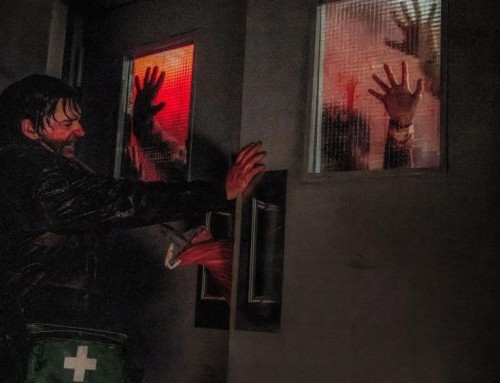
Next comes what is almost certainly the most alarming, fascinating, memorable moment in the film, that of the visit to the island of Circe. The magnificent character actress Samantha Morton (known perhaps to most audiences as the pre-cog in Spielberg’s Minority Report) slips almost trance-like into the role of the witch who turns men into swine, luring the starving men to her table to eat her endless supply of “soup.” While Odysseus stays on shore to hunt for food, his men are turned into pigs in a sequence that has left audiences speechless. Some say it is Nolan’s closest approach to making a horror film. Until this portrayal, Circe has been painted as a beautiful alluring goddess living in a vast palace surrounded by men and animals; here she is alone and in a shack atop a small hill, surrounded by rotting buildings and a lion, a tiger, a panther, and other animals. She seems to have melded into the rocks and grass and soil. Odysseus searches for his men and finds her alone with a pig pen, and he uses his wit and intuition to realize exactly what has happened. Her confrontation with Odysseus on the behavior of his men and their rapacious hunger can serve as a parallel to what is happening to his wife and son back in his palace; if only Penelope had such magical powers. Both Calypso and Circe are stripped by Nolan of their sexual encounters with Odysseus, likely for time but also perhaps to remove the messiness of sex from this austere vision, though it is throughout Homer. And like Calypso, Circe in the poem keeps Odysseus for an extended length of time; here it is an afternoon. He bargains for his men back, in exchange for which she advises that he must travel to the underworld to consult the prophet Tiresias in order to find out how he will make his way home. While Circe in the poem is languid and inviting, here she is hostile and seems indeed to loathe humans.
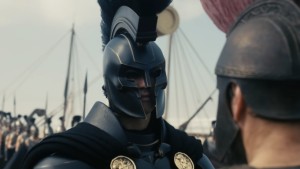
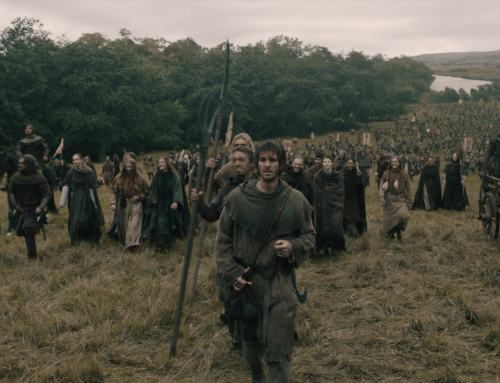
In the poem and ancient Greek culture, Hades was where all souls went to become “shades,” their souls floating around a kind of limbo. Odysseus is the only living human who ventures there and makes it back alive, after offering sacrifices and consulting not only the prophet Tiresias but dead warriors who fought at Troy (in the poem it is Achilles; here it is an obscure warrior from mythology named Sinon, not in Homer but in Virgil’s Aeneid, played by Elliot Page). One of the most visually arresting sequences in the film, Hades is at the conjunction of two rivers and, after making his sacrifice of two goats, Odysseus and his men watch as the shades rise out of the black sand of the expanse around them (filmed in Iceland). A massive crowd of the dead hovers at the fringes watching Odysseus speak with Sinon and Tiresias. Among them and gliding up to Odysseus is Agamemnon, king of Mycenae and leader of the Greeks in the war at Troy. Here he relates to Odysseus how, upon his return to his home, he was murdered by his wife Clytemnestra (played by Lupita Nyong’o, who also plays the queen’s sister Helen) for his sacrificing of their daughter Iphigenia to Artemis for fair winds to Troy. Like Circe, Clytemnestra in both the poem and the film serves as a sort of alternative parallel of Penelope, a homecoming to be avoided at all costs. Just as the people in our lives can appear in dreams in heightened, surreal forms that highlight larger significance and meaning, so here the towering figure of Agamemnon, in his anachronistic gleaming black armor and plumed helmet, glides through his few scenes silently, a startling and removed presence, barely speaking any lines; again, this film is a dream, and we are getting Odysseus’s impression of Agamemnon more than the man himself. The most striking sequence with Agamemnon is the war at Troy, a breathless, visceral sequence that feels almost like a silent film, relying on image and unsettling score by Ludwig Goransson. When the Greeks infiltrate Troy through the Trojan horse and finally open the Scion Gate, revealed gleaming in the night, in triumph, is Agamemnon, followed by his men who storm the gate and commit the ultimate violation of xenia.
Courtesy Universal
Long-suffering Penelope has waited out the twenty years of Odysseus’ absence by sitting at her loom, tolerating the invasion of the dozens of suitors, men of various ages who wish to win her hand in marriage, and thus inherit the throne of Ithaca, instead of her son Telemachus, who is on the threshold of manhood and desperate to know what his father was like and if he is in fact dead or just about to appear over the horizon. The character of Penelope has always been regarded as virtuous, stoic, loyal. But the film portrays her own inner strength, as well as giving her a momentary lapse in her stoicism by shouting at her son (a refreshing addition, as even Penelope is a human and can hold in her fear, rage, and grief only so long) and resilience with what she faces, from both the obnoxious suitors (or as classics scholar Mary Beard prefers to call them, thugs) and her son, who applies his own pressure on her at a certain point to agree to a plot of marriage that will temporarily assuage the situation while Telemachus works to rid them of the men and take the throne. There are complications as to why he cannot do this already, and like the film’s continuous stress on “Zeus’ law”, involves social codes of the times.
This is as much Telemachus’ story as Odysseus’, a coming-of-age from boyhood to manhood. Telemachus was a baby when Odysseus left for Troy, and he has never laid eyes upon his father. He struggles to handle the situation with the suitors, caught between the youth that prevents him from taking his father’s throne and waiting/expecting for his mysterious father to return home. He sets sail to visit Menelaus and Helen, now returned from Troy, to find out if they have any news of Odysseus. Here Menelaus temporarily becomes the storyteller, giving Telemachus – and us – a firsthand account of the war. We meet Helen, perhaps the most discussed and controversial casting of the film, played by Lupita Nyong’O. The face that launched a thousand ships is now scarred, the implication being by her cuckolded husband. (a detail not in Homer). They dine at their daughter’s wedding feast, now a middle-aged married couple in obvious enmity. Menelaus urges Telemachus to find a way to dislodge the suitors from his home.
Keeping watch over his absent master’s kingdom is the loyal swineherd Eumaeus, one of the most compelling and trustworthy characters in the poem. Here, he is played as a blind man by John Leguizamo, in one of the film’s most grounded and strong performances. He is, however, not blind in the source, and in the film it robs him of much of the agency and ability he has in the epic. I wonder if Nolan wanted him to function as a sort of representation of Homer himself, a constant and wise presence amidst the unfolding drama on Ithaca, who would later set it all down in writing.
Robert Pattinson turns in one of the film’s most entertaining and authentic performances as the sleazy and cocksure Antinous, a prince of one of Ithaca’s aristocrats vying for the hand of Penelope. One of the biggest additions by Nolan is the notion that when the call came for Ithacan men to join the war, lots were cast, and young Antinous bribed his way out of going by giving his lot to his contemporary Sinon. While not in Homer, this successfully gives an extra layer of the cheat, liar, and coward to Antinous. Prominent in the poem is the suitor Eurymachus, who treats Penelope and Telemachus with compassion and is Penelope’s first choice for potential new husband. This is given to Antinous in one scene when he puts on an almost convincing show of true love and concern for Penelope.
Courtesy Universal
After a rather confusing scene invented by Nolan involving Odysseus infiltrating a visit to a temple and murdering parts of the suitors’ crew, Odysseus returns to his palace and recognizes Argos, the dog he chose as a puppy before leaving for Troy. It is one of the most moving passages in the poem for all who read it; the old dog recognizes the warrior and thumps his tail… then dies. At this moment in the film – not the poem – Telemachus recognizes his father. Together they form the plan of taking back their household, their kingdom, and their wife/mother. But before he can reveal himself, Odysseus becomes the Trojan horse in his own household, allowed in according to xenia, where he is mocked by the suitors but granted a private audience by Penelope. While being questioned by Penelope, Odysseus has one of the few visions of Athena in the film, a vital and vibrant presence throughout Homer’s epic. Here it is revealed, as another (and very moving) invention by Nolan, that she is in fact the hallucination or Athena’s embodiment of a young Trojan girl whose execution is witnessed by Odysseus. This gives Athena an entirely new resonance, one that I feel worked on many levels, even if it replaced the Homeric role of Athena.
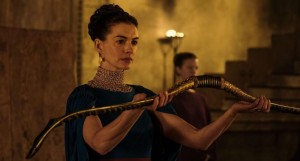
The subsequent denouement is the darkest chapter of the epic, with Penelope finally agreeing to marry whichever suitor passes her test: stringing Odysseus’ bow and shooting an arrow through twelve axes. When every arrogant man tries and fails, Odysseus, dressed as a beggar, steps forward to try. In the poem, he is supported by Telemachus and Eumaeus the swineherd as well as the loyal cowherd Philoetius in taking the suitors down in vengeance. Philoetius is missing from the film, a cut that is understandable for clarity and time, but in my view harms the effectiveness of the slaughter of the suitors; while all the weapons in the palace are cleared out in advance and the doors are locked, it was difficult to believe that Odysseus alone (Telemachus is busy fighting a suitor elsewhere, Eumaeus is blind) could take down a banquet hall full of hostile men. Whenever films portray one man against many who somehow manages to come out the winner, it is straining credibility, even if he is the only one with a weapon. I wanted this sequence to be breathtaking and vindicating, after the monumental build-up. Though well-executed in some ways, this rendering left me less than fully convinced or moved. Watching the four men face the defenseless suitors would have been immensely exciting and rewarding filmmaking. In this sense, Nolan misses a golden opportunity handed to him by Homer.
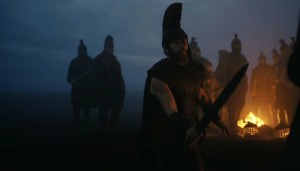
While the poem ends with Athena commanding the men to lay down their swords following the execution of the suitors as well as Penelope’s twelve maids who betrayed her by conspiring with them, Nolan crafts an ending that brings his constant references to Zeus’ law to its inevitable conclusion (at least for Nolan). Due to his violation of xenia by invading and destroying Troy, Odysseus must exile himself and his wife from his own land and allow his son to assume power. Husband and wife ride off into the west, speaking of the upcoming fall of the Bronze Age and the subsequent future rise of civilization. Knowing the source material and its historical context well, I can only imagine the confusion this gave the average audience member for many reasons. It is a narrative and thematic choice that will no doubt inspire perpetual discussions and disagreements among viewers and scholars for years to come. It also becomes the film’s final touch of departing from Homer. While many believe the epic poem takes place in a time of antiquity where it was thought the gods were removing themselves from the mortal world following the sack of Troy, it does not state or imply that Odysseus abandons his home due to his indiscretions. Homer may be condemning war in both The Iliad and The Odyssey, but he never goes to this length. Nolan is effectively assuming the role of modern bard demanding a higher price for the violation of Zeus’ law. In this he is consistent in focus and in what is ultimately a dark, cynical, yet in the last moment hopeful vision of a timeless classic.
Courtesy Universal
Tales like this must be engaged with, reinvented, reimagined, and reworked to resonate with each new generation and epoch of humanity. Its core themes and ideas remain, but like all archetypal stories, it is an ink blot test that shifts in shape to reflect what each person sees within it. After watching The Odyssey, we can see all the kaleidoscopic ways Christopher Nolan internalizes what started millennia ago among oral traditions and eventually found its way to the page by a nebulous, mysterious man or collection of storytellers under the pseudonym of Homer.
The Odyssey is now playing in theaters.


Leave A Comment