



Filmmaker and Detroit native David Robert Mitchell first made a name for himself with his debut feature, the comedic coming-of-age drama The Myth of the American Sleepover back in 2010, which won the Special Jury Prize at the SXSW Film Festival and was selected for the Cannes Critics’ Week shortly thereafter. His sophomore feature, the chilling and inventive It Follows from 2015, was a critical darling upon its surprisingly profitable theatrical release, becoming something of an immediate cult favorite and has quickly become one of the most influential horror films of the past decade. His follow-up to that film, the equally confounding and enthralling 2019 neo-noir satire Under the Silver Lake was dumped upon its delayed release by distributor A24, despite its favorable critical reception. That film showed a further level of sophistication from the versatile writer/director, which is why it’s all the more frustrating that the filmmaker hasn’t made a film since then. Thankfully, Mitchell has returned with his first studio film, produced by J.J. Abrams’ Bad Robot production company. His latest is an Amblin-esque dinosaur creature feature that doesn’t shy away from its many influences, but shows just how talented and flexible he is as a filmmaker.
Courtesy Warner Bros
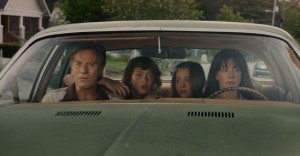
Set in a fictional corner of Metro Detroit circa 1982, Denise (Anne Hathaway) and Greg Platt (Ewan McGregor) are two working-class parents trying to make ends meet while their marriage is crumbling. Greg has taken up shifts working as a pizza delivery driver to help pay the bills, while Denise hides away in her basement in her off time writing a novel about wanting to escape a family lifestyle and move away from the suburbs. Their teenage daughter Audrey (Maisy Stella) is obsessed with everything Carl Sagan and aspires to become an astronomer while their youngest son Brian (Christian Convery) is secretly smoking cigarettes, reading Playboys and has found himself in the sights of a local school bully. Alongside their trusted kanine Starbuck, the Platt family’s life is thrown into chaos when their neighborhood has seemingly been transported back to the stone age and dinosaurs begin to wreak havoc throughout their quaint little suburban existence. With no way of escaping, the family must come together to survive and figure out a way to get back home.
The fourth feature film from David Robert Mitchell, The End of Oak Street is Mitchell’s most audience-friendly film to date, but it’s also a gripping and sensational bit of throwback fun at the movies. Produced by J.J. Abrams, Mitchell’s latest is unequivocally an Amblin-style sci-fi adventure that balances whimsy, family drama and violent creature chaos, but unlike many of the recent attempts at echoing the classic stylings of Steven Spielberg, Mitchell understands what makes that formula so bulletproof in the first place. The End of Oak Street has a fairly straightforward premise and was likely an easy pitch — what if the final act of The Lost World: Jurassic Park was its own feature length film — but Mitchell allows the characters at the center of the film to take priority over easy spectacle and cheap Hollywood nostalgia. While comparisons to E.T. and Jurassic Park are unavoidable, the film plays much closer to Spielberg-adjacent films such as Tobe Hooper’s Poltergeist and Joe Dante’s Gremlins. The film boasts some genuinely frightening moments, the violence is rather gruesome for a PG-13 rating — or what really feels like a 1980’s PG — and Mitchell is rather unsparing when it comes to his body count, but the characters at the heart of the film are a strong enough foundation to ground the chaos around them.
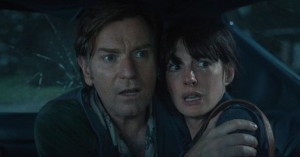
Here is a high-concept that doesn’t merely coast off its “dinosaurs in suburbia” premise and instead features authentic characters that feel like real people thrown into an unbelievable circumstance. Ewan McGregor is perhaps a bit too reserved for the kind of Craig T. Nelson father role the script requires, but the actor does imbue a sense of weariness that makes his flawed, doing-his-best dad character feel relatable. Anne Hathaway is now 4-for-4 when it comes to great performances in 2026. Denise is a determined and strong-willed mother who also suffers from a lack of confidence in her abilities as a writer. Yet when survival is imminent, she doesn’t hesitate to pick up a rifle or fire poker in order to defend her family. Mitchell’s script keeps things simple and thankfully never convolutes itself into tedious exposition.
Courtesy Warner Bros
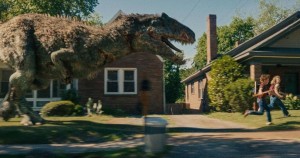
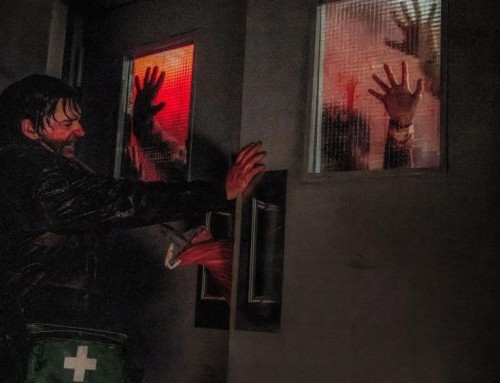
Mitchell has proven himself to be an exceptionally skilled craftsman and he further showcases his abilities to ruthlessly milk tension out of a scene through careful camera movements and a patient sense of visual rhythm. For much of the first half of the film, the writer/director deliberately reveals intentionally-limited information about the dinosaurs through blocking and precise framing until they come fully stomping through the front yard of the Platt family’s home. These weaponized uses of the unseen add a strong level of menace to the ferocious dinosaurs, making them the most frightful on-screen dinos since Spielberg’s 1993 classic. Mitchell successfully taps into the genuine fear of waking up to find a dinosaur just outside your home, which serves as the basis for most of the film’s best set pieces. What makes these sequences — which largely consists of the family running for their lives and attempting to find cover — so effective is Mitchell’s sharp handle on churning tension. He’ll deliberately hold on an elongated beat of suspense that makes mere moments feel like minutes.
Mitchell’s camera, shot by Us and It Follows dp Mike Gioulakis, will move around the frame in-and-though the environments, often through windows, above characters heads and all throughout the space around them. Very few filmmakers have mastered the slow wide-angle camera push post-John Carpenter quite like Mitchell has. The variety in the film’s set pieces also stands out, including a sequence involving a giant snake that uses the lack of sound or score to chilling effect. An exceptional Michael Giacchino score aids in the film’s propulsive thrills, while some well-equipped split-diopter shots are used creatively and always elevate the emotion or mystery in their respective scenes.
The film generally balances its humor well, despite a few tonal shifts that feel jagged. One particular head-scratching scene involves Denise and Greg finding two dinosaurs mating and decide to use the moment as a cheeky photo op. While the scene does showcase the fractured couple’s bond begin to strengthen, it’s a tonal misstep that feels out of place from the rest of the film. Mitchell’s film also showcases a rather delightful mean streak, but it ultimately flirts with being far meaner than it actually ends up being, lacking a certain commitment to the bit by the film’s finale.
Courtesy Warner Bros
The End of Oak Street is great late-summer entertainment. Writer/director David Robert Mitchell’s latest is a fun, frightening and original big-screen tentpole that deserves to court audiences who have already seen Spider-Man and The Odyssey countless times and are looking for something new to dig into. It also just might be the best film showcasing rampaging dinosaurs since Spielberg’s original Jurassic Park.
The End of Oak Street is now playing in theaters.

Leave A Comment