



Dead Man’s Wire is a type of film that any director-for-hire could have easily gotten the job done for this crime thriller. However, household legend Gus Van Sant has turned this into something engrossing and superbly crafted, as it echoes the work of the late Sidney Lumet and Alan J. Pakula—most specifically Dog Day Afternoon.
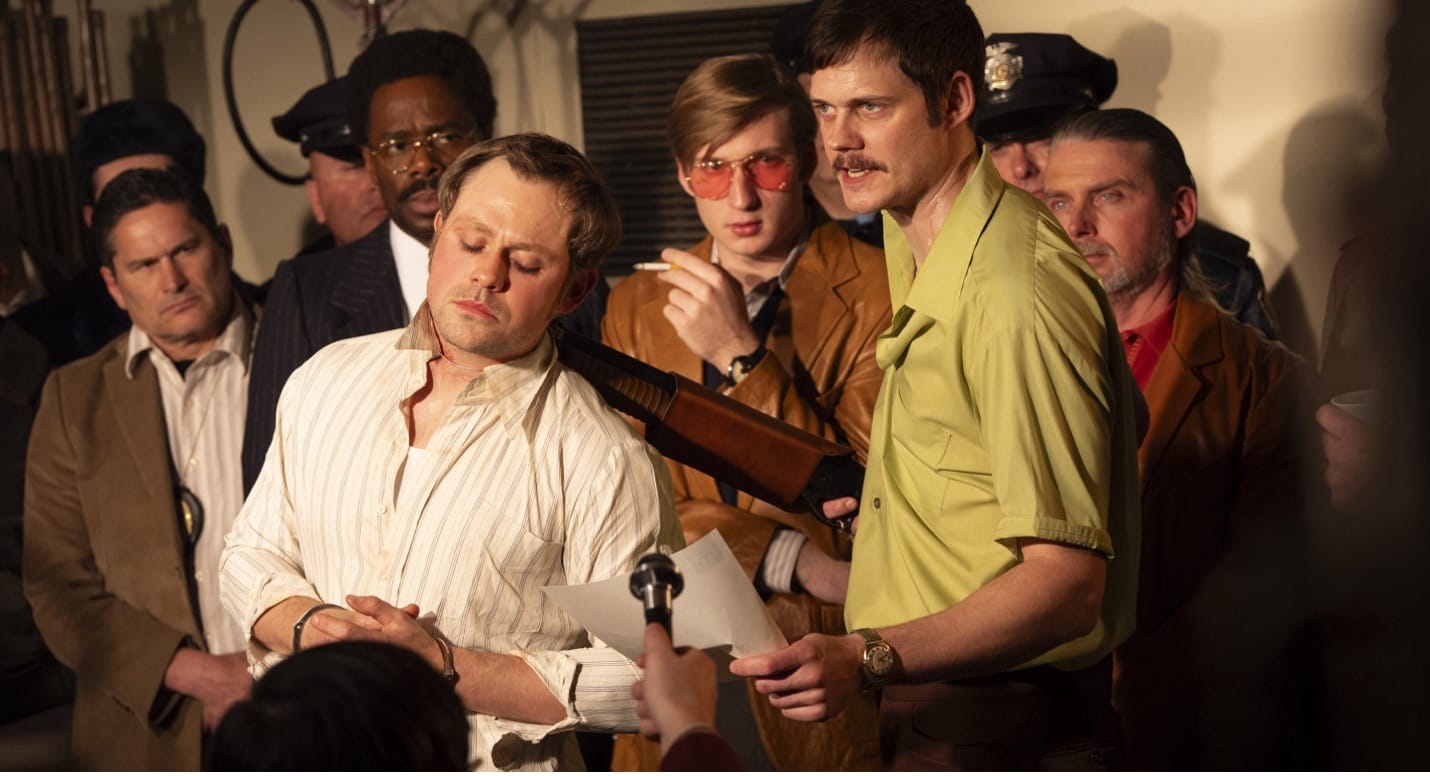
On the surface, this is a generic hostage standoff movie where the kidnapper this time is the protagonist, and the hostage and the corporate culprits and institutions are the antagonists. For a majority of the film, we see the kidnapper Tony Kiritsis (Bill Skarsgård) and a mortgage broker, Richard Hall (Dacre Montgomery), which is an interesting dynamic, as Tony is a kind guy, and his demands include immunity, $5 million in return for losses and damages, and a public apology from Richard’s father, M.L. Hall (Al Pacino). M.L. Hall is the CEO of a predatory mortgage company that foreclosed Richard’s Indianapolis property. Tony executes his precision plan by wrapping a wire around Richard’s neck that is strapped to his shotgun. He also makes negotiations with law enforcement and aims to make demands with M.L., whose ego is too inflated to reach any sort of public apology.
Courtesy Raw-K Entertainement
A detective named Michael Grable (Cary Elwes) enters the narrative, who ends up taking negotiations with Tony and even becoming a drink buddy of sorts in retrieving Tony’s demands. All Tony wants is to get an apology and to not be publicly dehumanized. Van Sant unravels the plot with a moral compass; the exchanges between the entire cast are supercharged with a lot of engrossing drama. Van Sant uses a lot of 70s aesthetics with its gritty tone. The decor and wardrobe feel authentic as well, and Van Sant utilizes a lot of freeze-frames and intercuts the story with a lot of archival footage of the event to capture the precursor to news media sensationalism that would pivot in the 24/7 news cycle. There is rich historical realism to the material, and it shows just how powerful the media is in shaping public perception.
Where Dead Man’s Wire succeeds most is how timely the material feels as it centers around rampant greed and rugged individualism in this country. Here, it’s just a small-town Indiana community, but the demoralization of greed bleeds into every community essentially. Eventually, the disenfranchisement of the working middle class can only go so far until an act of resistance will spring up.
 Courtesy Row-K Entertainment
Many other characters spring up throughout that reflect the chaos along with Elwes. A DJ radio personality named Fred Temple (Colman Domingo) becomes the voice of reason who allows Kiriti to air his personal grievances. The casting of Pacino is quite deliberate in relation to the Dog Day Afternoon casting, as he sees the hostage situation more as a pissing contest in protecting his ego than the safety of his son as he watches the media circus from his vacation home in Florida. Myha’la is also compelling as Linda Page, a TV news reporter who objectively covers the story. Even Danny Elfman’s score commences with the atmosphere and suspense.
All the individuals in the film bonded together into a post-Nixon world of mistrust and greed that was only amplified further in the Reagan years a decade later. The cronies are seen as more guilty, but Tony’s actions are justified but rather more rationalized. The plot draws parallels to the ongoing cronyism and greed that still lingers today, and Van Sant allows the film to feel both historic and modern. Gus Van Sant has often avoided making morality plays in his films before. With this being his first film in nearly 7 years since Don’t Worry, He Won’t Get Far on Foot, Van Sant always left interpretation to the audiences before.
With Dead Man’s Wire, this marks his first morality play with a moral compass, but he still allows the audience to confront complex ethical questions that don’t offer easy answers. This shift in approach invites viewers to engage deeply with the characters’ dilemmas, prompting discussions that linger long after the credits roll. By blending thought-provoking themes with his signature storytelling style, Van Sant challenges us to reflect on our own values and the consequences of our choices. This is a very solid suspense drawer and now marks two good films Van Sant has made after having a mostly bumpy period in the 2010s.
DEAD MAN’S WIRE IS NOW PLAYING IN LIMTED THEATERS. IT OPENS WIDER, INCLUDING METRO-DETROIT on FRIDAY, JANURARY 16th, 2026


Sounds interesting
Not Van Sant’s best, but Skarsgard carries the film based on an actual incident. Great set decoration to reproduce the 70s
3 of 4 stars