

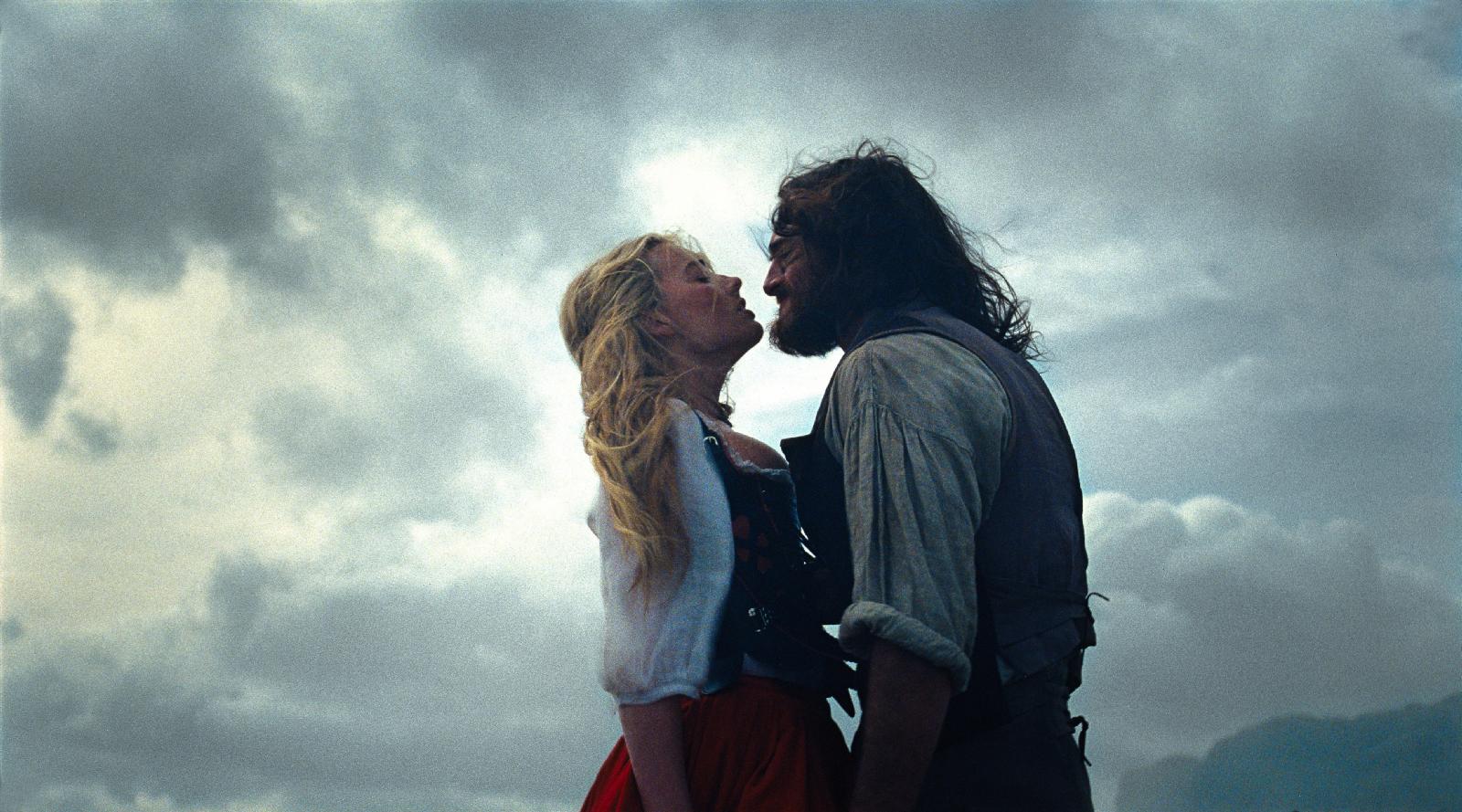

Like the newest Dracula film by Luc Besson, the latest Wuthering Heights seeks to reinvent a timeless classic novel that has spawned countless film and television adaptations, each tackling different aspects of the dense source material. Admittedly, I gave up reading Emily Bronte’s novel when I came to it over ten years ago, and to my memory it was because the bleakness and misery of the story and the characters seemed to block me from gaining any foothold. This is not a story of enlightening and exhilarating love; it is a story, regardless of adaptation, of the corrosive, destructive direction taken by Catherine and Heathcliff, a strange sadism that maybe doesn’t eclipse their love so much as express it.
Courtesy Warner Bros
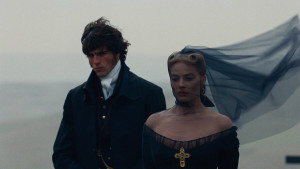
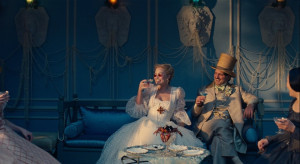
Young Catherine Earnshaw (Charlotte Mellington) lives on the heaths of England with her tyrant father (played with comedic tragedy or tragic comedy by “Doc Marten” star Martin Clunes) and their servants at Wuthering Heights. When she finds a stray boy and takes him home, she names him Heathcliff (“Adolescence” breakout star Owen Cooper) and therefore claims him as her own. Through the years they become inseparable, and when she comes of age, Catherine (now Margot Robbie) rebuffs him (now Jacob Elordi) and marries a recently arrived wealthy textile merchant named Edgar Linton (Shazad Latif), to help Heathcliff rise as much as herself and escape the looming shadow of her alcoholic father. But Heathcliff only overhears Catherine say to her faithful servant Nelly (Hong Chau) that she could never marry him. This propels Heathcliff to flee, and Catherine, mystified as to his vanishing, succumbs to the empty but staggeringly beautiful life of luxury.
Years later, when Heathcliff returns and buys Wuthering Heights with his newly-acquired wealth, the connection is reignited with Catherine, who is almost mummified within her mausoleum of opulence. The film is drenched in every possible visual detail, from the set design to costumes, to the point of resembling an art exhibit. Floors are blood-red and walls crawl with plaster hands and drops of moisture, the sensuality of the fractured and abandoned emotions between Catherine and Heathcliff invading every environment, as if Catherine’s very internal organs are threatening to burst out and shatter the ordered and controlled world built up by her husband’s largesse. But director Emerald Fennell seems to be going to these extremes to convey the inner emotional bankruptcy of Catherine contrasting with the overabundant plenty surrounding her. This is contrasted with the heavy presence and influence of the moors and the countryside when the lovers are growing up, as if unrestrained nature were finding embodiment in their discovery of each other. Even naming him Heathcliff seems to identify him as an avatar of the elements. Fennell herself describes it as “an emotional landscape, the absolute physical embodiment of an emotional fallacy.”
Courtesy Warner Bros
Fennell made the film not as a strict adaptation but as an attempt to capture how the book made her feel when she first discovered it as a fourteen-year-old. She wasn’t interested in historically accurate Victorian depictions as much as her teenage imaginary pastiche and pathos. This approach necessitated a seemingly ruthless stripping of much of the complex story and serving up an almost alarming immediacy and intensity to the chess game played out by Catherine and Heathcliff, a kind of love-as-annihilation that brings to mind Romeo and Juliet if both lovers weren’t absorbed by a youthful optimism but a narcissism that views the world around them, including those closest to them, as merely pawns to act out their fluctuating desires and spitefulness. Even the sex between them isn’t so much tender expression as desperation, as if their need to not only merge with each other but go beyond themselves exceeds the reaches of physical intimacy.
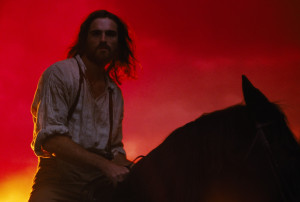
Most adaptations of the novel have received criticism for their casting of Heathcliff as Caucasian rather than as described in the book, a “gypsy-looking” boy with black eyes and hair who Catherine’s father finds at a slave auction in Liverpool. I can’t speak to Fennell’s reasons for casting Jacob Elordi other than her saying he resembled the picture of Heathcliff on her tattered edition in the 90s. The book seems to depict the ethnic identity of Heathcliff as a kind of threatening and overturning of the aristocratic class system of the time, but this element is excised from the film. To my view, it seems to be so only to focus all the more on the direct intensity of the relationship between Catherine and Heathcliff, unclouded by any class/political/social commentary that Emily Bronte may have inserted into the novel, a certain undiluted impression a fourteen-year-old would have had, seeing only the tortured and almost transcendent love pervading the story.
Courtesy Warner Bros
The machinations that play out not only between Catherine and Heathcliff but also her cuckolded husband, his naïve but surprisingly hungry sister Isabella (Alison Oliver), and Catherine’s eternally loyal but quietly lonely servant Nelly give the film a slow build of twisting layers and contradicting motivations that all dovetail, of course, in devastation. Fennell’s direction is tight, guided by a lifetime of deep connection to the material, and she charges forward with the Gothic opera of it all. Like the novel (I presume), this is not a film of rationality or intellect. It is pure romantic melodrama, but not without authentic humanity, even if much of that humanity is hopelessly selfish and scorched-earth.
Wuthering Heights is now playing in theaters.


Thought this one looked really intersecting
Very good adaptation of the old classic. Different than other versions. Jacob Elrodi is very good as the adult heathcliff. Set decoration and cinematography re first rate. 3.5 of 4 stars