

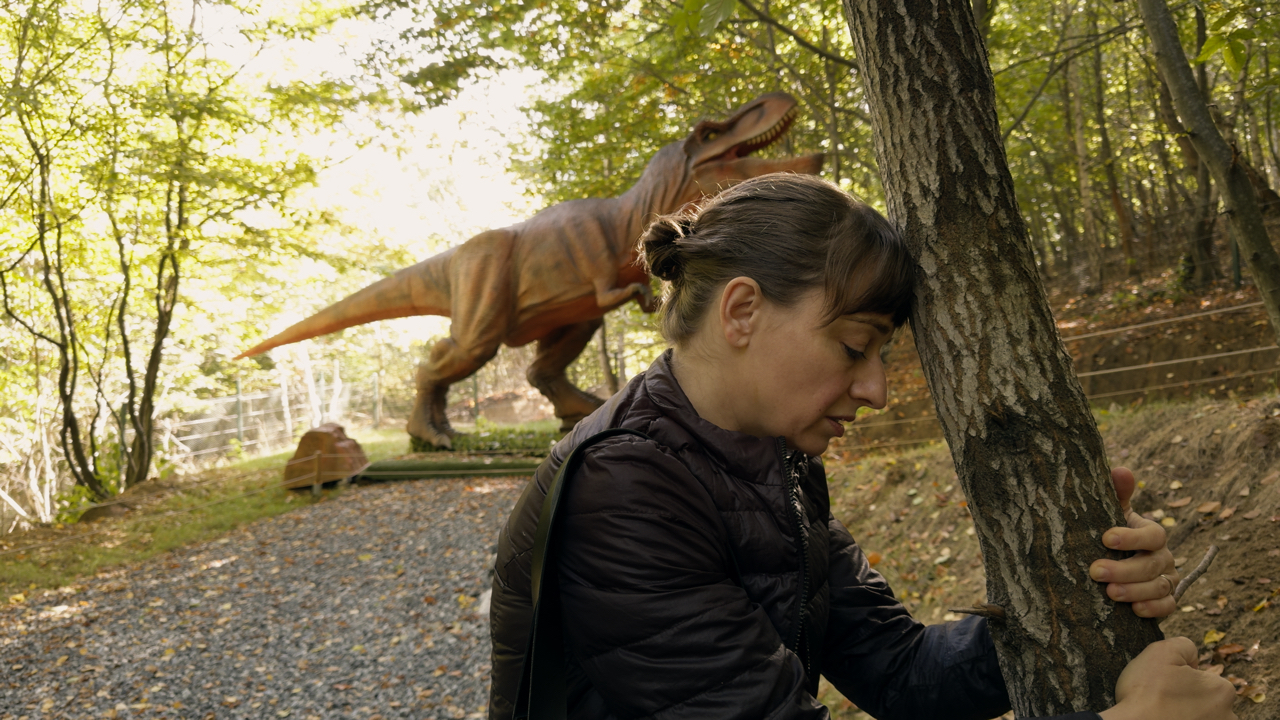

Kontinental ’25 is the latest film from the Romanian director Radu Jude. By comparison to his last three pictures, this one is the most reserved. Yet, it has all the fire, passion, dark and twisted humor as well as biting social political observation that Jude has become known for. It also, like his very best works, contains a main character that is at once a fascinating and sympathetic character but also one who is at times capable of terrible decisions.
Courtesy 1-2 Special
In this film, a bailiff is sent to evict a man from his dwelling in a basement boiler room. As the film opens, we witness this man, obviously living on the edge of society, perhaps homeless already, as he wanders the streets, begging for food, cash and work, while grousing for anything he might find of value. He even takes a ribbon off a statue of St. Michael. This man, Lon, was once a celebrated athlete, as it turns out. He someone with Olympic ambitions. During the eviction the main character, Orsolya, gives the man twenty minutes alone to collect his personal belongings. When she and the police return, having arrived and clearly upset him despite his knowing that he was due for eviction, they discover that he has hung himself.
This sends Orsolya into a spiral where she begins to doubt everything and claim a level of guilt and ownership over the situation that borders on the absurd. Is her empathy misplaced? Is it an act to cover other things we do not know about her? What is making her respond so deeply? It turns out there is no one answer, and the journey to understanding what makes her function is the entire point of the film.
Courtesy 1-2 Special
She has a husband and children, who go on a Greek vacation shortly after the eviction. While they are gone, she has a series of encounters with people, friends and otherwise, which steer her toward clarity. Yet she always seems to be doubting and trying to assert her experience as primary. Is she some sort of egoist, perhaps? The film does not judge her, though within its frame, other characters may. Largely, though, they do not. This is purposeful. The film builds its argument slowly, about guilt and ego. About colonization, assumption and invasion of spaces public and private. It does this through frames historical and personal. Our nominal heroine is an ethnic Hungarian living in Romanian territory with a mother who is fiercely Hungarian, to the degree of being a proud nationalist. Within this, we see that the public response to her involvement with the suicide is seen by some as Hungarian aggression toward a fallen sports idol.
Here, pride/vanity and concerns of what it means to live as an other in a land that is your own, coalesce. Indeed, when juxtaposed with the dead man, how different are the two? He was a Romanian, living on the bottom of his society, being kicked out by a Hungarian, much as many Hungarians felt displaced by Romanians in the Transylvania region where the film takes place. The film does not directly ask for empathy as much as it quietly expects the audience to make the connection and consider actions and responses.
That, ultimately, is what the film is about. How we respond to the world around us and why. Toward what purpose? It is suggested by more than one person in the film that our main character is being dramatic. A former law school professor, why is she so upset by this one act? Is she signaling guilt to the world in order to compensate for something deeper? Perhaps. Or, maybe the film is allegory for the social and political situations within its region but also a comment on how we “act” rather than take action.
Courtesy 1-2 Special
This is a film with two incredibly memorable performances which carry us through those events. Gabriel Spahu, one of the best things in Jude’s otherwise forgettable Dracula, is very touching as Lon, while Eszter Tompa brings a rare reality to her part as Orsolya. The way they approach their parts gives the audience a chance to identify with and understand the film’s overarching themes. This is something Jude, a master storyteller who also understands how to get audiences to face harsh material very directly, excels at. Here, Jude’s direction does not call for a busy camera. Instead, there is a stillness that seems almost Japanese, reminiscent of the work of Ozu or late Kurosawa, where events unfold within the frame. The camera does not follow the characters, but it does notice them within each section. This results in a film which has a lot of long and medium shots, where moments that count as “close” feel all the more intimate and immediate because of the relative distance. It is a highly effective approach, and one this reviewer wishes more directors had the courage to occasionally employ. One of the year’s best releases so far.
Kontinental ’25 is now playing in select theaters.


Radu Jude is one of the very best of our time and every release should be celebrated