


What would a filmmaker like Chloe Zhao, coming off her much-deserved Oscar win(s) for her cinematic masterwork, Nomadland, and known for small, intimate character pieces set in the American west, find intriguing about working within the MCU, specifically under the firm, not particularly creative-friendly, grasp of Kevin Feige? The needs of the masses don’t normally allow for overt Terrence Malick homages in a $200 million comic book epic, but Zhao is no ordinary studio lackey. While her sensibilities don’t seem like a usual fit for the style-adjacent Marvel and Chloe Zhao does indeed occasionally struggle to shine through the typical Marvel recipe, she succeeds in where it matters most; taking this franchise to interesting new directions and adding some gravitas in the process. Eternals achieves true, natural resonance in a franchise that doesn’t normally allow the time for such things.

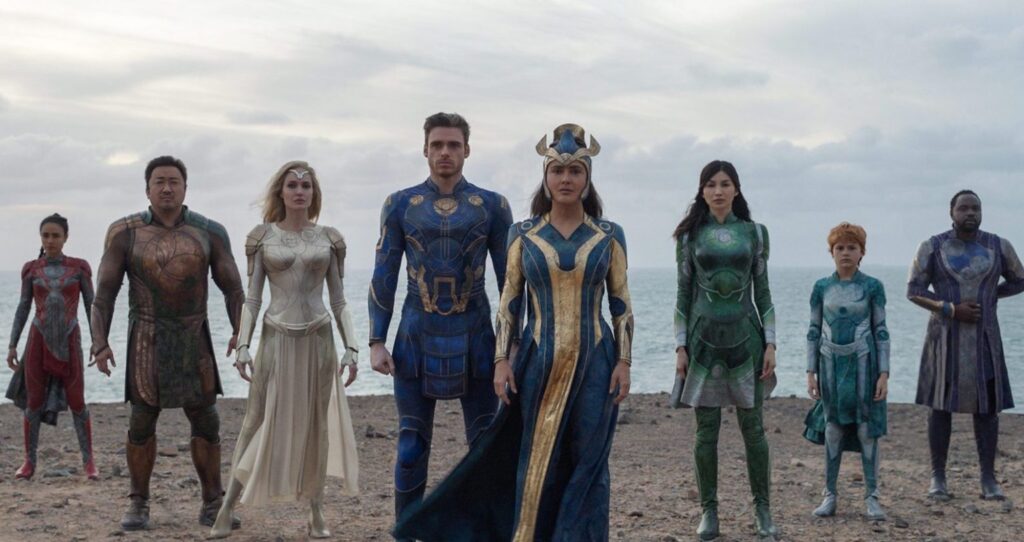
Created by planet-sized gods known as Celestials, the Eternals have been tasked with looking over Earth and its people for thousands of years. Firmly instructed not to interfere, their protection only comes at the threat of an evil alien race called Deviants, thus explaining why these beings weren’t present during that whole Thanos debacle that wiped out half of humanity for 5 years. The Eternals have been on Earth for over 7,000 years, sitting aside as humanity commits one atrocity after another. The group of ancient gods, lead by Salma Hayek’s motherly, Ajak, have been apart for many years, but are ultimately brought together when one of their own is killed, seemingly at the hands of a Deviant.
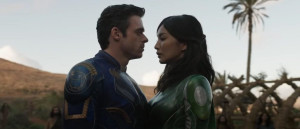
Before the opening Marvel logo, Chloe Zhao quickly establishes a more thoughtful, weighted tone than most Marvel films. We follow Gemma Chan’s Sersi, an Eternal attempting to live a normal life with a steady job as a school teacher and a well-meaning boyfriend, a severely underutilized Kit Harrington. Her reunion with the Eternals means reuniting with her ex, Ikaris, an intense, smoldering Richard Madden, with whom she’s spent centuries with. Every core relationship in Eternals feels fully realized due to Zhao’s patient storytelling.
Zhao finds a deep connection with these characters, which is deftly brought to life by the films vast ensemble. Kumail Nanjiani’s Kingo is more than the films comic relief. Finding new life as a leading Bollywood star, the egotistical Kingo brings with him a cameraman, Karun (Harish Patel), to document the Eternals’ journey, even if there’s no way that footage will ever get used. What’s introduced as a jokey gimmick is actually given a proper amount of earnestness by the end. Brian Tyree Henry, making a career out of stealing every scene he’s in, plays Phastos, the engineer of the group who becomes so disparaged by humanities endless atrocities, he settles down in the middle of nowhere to start a family. Henry delivers some wrenching moments of despair and infuses the genre with a degree of pathos we’re usually starved of. Angelina Jolie plays the fierce warrior, Thena, who suffers from a dementia-like illness that causes her to be a threat to anyone around her.
Surprisingly, it’s Eternals‘ existential themes that makes Chloe Zhao’s sensibilities a more than fitting choice for the material, allowing a deeper, more philosophical experience. The weight of sitting aside as the world tears itself apart is felt as the central characters wrestle with their emotions. Running at an admittedly exhaustive 157 minute runtime, Zhao explores the inner turmoil within the Eternals, giving each actor their own moments to shine. The added emphasis on character makes the inevitable third act battle feel tangible and adds genuine stakes and emotion in a franchise that too often forgets what exactly that means.
Despite the focus on character depth, Eternals has the massive undertaking of introducing the more outlandish, cosmic side of the MCU and Zhao largely succeeds on that front. Adapting the works of Jack Kirby is overwhelming just from a purely visual standpoint, but thematically, Zhao loses very little in her adaptation. While, like Dune, Eternals establishes a plethora of weighted backstory and exposition to sift through at the very top, but gradually allows the story to unfold in a more cohesive manner. Zhao is introducing us to giant gods that emerge through planets and follows an ensemble of characters over 7,000 years old, so its a fairly miraculous feat the end result is as accomplished as it is. The scale at which Zhao is operating on is so grand and operatic, you only realize afterwards how much the genuine sight of awe and discovery is taken for granted in the genre. What a treat that a Bollywood musical number is only among the top ten most memorable sequences.
The Eternals are actual gods and Zhao rightfully portrays them as such. From an opening text crawl that feels particularly reminiscent of Scorsese’s The Last Temptation of Christ, Eternals is ripe with religious imagery and metaphors that are precisely as layered as one would hope from a filmmaker on the level of Chloe Zhao. The cinematography from Marvel staple Ben Davis is vibrant and the action sequences, filled with long takes and swift camera movements, make terrific usage of Zhao’s “invisible” camera.
At the end of the day, this is still a Marvel production produced by Kevin Feige, so although Eternals largely feels like a film directed by Chloe Zhao, it also occasionally doesn’t. The villainous Deviants are more blandly designed creatures used as cannon fodder. The overarching attempts at tying in the rest of the Marvel universe isn’t nearly as graceful as one would expect with Chloe Zhao behind it, in fact, it does feel like the filmmaker struggles to wrap her arms around the established universe. The obligatory post-credit scenes that will audibly excite every fifth person in the room feels noticeably lifeless this time around, as if Zhao was forced to add them in against her will.
Chloe Zhao finds grace and humanity in the godly figures of Eternals. Whenever she’s not bound by the Marvel formula, Zhao crafts a dense, thoughtful epic that explores morality with an elegance that lingers long past the end credits.

At this point I think Marvel made a huge mistake hiring “art-house” filmmakers to take on a big franchise like Eternals. Just stick to fun, not everything has to be Oscar winning.
This movie is trash and I hope it brings grear death and suffering to Marvel.
I am sooooo over ALL the superhero films. “Eternals” just seems like another rehash of all the Avenger, Fantastic Four, Superman/Batman, etc. ad infinitum. Just because CGI and effects can make it look so cool, the fantasy is over for me. Yes, some wonderful filmmaking and decent performances. I’m as into escapist entertainment as much as anyone else. But I’m on ‘pause’ in watching any more of them. My opinion.
Surprised that made it out of the editing room. I don’t think it’s a bad movie by any means but just super jumbled.
Alright. So… saw it last night… and I’m just gonna say it. While by no means a bad movie, Marvel’s Eternals was definitely closer to Thor The Dark World than Winter Solider in regards to levels of enjoyment. Definitely set some exciting things into motion for the future of the MCU (and DO NOT miss both after the credit scenes), but on the whole it sorta felt like that tie in of a comic event that exists to specifically drop certain info for the larger story. Yup. That’s right. I’m saying a Marvel film was just OK…
This movie sucked ass, it sucked major taco bell as. It was boring af and had little energy. .
.Marvel took Martin Scorsese’s comments seriously and tried to make a comic book film which can also be considered “real cinema” but end up making a bland trash which was not even entertaining than a mid-tier MCU film nor an absorbing Chloe Zhao’s drama. It’s the cinematic equivalent of someone pushing down 15 idlies for two and a half hours down your throat until you choke.
1.5/5
I was very let down by the storytelling in this. Not one of Marvel’s best.
Another thought, ao far every MCU film which handles multiple superheroes will either have certain superheroes having their own stand alone prior to the team up or certain heroes appearing in another superhero film as a side character or in a cameo or the new superhero getting an ample and effective screentime in the team up movie. None of the characters in Eternals had been referenced before or used in previous films, so Chloe Zhao already has such a huge task at her hands to introduce all these characters, create enough chemistry between them and somehow make them believable.Suffice to say this film fails at almost every level of screenwriting techniques or shortcuts and the director/writers take a painful long way to explain the plot, the motivations, the conflicts in a tedious manner through exposition, characters with zero chemistry and so on.
I would like to compare this film with a recent another comic book film that had multiple new characters in it which is James Gunn’s Suicide Squad. I know, I know both are very different films tonally and everything, but James Gunn takes an effective route in making these characters relatable, established their motives, and developing ample chemistry between them to get us actually care for them to invest in a story which was actually downright insane on paper but somehow James Gunn does it. He also used an audience character in ‘Harley Quinn’ which kinda worked in few places too.
I’m not a big fan of Chloe Zhao’s Nomadland, I thought it was bland for the most part but I do adore ‘The Rider’ but Eternals on the other hand felt like a terrible mash between ‘Nomadland’ and a bad DC film where characters share zero chemistry fighting a world ending catastrophe caused by terrible villains with generic motivations something along the lines of ‘Justice League’.
Eternals isn’t a bad movie by any means but the people behind it have no clue whatsoever on how to make a blockbuster that people can actually enjoy watching at theatres. As someone who’s watching a lot of movies for quite some time, this could’ve turned out better if an existing character was used or a new character was made an audience character because this film does not have any clear focus at all and it’s all over the place and the film never took off whatsoever. I hope someone who actually have love for these characters direct the sequel otherwise this is going to be MCU’s equivalent of ‘Inhumans’.
Probably my worst superhero movie theatre experience since ayer’s suicide squad. I can easily say this the worst mcu movie ever yes worse than captain marvel and thor 2 kinda ones. Eternals proves only one point that is directing a theme park movie is not easy as it seems. I have high hopes for hawkeye and ffh hope marvel kicks back
I was pretty lukewarm on this one.
Eternals movie literally proved Thanos did nothing wrong and that he probably was the greatest hero the MCU has ever known
Most Marvel movies are at least crassly manipulative enough to be entertaining in a highly focus grouped way and this one was certainly a bold departure from that formula by being a boring mushy mess that wasn’t even fun to look at most of the time. Vary your fucking shots PLEASE, not every dialogue scene needs to be communicated exclusively through alternating flat close-ups of someone talking, which is what like 60% of this movie is. Somehow even after sitting through all 2 hours and god knows how many precious minutes of this I can only remember the trailer, which was marketed so aggressively that that it bored a hole into my hippocampus, where worms now live and speak to each other of very humanist things like kindness and forgiveness and that Ikea line that I took a shot for. Can’t wait for the next one where Kit Harrington will play yuppie merlin or some shit
It wasn’t Marvel at it’s best, but it’s also not Marvel at it’s finest either. I do appreciate the ambition.
I saw it on Saturday and I’d be lying if I said I wasn’t disappointed. Chloe is a genius, and maybe this one will grow on me, but it seems like she’s to busy trying to jam to many characters as opposed to telling a great story.
I invited a friend, who has a great sense of Marvel comics, and he was very let down.
I want to see this, I’m just not doing screenings or fests anymore
This is by far the worst Marvel outing yet.