

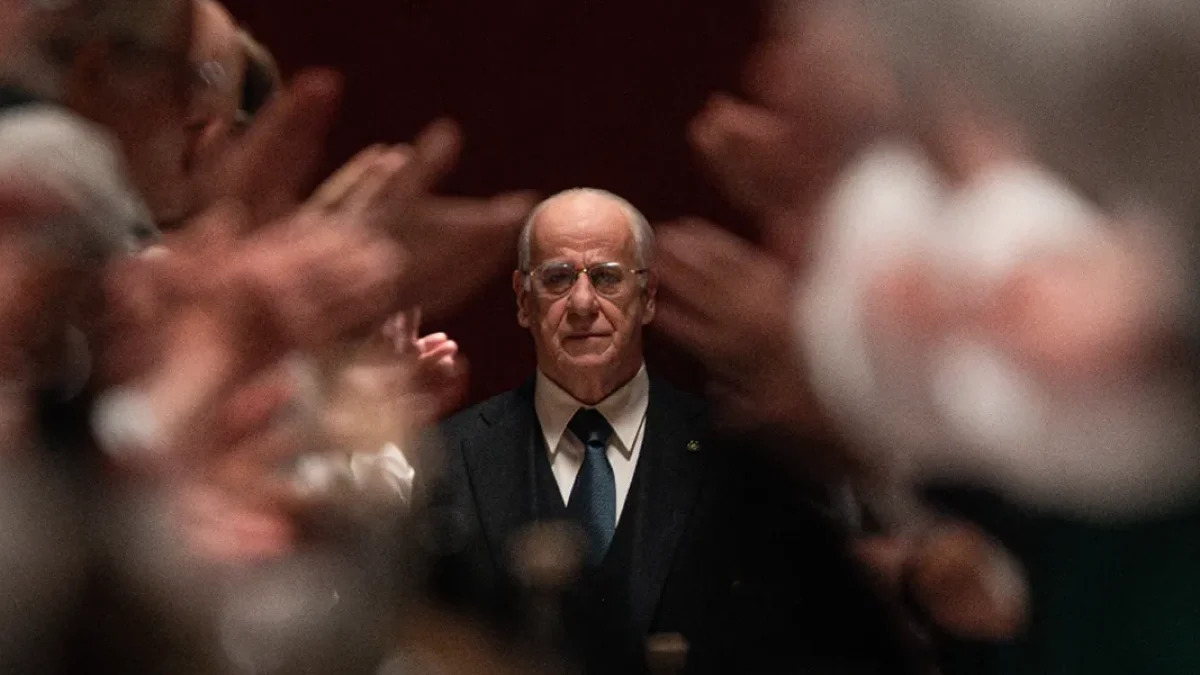

Paolo Sorrentino is one of the great European directors of the current day. He has made a long career out of examinations of aging and consequences, of memory and conflicts of ethics. In his newest film, La Grazia, we are introduced to an Italian prime minister who must navigate the waters of a euthanasia bill, the potential commutation of sentences for two spousal murderers and consider what his legacy will be, all while being haunted by the memory of his late love. He is also a renowned jurist, extremely cautious, and a devout catholic.

Courtesy MUBI
Tony Servillo plays the PM with an uneasy air of resignation and anxiety. The photography, by Daria D’Antonio, who also shot Parthenope and Hand of God, for Sorrentino, is clear, steady and lushly vibrant. It is noteworthy that some of the most colorful films of the year are coming from outside the United States. The editing is straightforward, and Sorrentino’s direction is as assured as ever.
This is a film that knows how to build its case. We are introduced to characters, then situations, and we then see them struggle within the frames that have been established. Each new wrinkle may make a viewer sigh as much as De Santis, the prime minister, with every request or implication. This is a man, after all, concerned with getting things absolutely correct, in the legal and moral sense, and who is worried about what his legacy will be. He is not thinking of this in a narcissistic way, but, as the film progresses, because he wonders what his lost love would think of him, not to mention god.

Courtesy MUBI
Eventually, legacy does play into his decisions, but so does, and more importantly, love, justice and family. If the first half of the film is about being inert, the second half is about turning that stasis into action. As DeSantis says to someone “There are layers to bureaucracy. It is in order to slow down decision making. We must not be too hasty in such matters.” So, in a sense, the film reflects that. As DeSantis weighs God, Law and Love in order to decide on Legacy and Justice, he begins to see the cracks in his world, and who the true friends and family are.
This is a slow burn of a film, a work that could be considered languid or sedate. It is, as with all Sorrentino, a lyrical examination of its themes. He is not a director given to explosive bursts of action, though much may occur in a scene, either through dialogue, movements or both. Yet, the experience of watching a Sorrentino is not unlike that of a Fellini. The two have different purposes, yet there is something in common between the two. There is a joy and weariness, a regret and nostalgia, in the works of both men. Sorrentino seems more interested in the political than Fellini, and is not as absurdist nor as surreal.
If the film has a flaw, it is the occasionally glacial pace that may make certain viewers lose interest, though the film itself is compelling enough that this should not happen. Servillo, onscreen in nearly every scene, truly carries the work, and when he is not on-screen, his presence is sorely missed. This is not to imply anyone else in the cast is weak, but they simply do not have the charisma or story that his character of DeSantis does.

Courtesy MUBI
This may not be among the very best films of the year, but it could be among the most important, in that it asks us to consider consequences. It is a film full of empathy and care, about men and women of integrity and about those entirely lacking. It is an examination of ambition and humility. It may be minor Sorrentino, but it is well worth checking out.
La Grazia is now playing in select theaters.



Always down for a Paolo Sorrentino film
I never thought about it that way before. Great insight!
I’ll be sharing this with a few friends.