



A quirky and oddly charming coming-of-age story about a young Italian woman in her early 20s struggling with loneliness and borderline personality disorder within her wealthy upbringing and the expectations of her disappointing mother as she attempts to find new friends and a boyfriend to forge a new path, Amanda works both as a compelling portrait of self-discovery and a vindication for all the isolated people out there that are oppressed by their own anxieties. Authentic and generous towards her characters, Carolina Cavalli’s debut feature echoes the work of many other stories about young adult angst that we have seen before, but there is something refreshing about the vision that earnestly explores the plight of being socially awkward that sets it apart from the rest.
The film’s titled character (Benedetta Parcaroli) in a way channels Mike Nichol’s The Graduate as she is a 24-year-old girl still staying at her family’s home as she mostly just relaxes in the family pool. She doesn’t hold a job and she isn’t attending college, and when she’s not at the pool, she often goes out to the local movie house. She ends up getting guys to talk to her at first because she is attractive, but eventually they find themselves detached from her due to her awkwardness and insecurities. She’s often very curt, has sudden outbursts, and just rubs many others the wrong way. She can’t hold a conversation due to her anxiety and nerves, and her only friend is her lifelong nanny, who was just informed by Amanda’s mother (Monica Nappo) to stop hanging out with her so she can encounter people in her own age group.

Eventually, an old childhood friend from Amanda’s childhood shows up at their house named Rebecca (Galatea Bellugi), and she is able to reconnect with her estranged playmate. Amanda’s spirits begin to lift as she feels in good company with someone her own age. As the friendship progresses, Amanda begins to realize that Rebecca is even more alienated than she is, and Amanda ends up finding her energy drained again. To lighten things up, the film offers some wry satire, especially in its dichotomy with its exchanges between Amanda’s older sister Marina (Margherita Missoni), whose young daughter plays music at a prep school, and Rebecca, who is disappointed that her daughter has a tutor to guide her with her music and studies. Amanda’s open wounds from her bourgeois upbringing reveal themselves as she states that Marina is the problem as she should be more encouraging and less oppressive for her musical gifts that could open up opportunities playing at a concert that will only lead to Marina continuing to live her mundane life of meaningless relationships and self-absorption. The tension between the two sisters is certainly one of the highlights of the movie, something Cavalli could have dug into more deeply.
Structurally, the film plays out like a series of vignettes as Amanda just drifts along the narrative, encountering different characters and being challenged by others. During her encounters, Amanda begins to understand that loneliness isn’t just exclusive to her; it’s more of a universal feeling. The setting of the movie theater works well as a metaphor to reflect this, as nearly every patron that attends the movies is there and is watching old, archaic movies. She ends up locking eyes with one of the young boys; he takes on her date, but it goes awry as Amanda doesn’t know how to carry on a conversation. It’s a very soul-crushing scene, especially when they re-encounter and the potential boyfriend tells her to stop texting him ten times a day and she finds out that he has taken a liking to Rebecca.
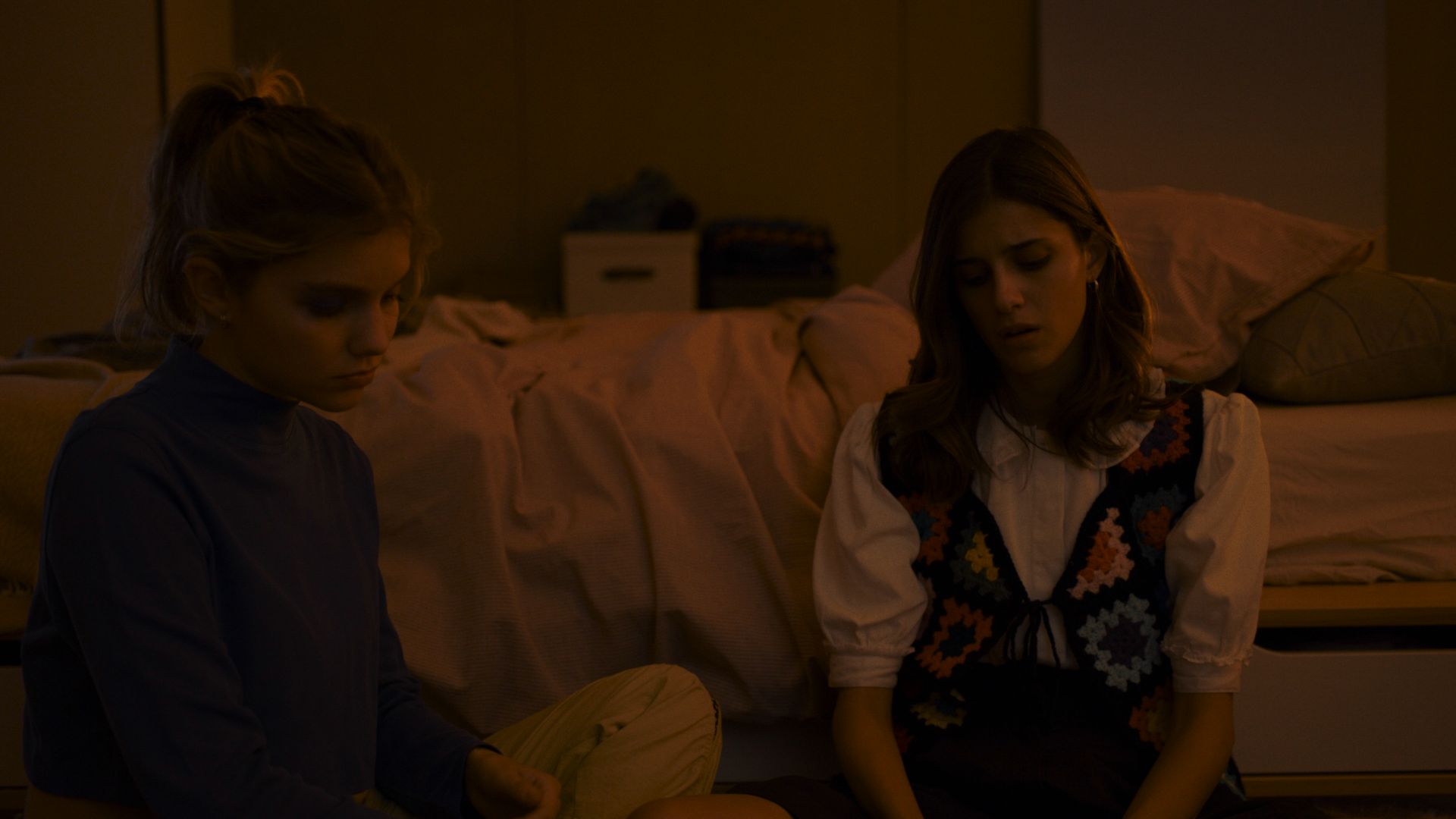
Likewise, just as Amanda aimlessly drifts through life, the film’s structure similarly moves from scene to scene, capturing the interactions Amanda has with the handful of others she meets with a carefree spirit. Moreover, each of the other players is just as lonely as Amanda. Rebecca is agoraphobic; everybody in the half-empty movie theater she frequents weekly is there alone, and the boy she stares at from across the street has nothing else to do that night other than get some food with her. Cavalli certainly brings empathy to the introverted character, who finds a bittersweet sadness that is both delicate and offbeat.
One of the film’s incidental joys is wondering if Amanda or Rebecca will end up getting out of the isolated runt they are in. Their lives go through cycles and the motions of nothing seeming to progress. Amanda holds a lot of disdain for her upper-class upbringing but doesn’t have the willingness to completely detach herself from it, nor does she have the inclination, as she has been enabled by her lifetime. She does realize the absurdity of it, though, and she can see through all the emptiness of it all. The film refreshingly avoids having its misfit protagonist “grow” into a more functional member of society, as the film becomes more of an inspection of the healing power of genuine friendship. Amanda is essentially how we grow as people through experiences and through others. With that, we can evolve out of the transgressions that sadly hover over our worst eccentricities and impulses. Cavalli’s debut film is impressive. One that holds a lot of wit and spirit, along with some genuine curiosity about the human spirit. There is enough rich humor and a striking style to show a lot of promise for what Cavalli has in store for her next film. Regardless, I’m still letting this one process, as it was a rewarding experience that is a genuine tribute to misfits, isolation, and one’s own peculiarities.
Amanda is now playing in limited theaters




Sounds good! I was unaware of it before. Will give it a watch if it comes here at all. My independent Theatre has a French film festival going on so there’s nothing really playing here at the moment, unfortunately.
Sounds very interesting
Good review
Almost worried this review was too good. Got a lot of info from it. Inspired to see it, but if they don’t play Boston’s “Amanda”, I will throw buttered popcorn on the floor and refuse to pick it up.
Sounds interesting although I would go out of my way to find it
This sounds intriguing. It’s on my list. Will check it out.
Sounds interesting. One I’ll check out when I get the chance.
[url=https://erectiledysfunctionpills-247.top/]cheap erectile dysfunction[/url] – ed drugs online
Great review .sounds like a film I can enjoy and relate to except being rich
Casino shares close down 9.4% * Naouri questioned by police * Casino has a large debt burden (Adds details paragraph 3 and 4) PARIS, June 1 (Reuters) – Jean-Charles Naouri, the boss of heavily indebted French supermarket group Casino, is being questioned by police as part of an ongoing investigation into alleged stock price manipulation, corruption and insider trading at the company, France’s financial prosecutor’s office said on Thursday. Shares in Casino, already under pressure from the company’s financial problems, closed 9.4% lower. The national financial prosecutor said in March that it had opened a preliminary investigation in February 2020 into Casino over alleged price manipulation, corruption and insider trading charges in 2018 and 2019. When contacted by Reuters on Thursday, Casino said it had no comment to make.
[url=https://kekkekamperen.nl/wp-content/pages/best_online_casino___online_casino_reviews___ontario_casinos___online_casino_free_spins.html]best online casino [/url]
Naouri is the 74-year-old chairman and CEO of the company, which owns the Franprix and Monoprix chains. The prosecutor’s office declined to comment on whether the probe targeted Naouri directly. The probe was launched in 2020 after the prosecutor’s office was alerted by France’s AMF market watchdog, a source close to the matter said. Last week, Casino said it was officially starting court-backed negotiations with creditors as the company seeks a way out of its financial woes while weighing two tie-up bids from wealthy investors. Casino has been plagued for years by hefty debt following a string of acquisitions and by declining revenues and loss of market share in an increasingly competitive domestic market.
(Reporting by Benoit Van Overstraeten, Silvia Aloisi, Dominique Vidalon, Tassilo Hummel and Sudip Kar-Gupta Editing by Susan Fenton)
By Chiara Elisei LONDON, June 5(Reuters) – A European derivatives committee said on Monday that a bankruptcy credit event has not occurred in relation to France’s debt-laden Casino, dashing investor hopes for a payout on credit insurance linked to the retailer. The EMEA Credit Derivatives Determination Committee (CDDC) met on Friday to discuss the question raised by an investor, it said on its website. The heavily-indebted French retailer said last month it had entered court-backed talks with creditors after receiving their consent to open a court process known as conciliation without triggering a default under the terms of Casino issued bonds. The CDDC said on Monday that in reaching its decision, it had considered previous cases including Casino’s holding company, Rallye. The committee said it had also considered features of French conciliation, noting that the process was designed to result in a full consensual agreement with creditors.
[url=https://kitjohnson.co.uk/pag/caesars_online_casino___top_online_casino___real_money_online_casino___online_gambling.html]online casino [/url]
But if a partial agreement is reached, this does not bind creditors who do not consent, meaning that other ways to get them on board would be sought, it noted. Additionally, under French law, the opening of a conciliation procedure would override events of default in the debt instruments, the statement added. However, the CDDC concluded that this alone was not sufficient to trigger a bankruptcy credit event. A separate question was posed to the committee on Friday on whether a “failure to pay” credit event had occurred for Casino.
The committee has not decided yet whether to accept the question. A number of circumstances can constitute a credit event, which can trigger a payout on credit default swaps which insure against losses from exposure to corporate or sovereign debt. There were $428 million of net notional Casino CDS outstanding as of May 19, according to data from securities clearing and settlement firm DTCC. Casino has been plagued for years by hefty debt following a string of acquisitions and by declining revenue and loss of market share in an increasingly competitive domestic market.
(Reporting by Chiara Elisei, editing by Dhara Ranasinghe and Emelia Sithole-Matarise)
PARIS, June 8 (Reuters) – French retailers Teract and Casino have decided by mutual agreement to end exclusive talks to combine their retail activities in France, debt-laden supermarket chain Casino said on Thursday. Teract and Casino had been in exclusive talks since March, with the deadline for the talks expiring on June 8. Casino and Teract, however, remain open to discussions on a potential commercial partnership, which could cover baked goods including viennoiseries and other pastries and a contract to develop fruit and vegetable channels, Casino’s statement said.
[url=https://alkesoccer.com/download/pgs/online_slots___online_casino_reviews___best_online_casino_no_deposit_bonus___online_slots.html ]best online casino [/url]
(Reporting by Dominique Vidalon; Editing by Silvia Aloisi/Sudip Kar-Gupta)
I’m also writing to make you know of the remarkable discovery my cousin’s daughter obtained viewing your web page. She realized lots of things, most notably how it is like to possess an amazing helping nature to make most people without difficulty thoroughly grasp selected advanced topics. You undoubtedly did more than her expectations. Thank you for imparting those good, trustworthy, educational and as well as cool guidance on this topic to Evelyn.
This actually answered my problem, thank you!
My husband and i felt fortunate that Chris could do his basic research with the precious recommendations he got from your very own web pages. It’s not at all simplistic to just possibly be giving out facts that many some people have been trying to sell. We know we need the writer to be grateful to for that. The main explanations you made, the straightforward blog navigation, the relationships your site assist to instill – it is mostly unbelievable, and it’s aiding our son in addition to our family reason why this content is interesting, and that’s truly serious. Thanks for all the pieces!
I am just writing to make you understand what a useful encounter my cousin’s princess enjoyed viewing your site. She figured out plenty of things, not to mention what it’s like to possess an ideal teaching character to let other individuals smoothly gain knowledge of a variety of extremely tough subject areas. You undoubtedly did more than our expectations. I appreciate you for churning out such informative, trusted, revealing not to mention cool guidance on your topic to Julie.
I have to express thanks to this writer for rescuing me from this particular trouble. Because of surfing around through the internet and coming across methods that were not helpful, I was thinking my entire life was gone. Being alive devoid of the solutions to the issues you have solved as a result of your site is a serious case, as well as the ones which could have badly damaged my career if I had not encountered your web blog. That capability and kindness in dealing with almost everything was helpful. I’m not sure what I would have done if I hadn’t come across such a subject like this. I am able to at this time look forward to my future. Thank you so much for this specialized and result oriented guide. I won’t be reluctant to endorse your web blog to any person who requires support about this area.
I intended to compose you this very small observation to be able to give thanks once again on the exceptional tactics you have discussed on this site. It was certainly extremely open-handed of you in giving easily exactly what a lot of people could possibly have distributed for an e book to end up making some cash for themselves, chiefly now that you could possibly have tried it in the event you considered necessary. These thoughts also acted as a good way to be certain that other people online have similar fervor the same as my personal own to figure out a little more on the topic of this problem. Certainly there are many more fun sessions ahead for folks who scan your blog post.
My wife and i ended up being very cheerful that Albert could round up his investigations by way of the ideas he was given when using the web pages. It is now and again perplexing just to possibly be giving for free ideas most people could have been trying to sell. We really recognize we now have the blog owner to thank because of that. All of the illustrations you’ve made, the easy site navigation, the friendships you will help to instill – it’s got many great, and it’s really leading our son in addition to us understand that content is exciting, and that’s particularly essential. Many thanks for the whole lot!
I precisely wanted to say thanks yet again. I am not sure the things I could possibly have sorted out without these secrets shared by you on that topic. It had been the frightful difficulty in my opinion, but encountering your specialised avenue you handled that made me to cry over fulfillment. Now i’m grateful for the guidance and even trust you comprehend what an amazing job that you’re providing training the rest through the use of your site. I am certain you haven’t encountered all of us.
Can I simply say what a aid to find someone who really knows what theyre talking about on the internet. You definitely know methods to carry an issue to light and make it important. Extra people need to read this and understand this facet of the story. I cant imagine youre no more widespread because you positively have the gift.
I am often to running a blog and i really recognize your content. The article has actually peaks my interest. I’m going to bookmark your website and keep checking for brand new information.
very nice submit, i actually love this website, keep on it
WONDERFUL Post.thanks for share..more wait .. ?
There are actually a lot of particulars like that to take into consideration. That could be a great point to convey up. I offer the thoughts above as general inspiration but clearly there are questions just like the one you convey up where the most important thing will be working in honest good faith. I don?t know if best practices have emerged around issues like that, however I’m sure that your job is clearly recognized as a fair game. Each girls and boys really feel the influence of only a second抯 pleasure, for the remainder of their lives.
It’s best to participate in a contest for among the best blogs on the web. I’ll recommend this web site!
Hiya! I just want to give a huge thumbs up for the good data you could have right here on this post. I will probably be coming again to your weblog for more soon.
This actually answered my downside, thanks!
My wife and i felt very fortunate that Peter could finish off his investigations because of the ideas he came across out of your weblog. It is now and again perplexing to simply possibly be releasing tips and hints that many others have been making money from. And we fully grasp we’ve got the blog owner to thank because of that. Those illustrations you’ve made, the simple site menu, the relationships you can assist to foster – it’s everything amazing, and it’s really leading our son and us consider that the theme is amusing, and that is unbelievably important. Thank you for all!
An impressive share, I simply given this onto a colleague who was doing a little analysis on this. And he actually bought me breakfast as a result of I discovered it for him.. smile. So let me reword that: Thnx for the deal with! However yeah Thnkx for spending the time to debate this, I feel strongly about it and love studying more on this topic. If attainable, as you develop into expertise, would you thoughts updating your weblog with more particulars? It is extremely helpful for me. Massive thumb up for this blog post!