



Megadoc is the new documentary, from director Mike Figgis, about the making of the 2024 film Megalopolis, a movie that has quickly become fodder for those who wish to heap upon the career of its director, Francis Ford Coppola. Infamously, Coppola sold a large stake in his wine business in order to personally finance the entire production of this film. This fact goes a long way toward explaining how, and why, Coppola maintains strict control over it ever getting a home release, and why he was the way he was on the set of the film. Figgis, however, has created something more than a “first this, then that” type of record.

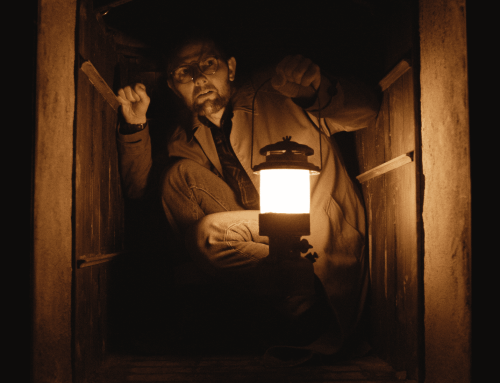
Courtesy Utopia
Known for lyrical, hard hitting and harrowing works such as Leaving Las Vegas, Figgis has taken a similar approach to cataloguing the production of Megalopolis. You will see rehearsals, team bonding exercises, and multiple takes as well as moments spent working, or arguing, on or about, various moments. Interestingly, you will also see a series of screen tests, from years prior, where Coppola had looked at a plethora of actors for the film, during times he thought production might be about to begin. The insertion of these tests, which often amount to full-blown scenes being played out on mock sets, may make you long for the film, or films, that might have been, had Coppola gone in a different direction.
Megalopolis is the most singular vision in the career of its maker, for good and ill, and his insistence on everything being precisely his way comes across, at times, as both dictatorial and obtuse, as well as passionately defensive of the personal. Laurence Fishburne comments on this in one sequence, stating that “Francis knows he has contradictions, and that’s part of what makes him who he is.” Indeed, almost everyone is given a chance to say something, positive or negative, about Coppola. Aubrey Plaza, for instance, recounts “the most bizarre audition I have ever had” while Shia LeBeouf, who clashed with Coppola throughout the production, appears to have been both mesmerized and frustrated by Coppola.
Along with Hearts of Darkness and The Godfather Family: A Look Inside, one can create a certain image of Coppola as a passionate, driven and singular film maker. George Lucas shows up and offers that “Francis is not like me. I am careful and risk averse, but Francis is very much about emotion and following his instinct. He is flamboyant and artistic in ways I am not.” The film does not excuse some of the more excessive moments, but records them, and allows a complex picture to emerge.
It occurs to this reviewer, however, that with film being a collaborative medium, even when it is all your own money and your personal passion project, perhaps the results could be better and the set freer from tension, if you had listened to those talents on both sides of the camera, rather than steam rolling them. One particular moment is captured where Coppola tells his cinematographer that his job isn’t to help with continuity and a consistent visual look, but just to “do as you are told and capture the beautiful images I want you to shoot. I’ll edit the fucking thing and you’ll shoot it how I need it shot because only I know how it will all fit together.”

Courtesy Utopia
Ultimately, this is a work about the tension between the personal, and the singular and the group or the collective. It is a film that straddles the line between fly on the wall and reflective. It is undoubtedly one of the best works in the career of its own maker, and perhaps more interesting than the film it was about. If you love seeing how the sausage is made and all the pain and pleasure, good and bad, see this.
Megadoc is now playing in theaters.



I’ve really enjoyed the docs about making Francis Ford Coppola’s films. Will see this when I can.