

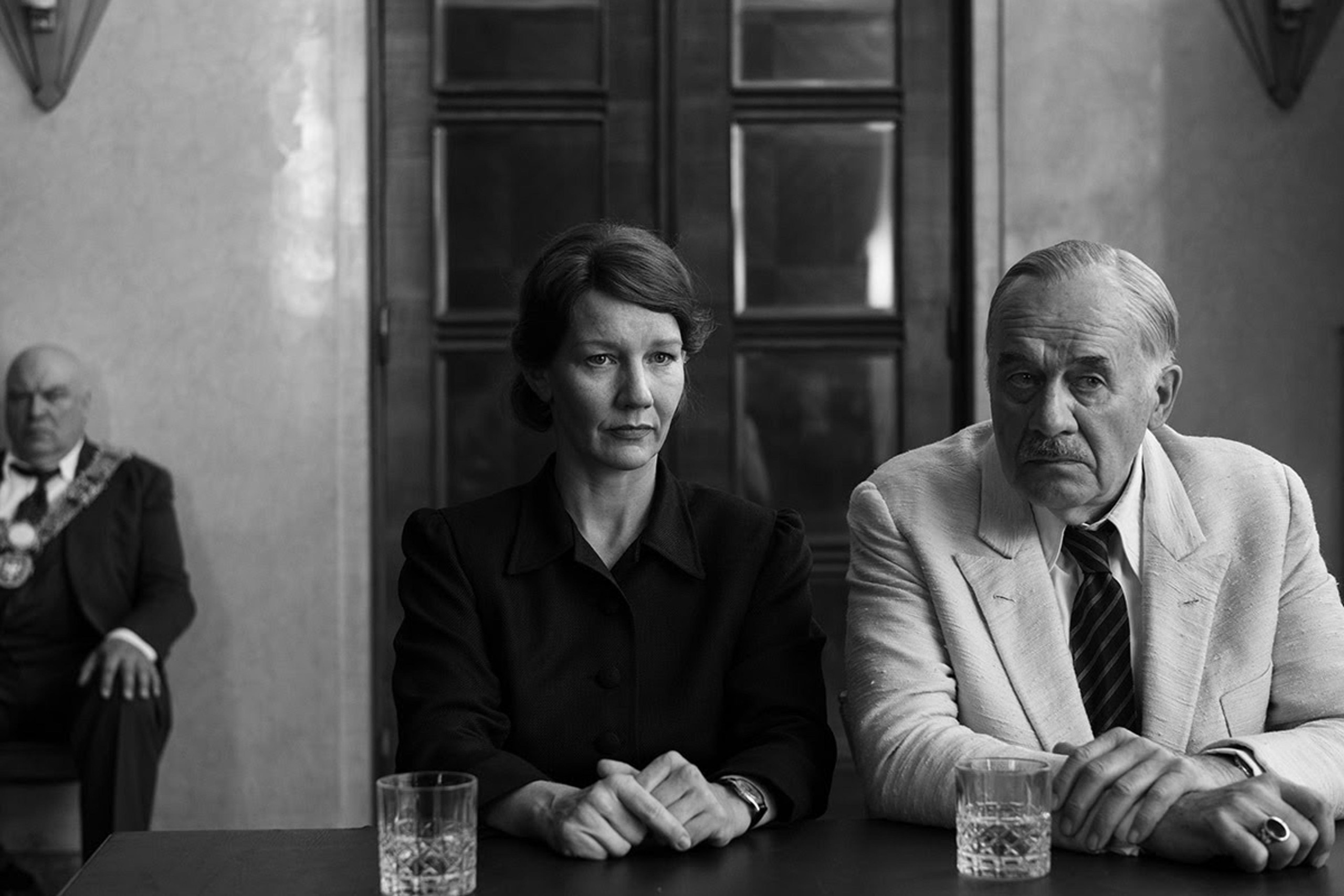

Paweł Pawlikowski returns with a film that feels like a natural extension of the loose trilogy of post-war European drama he previously explored with Ida and Cold War. Captured entirely in a striking monochrome black and white, this is an artful and poetic movie that leans heavily into mood and historical reckoning. While the approach is undeniably ambitious and visually captivating, the narrative does occasionally come off a little slight on the surface, yet it more than makes up for this by carrying a wealth of rich, densely packed ideas underneath its austere exterior and quietly muted approach.
At its core, the story examines the complex dynamics between fathers and daughters, tracking a deeply emotional journey across a fractured landscape. The plot follows Thomas Mann (Hanns Zischler), an aging author in his later years who returns from exile to Germany in the summer of 1949 to accept a couple of official honors in both Frankfurt and Weimar, just as the country stands on the precipice of being split into a communist state in the turbulent wake of fascism’s defeat. The film handles this historical friction with immense grace, aided immensely by its stellar cast. Hanns Zischler portrays Thomas Mann with an aura of heavy, detached contemplation, while Sandra Hüller delivers a phenomenal performance as his daughter, Erika Mann (Huller). Serving as his driver, secretary, and political buffer, Erika exudes a sharp, palpable animosity toward her father, expertly breaking down the profound bitterness, grief, and generational resentment, she holds for him following the recent tragic suicide of her brother, Klaus Mann (August Diehl). Along their journey, they collide with a vivid ensemble of figures from their past and the post-war political landscape: Mann (Diehl) haunts the narrative as a symbol of the fragile weight of family artistic legacy; Johannes R. Becher (Devid Striesow) brings an unsettling ideological fervor as an East German cultural commissar eager to co-opt the literary titan; Betty Knox (Anna Madeley) and Arthur Quint (David Menkin) represent the cynical surrounding press corps; Gustaf Gründgens (Joachim Meyerhoff) offers a glimpse into compromised artistic survival; and a jazz singer (Joanna Kulig) lends a haunting musical soul to the film’s smoky background spaces.

What starts as an icy distance between Thomas and Erika Mann eventually shifts toward a quiet acceptance, allowing the two characters to make amends through some genuinely touching and beautiful payoffs as the narrative unfolds. Along their travels across various historically resonant locations and bombed-out streetscapes, the movie occasionally becomes a bit repetitious, particularly as it repeatedly pauses to examine the tedious, boorish behavior of the various bureaucratic government officials they encounter along their journey. However, these narrative stretches never outstay their welcome because of the astonishing precision behind the camera.
Cinematographer Łukasz Żal frames every composition with stark, silvery elegance, turning ruined streets and somber interiors into haunting tableaus that mirror the dislocating struggle for identity and home, all while the sonic landscape brilliantly grounds the historical atmosphere through the melancholic strains of Bach and Beethoven filtering through room corners, scratchy jazz broadcasts drifting from distant radio background noise, and a haunting final vocal song that echoes over the closing credits as an undeniably absorbing European arthouse drama.
FATHERLAND is now playing in limited theaters




Leave A Comment