



Spirituality collides with science in Sebastian Lelio’s latest period film, titled The Wonder. While suffocated with implausible detours and anchored by its elegant craftsmanship, The Wonder casts an irresistible spell while spinning an adaptation of Emma Donaghue’s 2016 novel of the same title. Florence Pugh compellingly delivers an understated lead performance as Lib Wright, a respected nurse who travels to a rural village in 1862 Ireland, where she is summoned to observe a young girl who hasn’t eaten anything for months.
A beautifully crafted film by Sebastian Leo and co-written by Alice Birch, Lelio, and author Mary Donaghue herself, the human drama increasingly grows inert due to how dry some of the drama feels. Though exquisitely shot by first-rate cinematographer Ari Wegner and a splendid cast led by Pugh and Tom Burke, this small-scale film does not quite ignite or pull the emotional sweep of Lelio’s previous human dramas like A Fantastic Woman, Disobedience, Gloria, or even his own U.S. remake of Gloria, titled Gloria Bell. The film is likely to lose shelf life and will probably get lost due to the oversaturation of content and films being released. which is quite tragic because The Wonder comes with many merits.
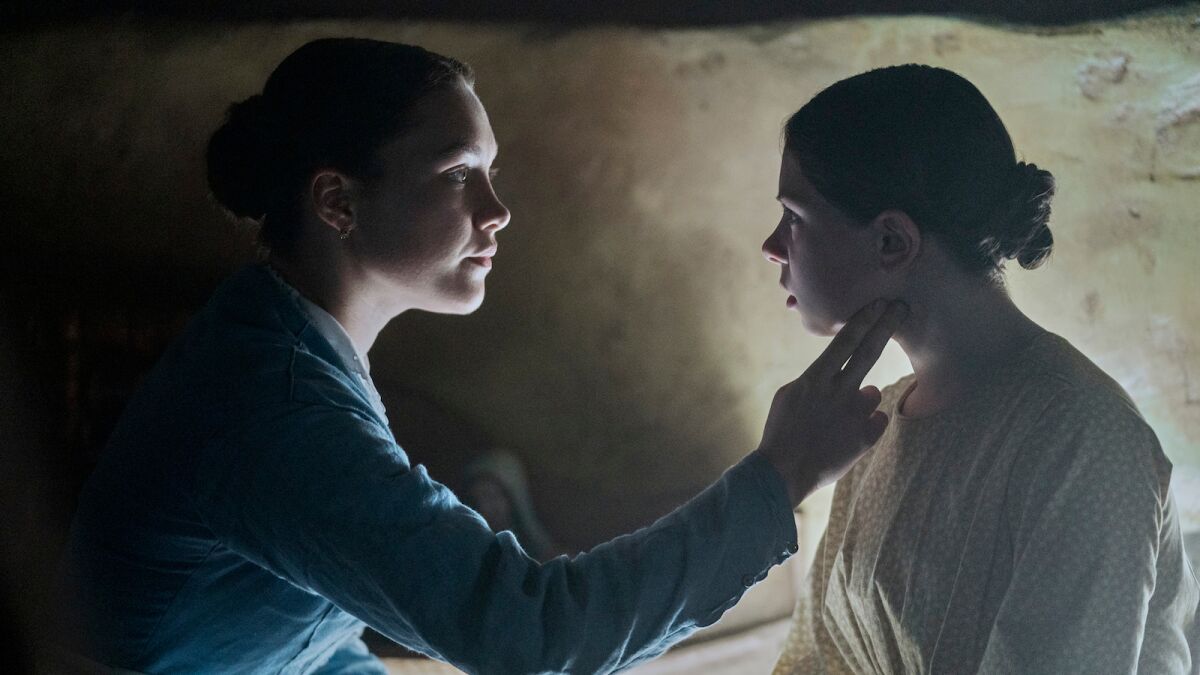 Courtesy of Netflix
The film’s narrative revolves around a potential spiritual miracle or possibly something fraudulent. A devout Catholic resident of a small Irish village believes a young, 11-year-old girl has survived for exactly four months without food. The child, Anna O’Donnell (Kila Lord Cassidy), no longer needs nutrition from food, but she claims she has been embodied by a holy spirit that keeps her alive. Of course, word gets out, and the claim becomes somewhat of a spectacle as pilgrims from local villages come to observe the natural phenomenon. A local board ends up summoning Lib to coordinate and conduct her health due to the lack of nutrition.
While Anna appears to be ill and fragile, she doesn’t appear to be thin or suffering from malnutrition. Lib is quite convinced that this is a stunt and that someone is providing her a little bit of food on the side. The film becomes a narrative about faith squaring off against rationality. However, Lib’s skepticism is outnumbered by the town’s council, which is driven by an all-male men of faith council that includes Dr. McBrearty (Toby Jones) and the local priest (Ciaran Hinds), who are convinced themselves that Anna’s starvation is indeed an act of divine intervention.

Lib ends up taking matters into her own hands, and she doesn’t allow Anna to see her parents. Anna’s health begins to actually decline. She has irregular heartbeats, coughing fits, and fevers. Lib ends up coercing her food in hopes she gets well. Due to Lib’s persistence, this makes matters worse. She ends up getting assistance from William Byrne (Tom Burke), a London journalist who is covering the story and who also believes the story is a myth. Lib ends up alternating sessions with a local nun. They both report their findings to the council. Lib certainly realizes there is conviction with the girl’s beliefs, and at times Anna comes across as if something has beholden or embodied her.
While the film is deliberate in pacing and has a slow-burn set-up, the second hour of the film becomes more compelling as Lib, Anna, and William have more exchanges. Long dialogue passages inside the interiors move outside to the ravishing Irish vistas that echo landscape cinematography in the recent Banshees of Inisherin. While faith appears to possibly win, Lelio and the scripters appear to keep the incident ambiguous, as it will probably depend on the viewer’s own faith to determine if it’s a sham or not. Perhaps I’m off on this, but it feels like Lelio and company play fair to both science and religion. In many ways, it comes off as a conundrum for conundrum’s sake that builds layers of ethics, but the execution feels undercooked.

What appears to be missing is the dramatic pull in the film, which has the build-up and many elements to keep it complex and resonant. But the drama gets lost, and the characters never quite reach the depth that the story strives for. The finale should be far more powerful than what is delivered. Even though it’s beautifully shot around some tall grass involving Lib caring for Anna, the climax and conclusion feel like they could have been painted on a much larger canvas. The ambiguities and complexities don’t feel earned, they come off quite muddled and unconfident as it requires the viewer to utilize their own beliefs with the material.
Also, on an arbitrary note: Lelio opens and closes the film on a film set that doesn’t seem to add much other than to remind us that films are all artifice and stories. The same can be said about the overall theme of the story and how it is conveyed. Who is really the oppressor here? Is Anna and William the unethical ones here who are so ingrained in their secularism and atheism that it is every bit as draconian as the phenomenon and the community that are suffocating Anna? What appears to come off as ambiguous and thought-provoking doesn’t quite translate well, and so much about the film feels miscalculated and ill-advised.

As the initially skeptical nurse who eventually becomes compassionate toward Anna’s spiritual plight, the stoic and radiant Pugh always delivers first-rate acting skill and she is well supported by Burke, who played the boyfriend addict in Joanna Hogg’s The Souvenir. Kíla Lord Cassidy as Anna adds a lofty performance as the ailing girl, who holds many vulnerabilities, and has many great exchanges with Pugh. The rest of the cast, including Jones, Elaine Cassidy, and Caolán Byrne as Anna’s parents, aren’t given much depth or the opportunity to register.
In the end, Lelio’s latest comes off as a bit of a slip and the film isn’t quite as a standout as his other films. While there is certainly an exploration of dark prejudices and the betrayal of humanism due to convictions and otherwise, it doesn’t quite satisfy, in which it left me feeling more bewildered and perplexed but not necessarily in an effective or wise way.
THE WONDER is now showing in limited theaters, including Detroit, and will be streaming on Netflix Wednesday, November 16th.


Yeah, I saw the trailer for this last month – looks intriguing.
I like Florence Pugh. Looking forward to this film.
Florence Pugh is great. Might watch it if I get the chance
I haven’t seen the film yet. It seems they have the right casting for the story. But if the story doesn’t deliver on a motion picture level and the audience doesn’t relate to the story. Is because the story sometimes not strong enough or it needed a stronger third act. Sometimes it’s both the actors. It could be the story the way it was written. And it the director job to understand that.
Doesn’t sound like my cup of tea. But I like the actress. I feel she can take on anything and make it special.
To bad it’s not any better of a movie. She’s so wonderful to watch though, I might just check it out.
Too bad not to bad
I think this is one that I might like to see even just for the cinematics. Although, the storyline looks like it might border on an A24 style horror…. could be an interesting watch!
I think the story should have been told differently but you are wrong, it’s partially about science and more about how churches ignore rape and how they decide to ‘hide it’..
We liked it a bit more than you did. We found the premise unique, intriguing and interesting. It sure which was more shocking; the rapes or the mother’s way to provide sustenance. I give it ****
I really liked your post.Much thanks again. Cool.
Appreciate you sharing, great post.Much thanks again.
I truly appreciate this post. Great.
I don’t think the title of your article matches the content lol. Just kidding, mainly because I had some doubts after reading the article.