



Closure and catharsis are certainly the themes explored, but at its core, Johanna Hogg’s latest feature, The Eternal Daughter, is an examination of artistic healing, isolation, and motherhood. Incisive, melancholic, and mysterious, the film taps into some similar exchanges between a mother-daughter relationship that were explored to such affecting perfection in The Souvenir films, yet Hogg’s experiment is refreshingly enigmatic and therapeutic. Hogg, like many other filmmakers, used her limited resources to craft a cautious film with its limited setting of mostly a hotel setting, and the film is mostly a two-handler chamber piece featuring Tilda Swinton expertly playing dual roles. A deeply compelling portrait of grief once again proves Hogg has the skill to deliver a quality drama with poignancy and mystique.
The film’s setting very much recalls the aesthetics of Hammer-horror films and even recalls a minor variation of The Overlook Hotel in Kubrick’s The Shining with its creepy atmosphere, long hallways, narrow driveways, and confined hotel rooms. The hotel is very ominous, as Ed Rutherford’s cinematography blends low-key lighting with some stark contrast in the nighttime shots that invoke a subtle, unsettling mood throughout the film. It also helps to have a creepy hotel that has gargoyles on the top of the building and haunting sounds of windows closing. Hogg’s style adds a lot of elegance to invoke her tone of uncertainty and guilt as this film becomes a journey between a mother and daughter attempting to reconcile and recapture their relationship that is in need of atonement.
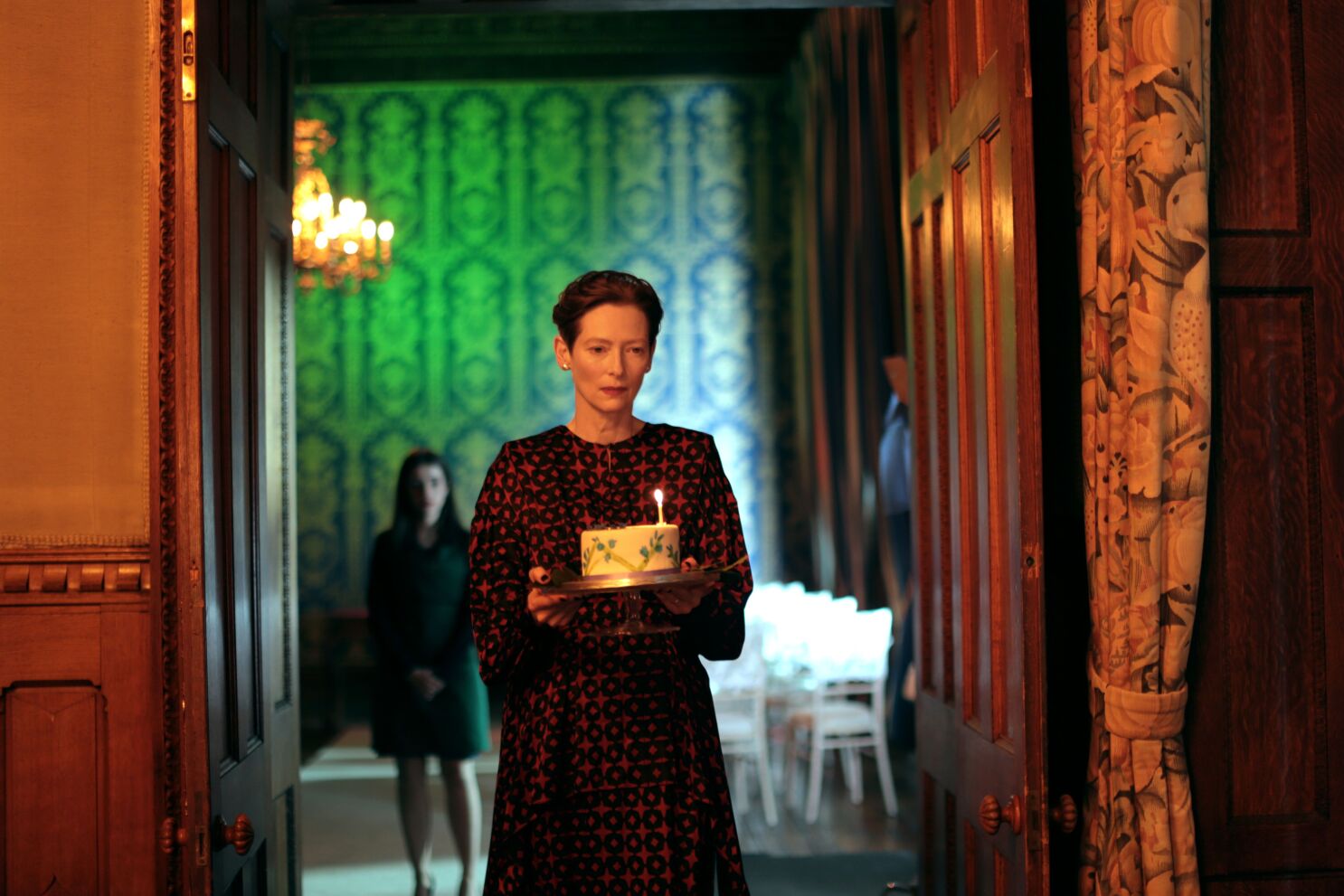
The film begins with a harsh fog on the English countryside as Julie (Tilda Swinton) and her aging mother Rossalind (also Tilda Swinton) travel with Rosalind’s dog named Louis. They both arrive at a hotel that Rosalind holds memories of after staying there with her aunt during World War II. Rosalind’s birthday is approaching, and Julie decides to take her to the hotel, where she feels it would elevate her mother’s spirits. Julie’s motivation is more than just reconnecting with her mother during a weekend visit; she is starting to feel some creative vibes, but she can’t start writing until she makes amends with her mother, with some past guilt that weighs on her.
Just as Hogg’s Souvenir films tapped into Hogg’s own personal guilt and creative psyche, and both of those films were a deeply personal portrait of her filmmaking roots (Spielberg fans, watch this if you like Fabelmans), The Eternal Daughter could certainly play off as a meta companion piece to her two-part memoirs. For starters, the characters’ names are the same as they were in The Souvenir. In fact, they are the same characters. It’s just that the Julie character, which was played by Tilda’s own daughter Honor Swinton Byrne in The Souvenir films, is now older, and this time played by Tilda Swinton. The role of Rosalind in The Souvenir is reprised. Even though there are very few references to the first film other than it taking place in the same universe as The Eternal Daughter, it becomes a self-referential portrait of Johanna’s own disconnect that she potentially held with her own mother.

The exchanges between the two Swinton’s are quite impressive. In contrast to other films in which we saw actors playing onscreen in dual screens together, such as David Cronenberg’s Dead Ringers and Spike Jonze’s Adaptation, the two Swintons are rarely in two shots or master shots together.Hogg stages their scenes in clean shots, in which we don’t even have over-the-shoulder coverage. The camera bounces between their separate coverage. What would come off as a budgetary constraint or as a gimmick doesn’t here because each of the shots between the two Swinton actors mirrors each other in terms of framing.
The staging also heightens the isolation and atmosphere of the narrative and tone. To add to that, there are a lot of stylized aesthetics in the film that elevate it away from feeling like a verbose two-handler. With striking angles, split diopter shots that feel just like the ones Guadagnino used in his Suspiria remake, along with a tone that echoes both Hammer horror and the atmosphere of a giallo film, The horror aesthetics are an odd decision simply because Hogg never goes for the full out horror effect, there aren’t even horror tropes or surrealism that come to the surface that would have added to a greater impact. Hogg proves she understands the visual language of the film, but the film could have certainly benefited from some horror elements, even if they were just Bunuelian-style nightmares.

We get a few more characters in the film that bring some opaqueness to the film, which includes a passive-aggressive hotel clerk (Carly-Sophia Davis), who is easily annoyed by Julie’s requests like getting wi-fi, closing open windows, and requesting tea for meals. Throughout the night, we hear strange creeks and noises in the hotel that recall last year’s Memoria. There is even a profile shot of Swinton looking out a window that recalls the shot of the glass walls in Memoria. The sounds do not keep Rosalind awake as she drifts off to sleep from her medication. Julie encounters a fellow hotel guest in the film named Bill (Joseph Mydell), who holds in-depth conversations with Julie during the day in the lobby. Julie invites him to her mother’s birthday party, which he politely declines. The highlight of the film is indeed the birthday party at the hotel between Julie and Rosalind; the scene is both endearing and equally distressing as the hotel clerk is also the server that brings out champagne and cake. Not to reveal any spoilers, but the third act of the film digs deep with its emotional depth. Swinton fulfills these moments with deep affection and a genuine melancholy that upholds Hogg’s emotional depths that she aims to convey.
While the film experiments with horror aesthetics and atmosphere, it steers clear of the macabre in favor of an elegiac spiritualism that reflects the mother-daughter relationship within the narrative. The Eternal Daughter might leave some viewers perplexed on Hogg’s exact point; it feels like there is much more she could have done with the relationship that could appear surface-level, but there are enough clues and subtle observations that make this a fulfilling piece of work.
The Eternal Daughter opens in limited theaters and VOD on December 2nd


Always love A24 movies. Definitely gonna check this one out
I love me some Tilda so I’ll probably see it. Great review.
Huge Tilda fan here and great review of this film, thank you, Robert. Definitely will watch this one.
It’ll most likely hit streaming in the uk so I’ll definitely be interested in seeing this one.
A24 produces great movies. This film is very well casted. Specially when there’s actress’s involved, they bring the emotions on a different level. I like the cinematography work on this film. The directing style of this film is great.
Tilda Swinton is such a G!!! Also yes, the cinematography looks hauntingly beautiful; I can’t wait to see this. Great review, my dude 🙂