


Coming straight off his artful but uneven art-house horror debut, You Won’t Be Alone, which was a period piece set in 19th century Macedonia, Goran Stolevski proves to be quite a versatile filmmaker with his sophomore feature, Of an Age. An affecting queer romantic drama that is divided into two halves with two different time periods of 1999 and 2010. Luminous, melancholy, engaging, and liberating, Stovelski’s second feature stars Australian actors Elias Anton and Thom Green, who turn two summer nights during the course of two years that examines the elations of first love, and the complexities of reconnecting. Similar in narrative to Luca Guadagnino’s Call Me by Your Name, Barry Jenkins’ Moonlight, or Andrew Haigh’s Weekend (2011), Stoveski’s gay love story still feels refreshing due to how wondrously sensual, intimate, and thematically subversive it eventually becomes. The film’s structure and stylization are also revelatory—part road movie, part ode to first love, part coming-of-age saga, and overall, a piercing meditation on regret, Of an Age aims for and achieves a lot, as it encompasses many facets of the human condition.
Focusing on Nikola (Elias Anton), also known as Kol for short, when he embarks on a spontaneous road trip with Adam (Green) in search of Kol’s best friend and dance partner, Ebony (Hattie Hook), Adam’s younger sister. We first meet Kol shirtless in his family garage, where he is practicing his dance moves for an upcoming dance contest. Kol’s practice is disrupted by a distressing phone call from Ebony; she was stranded at a desolate and unknown beach after a long night of partying and has no idea what town she’s in; this quickly modifies Nikola’s plans for the day, during which they both would have been participating in the dance competition.
 Courtesy Focus Features
The film’s first chapter is set in 1999, during a time before Google Maps, GPS, and accessible smart phones. We see Kol getting out maps and phone books in an attempt to track down the vicinity of the possible beach Ebony could be stranded at. With no vehicle, Kol gets in contact with Adam, who has no hesitations in picking up his sister at a beach that is about 3 hours away. This means Kol and Ebony will be missing the dance competition, and we spend a large section of the film in the car, which contains extended dialogue exchanges that channel the car scenes in Abbas Kiarostami’s films or even Richard Linklater’s sharply scripted car scene in Before Midnight. The two young men discuss music, Franz Kafka’s The Trial, and Wong Kar-Wai’s Happy Together—as Astor Piazolla’s Finale (Tango Apasionado) plays cleverly through the Happy Together soundtrack cassette. They both discuss their futures, as we learn Adam is heading off to graduate school in Buenos Aires the next day.
Adam certainly keeps his sexuality to himself, which is very typical in 1999, where he’s labeled gay by one of Ebony’s friends in the beginning of the film as he inquires about her whereabouts. He also harks back to acting more vigorous and masculine once Adam confesses to having a Macedonian ex-boyfriend. Both before the confession and after the confession, you can feel the sexual tension, human connection, and intimacy forming between them. The first chapter is a sensuous buildup to how these two young men will pursue their desires. The attraction continues to build up through the course of the day in very subtle ways, including a very delicate moment in the film where the three stop at a gas station for lunch as both men subtly lock eyes as Big Runga’s hit 1999 song Sway from American Pie plays in the background. This moment is quickly disrupted once an old friend of Adam appears, and even Adam starts to bro up in this particular moment to reflect the attitudes of that era.
 Courtesy Focus Features
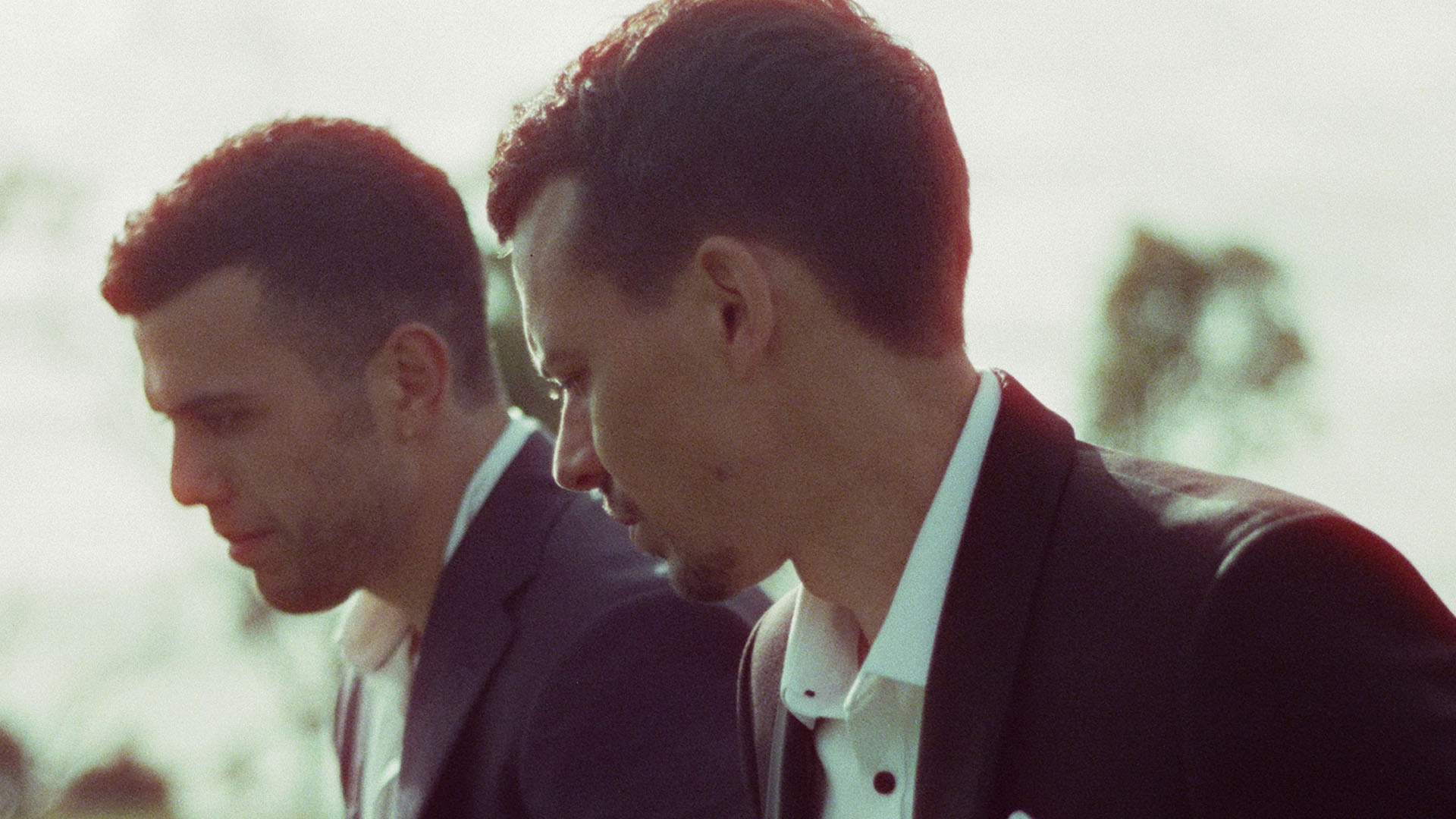
The narrative leads them to a party where we hear a lot of nostalgic 90s alternative rock songs playing in the background, like the Live song titled The Dolphins Cry. Just as he did with You Won’t Be Alone, Stolevski adores soundtracks and loves using pre-existing music as well as songs from films he loves (Happy Together, Somewhere) to bring new context to what was used prior. It’s almost as if he’s the new up and comer who wants his predecessors to remain relevant in the hopes that younger generations will discover his wistful pleasures so that great films from seasoned directors can live on. As the night progresses, Kol’s attraction and yearning for Adam intensifies and becomes more explicit at the party, but they end up parting ways, during which Kol experiences xenophobia from one of Ebony’s friends. The two men reconnect after the bigoted slur, and in the most exquisite shot in the film, shot by Matthew Chuang, both men look out into their town of lighted up buildings from the top of a hillside and have a very tender and heartfelt goodbye in the closing hour before dawn. It’s a sublimely ambient moment in the film that captures the innocence of first love and the bittersweet sadness of having to say goodbye. Chaung’s cinematography is visually sublime here, the way the camera observes their body movements, gazes, and unspoken longing is so delicate in the way it’s observed.
The second chapter of the film takes place 11 years later, in 2010, as Ebony is getting married in Melbourne. Both men travel back to Australia, and it’s revealed both men live outside the country. Kol lives in Sweden, and Tom lives in New York City. The film’s structure of the two time periods is eloquently constructed. The first is about newfound intimacy, Kol’s first sexual experience serves as a testimonial to our more malleable experiences over the years. However, Stolevski elevates these conventions as Kol confesses to Adam just how much that experience from that night meant to him. He says there have been other lovers’ senses, but nothing has captured the ambience that he felt that night. This honest exchange between both men not only transcends the material, it captures the essence of time, and we evolve in how we understand our unspoken longings with time. Kol and Tom’s first experience were partially based on raging hormones and lust, but later refined itself over the years. In other words, our more meaningful experiences or rather short-lived connections we have with people actually have the power to grow even stronger over time, as that same spark might not replicate itself again later in life. Human connection is really no different than a haunting piece of cinema, literature, or listening to a great album or song—certain human connections live on in our minds, and we either can’t move past them, or we may grow wiser with those reflections on who and what we want. This all works due to how the chemistry between Kol and Tom flows naturally, which contributes to the overall performance of its lead performances.
 Courtesy Focus Features
While the film’s last few scenes end in a very absorbing way, it would have felt more beguiling and less derivative of Her or Moonlight with a slightly different finale. While not revealing the ending, which is very poignant, but it also ends on a very familiar “ambiguous” indie movie note. Had writer-director Goran Stolevski just added an additional last scene or two, it would feel far less abrupt, and it would have expertly matched the intricate themes of regret and missed opportunities that Stolevski explores here. All around, nothing feels forced though; it takes the familiar tropes of a single-night love story or even first love and expands them more effortlessly than one would expect. Of an Age may be that small gay Aussie romantic drama released early in the year of Ant-Man, Magic Mike, and Creed sequels as many movie lovers play catch up on the Oscar-nominated films, but Of an Age deserves to be just as celebrated as any of the other Oscar-nominated films. The experience is an immensely gratifying one.
Of an Age is now showing in limited theaters

Well written review
I only read the top portion of your review before I see a film that you’ve reviewed and it’s extremely well written and I’m happy it’s as good as I was hoping! I know I was more happy with his last output than you so this makes me very eager to see it 🙂
Saw this on Sunday.. I was I bit disappointed with the film. Maybe because it felt like it was familiar ground. But it was well done and good young talent in it. 2.5 of 4 stars for me.
Sounds good… I’ll check it out when I can
Def will watch this based on your review. Thanks Robert.
I’ll give it a watch.
I thought this film was quite good — probably 3 out of 4. The slow dance of the two men figuring each other out, and the seductive, slightly teasing cat and mouse aspect with the older Adam toying with Kol’s presentation of himself — his mispornuniciation of Borges and “vicissitudes”, and his seeming closetedness — were nicely done. I personally found the sister Ebony so freakin’ annoying and shrill that i wanted her to go away, but that’s not a fair criticism of the film. I have two rservations. First, the story of two people briefly meeting and falling in lust and love and separating is quite familiar, and I’m not sure this film added substantially to that. Second, it seems like every indie film now must be composed almost entirely of incredibly close shots, with a handheld camera that never stops moving, and rapid endless edits of the same scenes from multiple angles — this has now become almost the cliche of small low budget indie films (Afterson, Stolevski’s previous film You Won’t Be Alone), and I’m getting a bit tired of it. There were times when I wanted to scream — stop moving the camera around and editing constantly, and please give me a medium or long shot!!!! But it’s a pretty decent film overall.
Great review, Robert! I honestly felt the movie should have leaned more into poetry than dialogue. Some of the dialogue came across as coy to me, but his images were incredible.
Seriously loads of useful tips. canadian pharmacies
Thanks for finally writing about > reformas-1024×683 – ProjectDifusión
I value the blog post.Much thanks again. Will read on…
Thanks again for the blog post. Great.