


A quietly distressing tour de force, Jonathan Glazer’s screen version of Martin Amis’ 2014 novel of the same title, The Zone of Interest, takes a much different approach in its examination of the horrors of the Holocaust and Nazi death camps. Both observational and austere, Glazer uses Kubrick’s style aesthetics, an ominous tone, and showcases perfectly cast actors to create an unsettling study on complicity. By exploring just how normalizing the demoralizing can get in its chilling investigation, by never showing the Holocaust victims, Glazer instead shows a Nazi commandant and his family carrying out their daily lives as genocide occurs in the concentration camps just next to them. A film of moral quandaries, this is an unnerving and unwavering film that will leave you haunted.
Four films in now, Glazer still proves to have a gift with his visual skills. Even though it often takes a decade in between projects, there is no denying the pristine craft and artistry that he puts into his projects. film holds varied aesthetics and themes that are wildly different from one film to the next. With The Zone of Interest, his unique streak continues as he centers on Rudolf Höss (Christian Friedel), the German SS officer under Hitler who was convicted of war crimes after the defeat of Nazi Germany for his role as the longest-serving commandant of Auschwitz’s extermination camps. We never go inside the camps, we never see the atrocities of the Holocaust, and Glazer’s camera serves mostly like a surveillance camera, in which Glazer and cinematographer Łukasz Żal actually hid cameras around the set as the actors blocked out their scenes.
 Courtesy A24 Films
The film is a portrait of Rodolf and his family. We follow Rudolf Hoss and his family’s daily routines. We are introduced to his wife Hedwig (Sandra Huller, Anatomy of a Fall, and Toni Erdman), who raises their children in their garden, as we see smoke from the camp from afar. We see other daily routines of a family on a picnic or swimming in a nearby river. We also see meals prepared, dinners occurring, a birthday celebration, and one of the most striking images involves Rudolf smoking so callously by the gate of the home. There is actually very little plotting or any narrative threads. The only drama that occurs is when Rudolf is informed that he must transfer, and Hedwig is upset that they must leave the house. Yet, it’s a film where you sense and feel doom in the milieu. You see Rudolf’s children collecting teeth from the Jewish victims as if they were rocks, or Hedwig trying on a coat of a woman’s coat. The mundane unravels with dread and imminent shock at just how far demoralization can reach within society.
One of the most eerie exchanges in the film involves Hoss meeting with chief engineers and architects to discuss how the new machinery is much quicker at burning human bodies and disposing of the remains. They discuss efficiency and the potential of the room for greater promotions. Glazer hints at just how horrifying the horrors of conformity will be as we see dark smoke and hear screams from the distance. Throughout the film, Glazer allows malice to suffocate the tone of the film; you can feel doom in every room. While the hosts carry out their daily joys of fine wine, meals, gardening, and swims, it’s the young children you feel horrific for, as they are certainly feeling defiled from being around such cruelty.
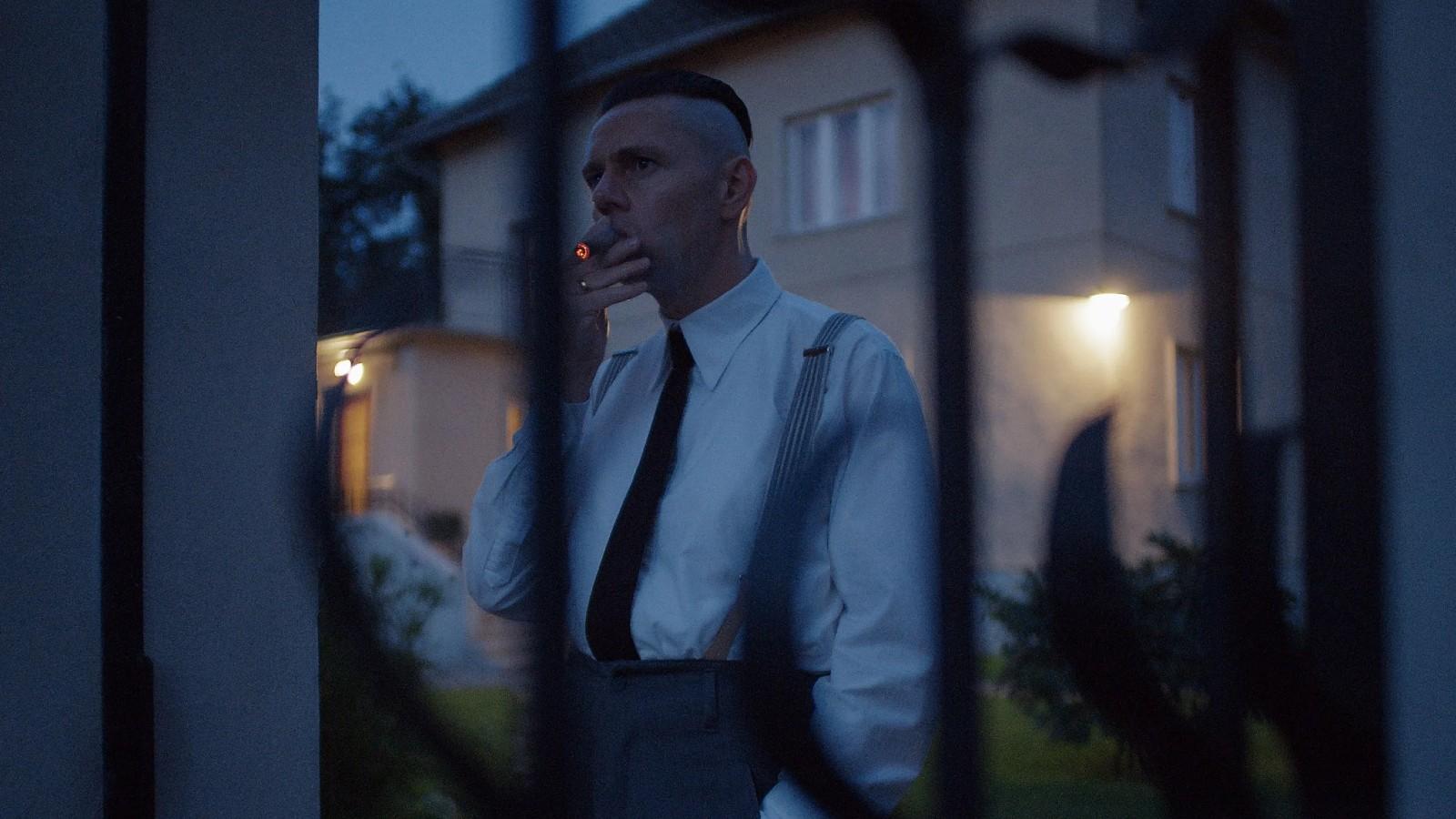 Courtesy A24 Films
The themes in the film bear to mind Michael Haneke’s The White Ribbon, and it feels just as timeless, or rather timely with the current crises impacting our country and the world. The film also suffers from some pokey pacing. There were moments where I was waiting for them to end, as my anxiety was reaching highs. Perhaps that is Glazer’s intention; the film is demanding to watch, but it’s rewarding in its reminder that we shouldn’t shy away from the past. While the film is only 104 minutes long, it does suffer from some pacing issues. I often wonder how it could have played out as a short film. Nevertheless, Glazer’s vision in his writing and directing, his perspective, and the film’s aesthetics are expertly crafted. Especially in a sequence that is shot in monochrome, Glazer’s thermal-image cameras explore a young girl hiding fruits and vegetables outside the camp for the prisoners.
The film also ends on a very powerful note that certainly clarifies Paul Hunham’s thoughts on history in Alexander Payne’s The Holdovers and how history is an explanation of the present. Too often, we are complicit in ourselves as we allow misery to wage on. Humanity carries on the same misery and mistakes as before because every era and generation believes it is unfathomable that we can repeat the same mistakes of the past, but most often we do. Glazer’s fourth film gives the film those effective reminders and touches, and Glazer turns the Holocaust drama into one that feels contemplative and urgent with its analysis.
The Zone of Interest opens in limited theaters on Friday, December 15th, 2023.


“ The film also ends on a very powerful note that certainly clarifies Paul Hunham’s thoughts on history in Alexander Payne’s The Holdovers and how history is an explanation of the present. ”
Hey, look at that! : )
I look forward to seeing this movie.
Looks interesting. Might check it out
Great review .seems like an interesting movie to see and get a sense of how the evil people were going about their days during this time ..
One of two films left this year I’m most excited for.
I’m really anticipating this one. Won’t say looking forward to it for obvious reasons but definitely one that’s on my radar.
I saw it last night and was completely blown away. There is a quiet dread permeating the frames depicting seemingly innocuous pastoral life within (literally) yards from a concentation camp. As the films plays on, and the attrocities are broached, one is left with the most horrific of revelations! A staggering masterpiece!
As always, your review is magnificent!
I thought the film was excellent, but for me it was a misstep to move in the final half hour from the intense and single-minded focus on the life in the house and its environs adjacent to the camp to the husband’s meetings over his position as camp leader, the extermination plans, and the mechanics of dealing with the transport of Hungarian Jews. What was horrifying because it was suggested became literal and obvious, and I started to feel like I was watching Downfall or The Wansee Conference. I got taken out of the spell the movie had cast, and its original vision, into a different kind of film, one that I felt I had seen before. Four starts for the first 3/4 though.
Finally coming out soon in MN. Going to go and see it when it does in a week or so. Can’t wait!
It crept in under my skin and actually gave me a minor anxiety attack. The almost bland, daily life of the family with the constant presence of the camps, the increasingly dark yet subtle descent into total corruption and evil really got to me. The sheer banality of day to day life and the ability to ignore such evil really speaks to human evil better than any other holocaust drama I’ve seen
Definitely a film that will stick with me for a long time. Something that I noticed with the cinematography is that it kind of reminded me of old school “Resident Evil” games where the camera for most of the film is static almost giving what refer to as “Security Camera” cinematography where you don’t watch it from any specific perspective but watch it like watching through a security camera where you let the events play out as if you are watching a real family just living their everyday lives. For better or for worse it may affect pacing for some but for me it really felt like I was observing a family like a stalker seeing something he shouldn’t see. The sound was equally as powerful as the visuals. The violence is heavily implied from the sounds of gunshots and screaming in the background to the uncomfortable items the family keeps as souvenirs, this film shows that you don’t need to see the violence to be disturbed. The ending was especially bold, won’t spoil it here.