

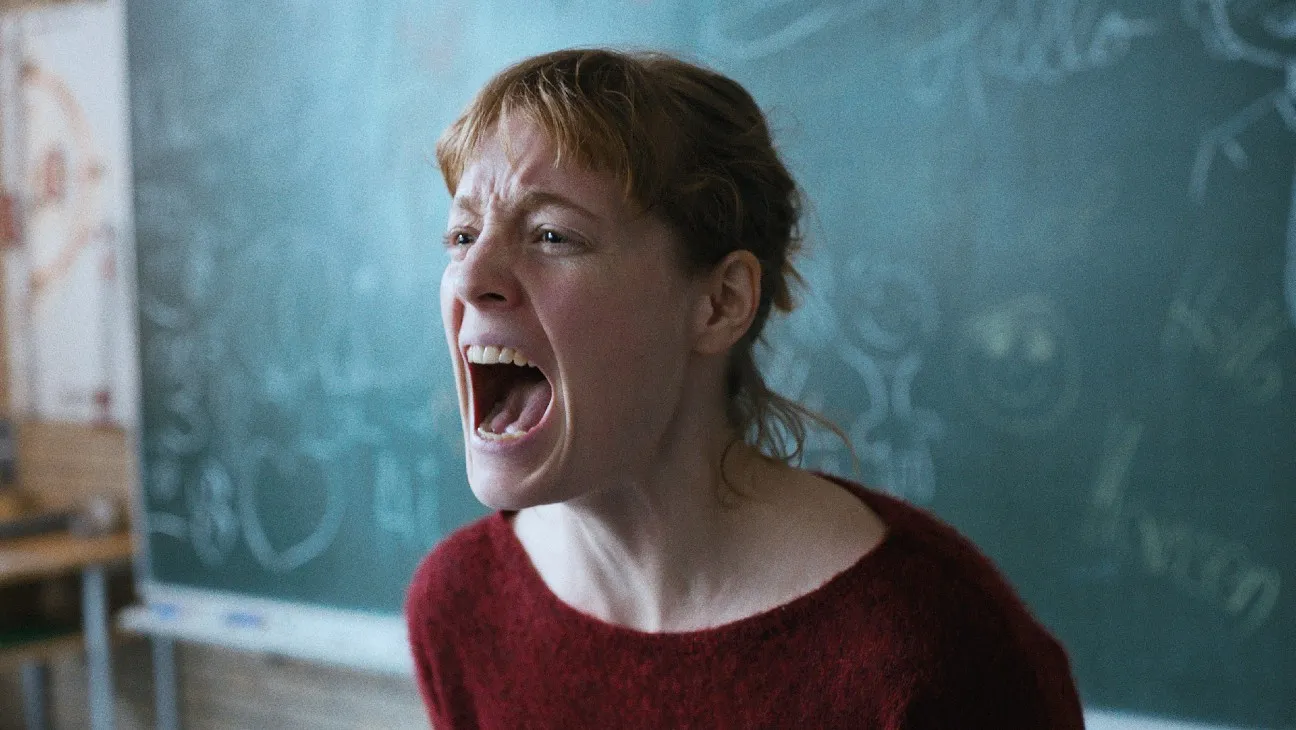

With some sharp writing, timely social commentary, and a wrenching performance by German actress Leonie Benesch, there are many reasons to embrace The Teachers’ Lounge, a debut feature by İlker Çatak, who wrote it with Johannes Duncker. Ferocious but empathetic, the film avoids sentimentality in this potentially heavy-handed tale of an idealistic middle-school teacher who takes matters into her own hands once there are numerous reports of fellow teachers and faculty personal belongings and money end up getting stolen. Avoiding cloying sentimentality and other inspirational classroom movie tropes, this gripping drama also plays out as a riveting character study that builds up some satisfying drama.
The film’s style and thematic similarities also recalls Laurent Cantet’s execution of his 2008 French classroom drama. titled The Class. From the staging by Catak to the realism of its cinema verité camerawork by cinematographer Judith Kaufman and seamless editing by Gesa Jager, it makes the audience feel like a fly on the wall, eavesdropping in on what’s going on throughout the school and inside the classroom.
 Courtesy Sony Pictures Classic
The commanding Leonie Benesch has shown promise ever since her supporting role in The White Ribbon and her skills are put to great use once again. Her Carla Nowak is a public-school teacher. She is a woman of principles and promotes fairness. She holds disdain for dishonesty and engages with the students, though she ends up coming to odds once suspicions and bad morale taint the school, which could potentially hold prejudices once a minor scandal occurs in the classroom and with one of the students’ mothers. Tensions arise, accusations metastasize, and conflict expands between fellow faculty members, colleagues, parents, and eventually the student newspaper. Catak and Dunker explore how the search for justice can be an uphill battle, especially since the truth can easily offend others and misconceptions and jaded perceptions can unfurl, undermining objective reality.
Ms. Nowak is a woman of principles. We see her prioritize a strong moral purpose where she cares about students’ rights and doesn’t agree with draconian-style searches and seizures once her administrators barge into her room in the beginning of the film by demanding students to clear out their pockets after a series of reported thefts have been occurring around the school. Ms. Nowak ends up noticing money stolen from her wallet, and she accuses Turkish immigrant Ms. Kuhn (Eva Löbau) as the culprit. This ends up destroying the reputation of the mother’s son, Ali (Can Rodenbostel), who just happens to be one of Ms. Nowak’s students.
 Courtesy Sony Pictures Classic
From that incident, more tensions arise, and it’s revealed that Ms. Nowak put her own surveillance camera’s up from her laptop in the teachers’ lounge, where other footage proves someone else stole the money who just happened to be wearing the same matching shirt. This ends up creating despotism and bad morale in the classroom, including a boiled teacher-parent conference where Ms. Kuhn informs the other parents of how unethical she was in her accusations. Rumors and gossip spread, and young Ali is the one who has to carry the torment from others who bear false witness.
Impressively, though, The Teachers’ Lounge ends up being very evenhanded in its character. People actually treat each other more compassionately when they are in smaller groups or when they are around each other individually, but they act more irrationally and bluntly once they are collectively towards each other. The film explores the dangers of groupthink and how it clouts their judgment. Even Ms. Nowak hides her Polish roots from other faculty members, so she doesn’t have outsider status in a German school.
 Courtesy Sony Pictures Classic
There is a strong testament to the cast, especially Benesch, who fails to deliver one false note with her emotionally charged performance. She is basically an isolated teacher, as if it’s her against the world, as she attempts to find atonement and raise the morale of a classroom in crisis from her own wrongdoings. There is no self-martyrdom or white savior complex with her character. She has well-intentioned principles, but the film doesn’t treat her as a routine heroic protagonist. She is a skillful teacher who just happened to make irrational decisions to sustain her own sense of truth and justice, which ended up holding unintended consequences of the torments she created for others around her. The film, which breezes by with an unyielding energy, raises some very important questions about ethics, authority, class and racial resentment, and objective reality. It also doesn’t declare itself to have all the answers. It’s like a subtle parable that examines, explores, and challenges quite nicely.
THE TEACHERS’ LOUNGE is now playing in limited theaters.



I saw this film last week at Manhattan’s Angelika Film Center. I thought it excellent and well worthy of my year-end Best Of list. Your brilliant review totally nailed all is attributes. You couldn’t cut the building tension with a knife.
I’ll have to check it out! Thanks!
“Catak and Dunker explore how the search for justice can be an uphill battle, especially since the truth can easily offend others and misconceptions and jaded perceptions can unfurl, undermining objective reality.”
This seems like an interesting film.
I’ll probably see this when it’s streaming.
This is a good story, compellingly told, but as someone who worked for his career as a lawyer and often dealt with issues that are explored in this film, i could not check at the door my complete skepticism about how the plot rolled out. Literally nothing in this film would have been dealt with in real life the way it is dealt with in this film. The kid still in the class after the teacher makes allegations against his mother?? The mother and the teacher talking on the phone and actually meeting after the incident explodes? No no no. Everyone would have been lawyered up to the ying yang the moment the plot started. One can suspend disbelief only so much. And I wanted to murder the boy and all the other smug, privileged kids in the school. A fun movie, an excellent lead performance, but utterly implausible.