

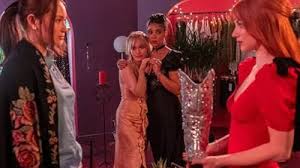

Director Meredith Alloway’s feature debut titled Forbidden Fruits, based on Lily Houghton’s 2019 play, is a witchy horror-comedy that starts clever and features superb casting. All the actresses are terrific and perfectly cast, yet the script and execution falter so much that the film never quite lands. This comes as a surprise given that the film was produced by Diablo Cody, who typically emphasizes sharp writing; while the original play likely offered that, the film’s execution feels slight and lackluster.
We are introduced to a trio of gorgeous saleswomen—Apple (Lili Reinhart), Fig (Alexandria), and Cherry (Victoria Pedretti)—at a boutique inside a Dallas shopping mall. They use their charm to persuade customers into spending thousands on overpriced merchandise. They eventually take an interest in Pumpkin (Lola Tung), a pretzel shop worker from the food court who quits her job to join the trio.
These women aren’t just mall-dwelling BFFs; they stay after hours to reveal to Pumpkin that they are a coven. In the back of the store, they conduct rituals, cast spells on ex-boyfriends, and claim that JFK had Marilyn Monroe killed. After serving Pumpkin blood-laced fruit punch, she passes out in the locked store and wakes up the next morning completely transformed—stylishly dressed and seemingly a natural part of the coven. Apple gifts her a charm bracelet that matches the rest of the group’s. Meanwhile, bizarre events unfold: a disheveled woman bangs her head against the glass, a doll appears with a hidden camera, and their supervisor, Sharon (Gabrielle Union), remains a disembodied voice in the office.

Courtesy IFC Films
As months pass, Pumpkin learns the truth about her companions. Apple lives in her car and faces allegations of poisoning her abusive father. Cherry seduces male mall employees in a montage that is both comical and sexy, despite her life being coerced by Apple. Fig, who hopes to attend graduate school, is in a relationship with Norman (Siddharth Sharma), a waiter at a mall restaurant. It is eventually revealed that Apple micromanages everyone’s lives and begrudges the other girls any outside relationships.
Eventually, paranoia sets in and the women turn on one another. This leads to a climax of dark humor and impressive horror moments—including an escalator sequence that would make the late George A. Romero proud. However, by the time the climax arrives, the preceding events haven’t added up to anything memorable. Characters manipulate each other in ill-advised ways, the dialogue grows repetitious, and the story loops into a downward spiral of silliness where the women never evolve beyond caricatures.
The narrative feels like a modern-day The Craft, as the tight-knit coven becomes a group of adversaries. Visually, the film evokes a mix of a Gregg Araki film and a 1980s Robert Altman chamber piece. However, the shopping mall backdrop offers no real commentary on the decline of mall culture, even as the limited casting of extras highlights the film’s budgetary constraints. While the film sets up potential satire regarding consumerism, “girl’s girl” dynamics, and Gen Z hollowness, it never fully launches into that terrain. Instead, it retreats into clichés, and the commitment to satire ultimately fails to land.
Forbidden Fruits is now playing in limited theaters




I adore witchy horror comedies, I will be seeing this even if everyone says it sucks!