

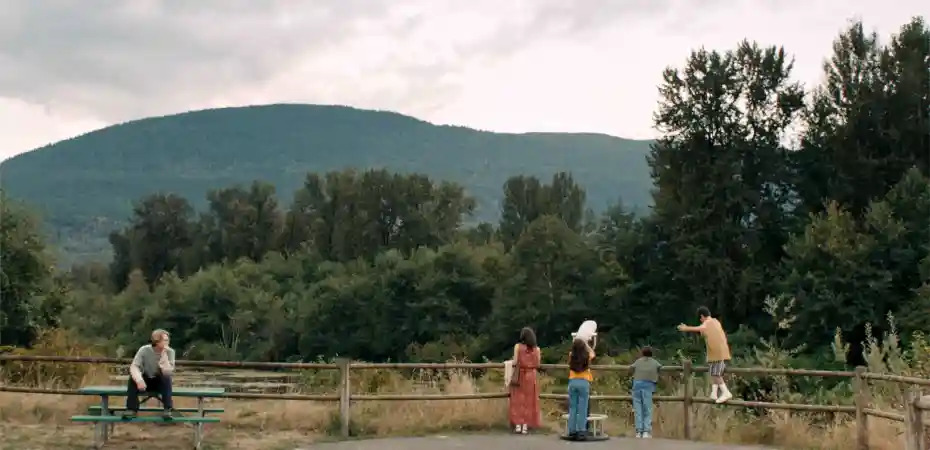

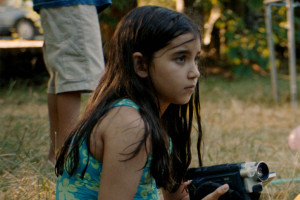
Blue Heron is a film that is formally daring and emotionally taxing. It is a work about memory and understanding, but it is not about answers or resolution as much as it is experience. Based on the life of its writer-director, Sophy Romvari the film centers itself around the story of Sasha, the only daughter of a Hungarian immigrant family that has settled on Vancouver Island. Sasha’s father is an artist, and her mother spends much of her time worried about her son from an earlier marriage, a boy of about fifteen or so, who has begun exhibiting disturbing behaviors.
Courtesy Janus Films
This is not a thriller, though it could have been. It is a memory play, and one in which the person recalling events does so imperfectly. Not to add mystery or to confuse the viewer, but rather because that is a reflection of real life. The film maker’s own memories of this period in her life are those of many children, aware of what is going on but not privy to most details. This does not mean the emotions and confusions are any less scarring or important. It is here, however, that the film is truly bold.
It takes about half the run time, but then the perspective shifts, and time jumps. At this point, all bets are off. Here, the lines between fiction and non-fiction blur, as elements of documentary enter the frame. To say more would be to spoil the experience and it is a film which, in its brief ninety-minute run time, is as much about that as anything else.
Courtesy Janus Films
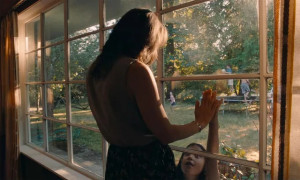
Romvari has proven herself an artist with a rare gift for wringing truth out of everyday occurrences, as well as a unique understanding of time and place. It may be early, but her rendering of Vancouver and the house where the film is largely set, is as vital to the film as anything in the works of Jane Campion. Her sense of how time and memory works could, with more evidence and exploration, place her with the likes of Linklater and Lynch. It may be only one feature, but this is a massively impressive first effort.
Eyul Guven, Iringo Reti and Amy Zimmer give a set of performances requiring a great deal of skill and depth. Each carries their part brilliantly, allowing the audience-and this is a testament to the writing and direction, as much as the actors themselves-to understand and care about their characters. Romvari gives her cast space to breathe, to exist and, therefore, to become real, which, of course, they were. Never forget, this is a very thinly disguised telling of Romvari’s family tale.
That earlier mentioned sense of space, where that family resides, is exquisitely shot by Maya Bankovic, a photographer who achieves an authentic immediacy quite rare in films. Many works would have opted for a certain distance, but here there is a lushness that never trips over into nostalgia. Except, of course, that nostalgia means pain from an old wound, and this film is about confronting, or at least understanding, as best one can, the traumas of a life. A fitting, unobtrusive score by Blitz/Berlin and sensitive editing from Kurt Walker round out the major technical and artistic notables here.
Courtesy Janus Films
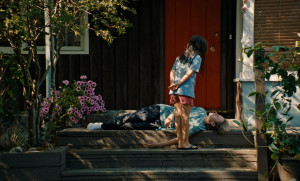
All, that is, except for Edik Beddoes, who plays the brother, Jeremy. His is a part that has few lines, yet he nevertheless anchors every scene in which he appears. There is something haunting about his eyes and his posture, which we as viewers grasp without having to be told. It is unnerving, yet we cannot help but want to find out more. That is a large part of the brilliance of this work. You will walk away being satisfied, perhaps drained but you will also want to know more, and not because the film lacks. Rather, it is because of how compelling a film you have just seen.
Blue Heron is now playing in select theaters.


A beautiful and passionate four-star review of a film my wife, son Samuel, and I saw last week in Manhattan. It may well be the best film of 2026, and I much enjoyed your marvelous insights!
Very moving film. Loved the way the director presented the story and the way it was shot. Audacious move half way through the film. Great performances. 3.5 of 4 stars
I will definitely check this out! Thanks for the review!