

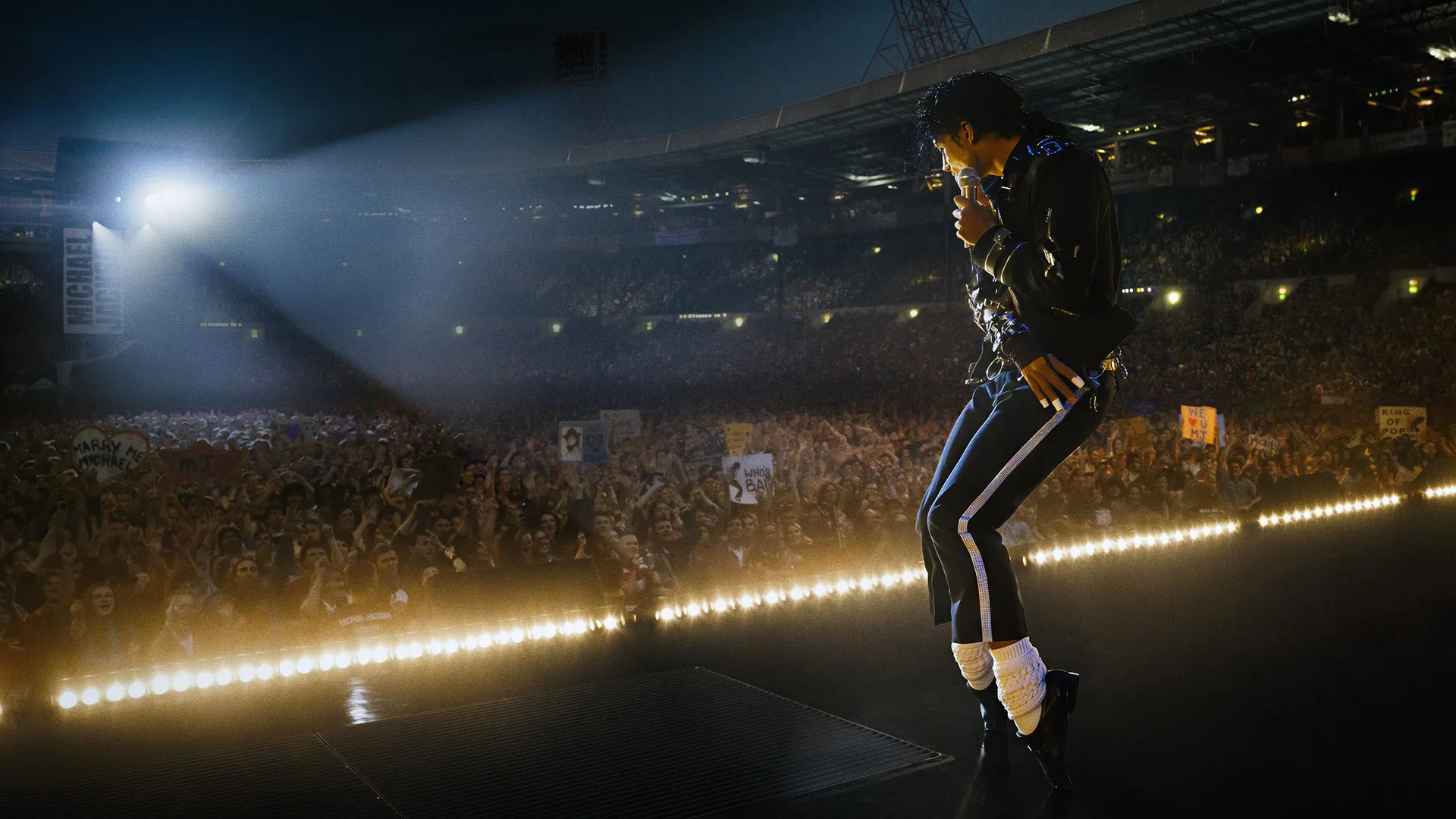

The Life and legacy of Michael Jackson has always been a daunting task to attempt to tell in a biopic setting. Jackson, the iconic King of Pop whose musical influence can still be felt to this day, dominated the face of music from the late 70’s throughout the 80’s and into the 90’s before allegations of child molestation hit in 1993. Although Jackson was never convicted and was found not guilty in several court cases, the scrutiny levelled against him continues to this day. What’s clear is that Jackson was indeed no ordinary talent and his life continues to be riddled with questions that will likely go unanswered for the remainder of time. Given the Jackson family estate’s notorious power in the industry and how close-guarded they are to retaining the integrity of Jackson’s legacy, it’s tough to imagine a true “warts-and-all” style biopic ever seeing the light of day. After many years in development, the film was announced some years ago with Training Day and The Equalizer director Antoine Fuqua at the helm. Yet, that hasn’t been the end of controversy surrounding the film’s subject. With an initial cut running somewhere around four hours, the film’s release was delayed amidst reports of a final act that covered the initial 1993 allegations that had to be entirely discarded over a legal oversight from the case’s settlement that prohibited the accuser or their story from being portrayed in a motion picture. Reports swirled around weeks of reshoots, a ballooning budget and a peeved director in Fuqua supposedly refused to deal with the Jackson estate, leaving Fuqua to direct from a van off set. Whatever chaos that stemmed from the production ultimately shouldn’t get in the way of seeing the final film as it stands. And in its final form, running at just over two hours, the Jackson biopic is unfortunately another shallow and surface level look into the life of its subject.
Courtesy Lionsgate
Directed by Antoine Fuqua, Michael is the type of “greatest hits” biopic that only touches on events and iconic moments from its subject’s life, but never seems interested in digging deep into Jackson’s mindset or what ultimately motivates him. Jaafar Jackson — Jermaine’s son — plays his late uncle, the iconic King of Pop Michael Jackson. Fuqua’s film opens with young Michael and his brothers who made up The Jackson 5 living in Gary, Indiana with their mother Katherine (Nia Long) and abusive manager/father Joe Jackson (Colman Domingo). The Jackson 5 are quickly assigned to Motown records where they instantly become a sensation, playing numerous television gigs, performing alongside Gladys Knight and shooting up to number one on the billboard music charts. As Michael’s stardom grows throughout the years, he wants to break free from his father’s clutches and go solo. Alongside legendary producer Quincy Jones (Kendrick Sampson), Michael would go on to release his debut solo album Off the Wall in 1979 before launching the biggest album of all time in 1982’s Thriller.
We’ve seen recent films buck the tired biopic formula with the likes of Rocketman, A Complete Unknown and Better Man all finding interesting angles into their depictions of their respective figures. Fuqua’s film, however, is as safe and as thin as they come. When telling the story of the larger-than-life Jackson, there needs to be some sort of hook or unique path into his story and Michael simply has no sense of dramatic stakes or even much of a story. The attempt to dramatically center the film around Jackson’s struggles with his abusive and controlling father doesn’t work as the script fails to develop this dynamic much beyond basic lip service. As a film centering around Michael Jackson, we’re never allowed to understand him as a person or what drives him beyond his desire to distance himself from his father. It’s implied, despite being well-known, that due to his stardom at such a young age Michael was never allowed to live a proper childhood, which led to him buying all different types of animals to live at his Neverland Ranch. Once again however, the audience isn’t given any insight into what this does to his psyche. Jaafar Jackson wonderfully succeeds at making Michael Jackson feel natural and human, even if the script fails to make him more two-dimensional than a wax sculpture. Jackson’s physicality is as on-point as one could hope, seamlessly disappearing into the role with poise and a strong presence that signals another strong talent in the Jackson family.
Courtesy Lionsgate
Colman Domingo makes the best of his material, which largely consists of snarling at his children and greedily forcing them to take whatever sell-out opportunity lands his way. Colman Domingo channels a sinister energy that eventually becomes Joe Jackson’s only defining trait. The film never stops to introduce any of the supporting players or give them any characterization apart from serving as a plot mechanic or to boost Jackson’s. Miles Teller’s entertainment lawyer John Branca shows up to immediately give Jackson the freedom he desires and that is the only thing we come to learn about him. Nia Long as Michael’s mother seemingly has the same scene of comforting her son and telling him how gifted he is four to five times over. Bubbles the Chimp, appearing as a crude CGI creation, is given more defining character traits than almost any other character in the film. Janet Jackson apparently doesn’t exist in this universe as she is never once mentioned or shown in the film.
The few moments of insight are short-lived, most notably the film’s best scene featuring Jackson inviting members from both the Crips and the Bloods gangs to join forces for the Beat It music video to inspire peace. As someone who grew up worshipping the Thriller music video, it is inherently fun seeing that shoot replicated on the big-screen, but even such an iconic moment in music history is portrayed as just another detour in Michael’s story. The music sequences are adequate whenever they’re not edited within an inch of themselves, but lack certain electricity that even Bohemian Rhapsody’ Live-Aid set piece was able to channel. Fuqua’s staging is largely bland with little artistic flair. Coverage is rarely exciting and much of the thrill from these sequences comes from Jaafar Jackson’s rather stellar work.
Courtesy Lionsgate
Michael is remarkably lacking in insight or depth into its portrayal of the King of Pop. This is a glorified puff piece that doesn’t even have the narrative backbone to make something of an emotional impact. Star Jaafar Jackson is dynamic and commanding as his late uncle, but the overall experience feels more like the Jackson estate attempting to keep the star’s legacy in tact and never shining a light on the man himself.
Michael is now playing in theaters.


I absolutely “ Loved it!! “ Jaffaar Jackson became his Uncle Michael right before our eyes, and every time there was a musical number I thought I was really looking at Michael Jackson. I was crying through many parts of the movie because of it. I also got a better sense of the pressure he was under mainly because of his father. Sure they didn’t cover everything but that was not their fault they had their hands tied legally. I firmly believe if they are able to make the sequel they will have more leeway to cover those issues. This is one of those times where I go by what the critics say, and I trust my own heart. I will be going back to see this again. I hope both Jaffaar Jackson and Colman Domingo receive Oscar Nominations for this along with Nia Long. They were fantastic!! To everyone who worked on this movie. Thank you for bringing Michael back. This is something we needed.
There were a lot of inaccuracies in the film. For what it was, it was good. The Jackson 5 mini- series back in 93 was the true bio about the family. This one was at least better than the Tupac movie they did back in 2017.
Liked the music and thought performances by young and old Michael and Colman Domingo as the father were top notch. But the whitewashing of the pervert and his life are quite incredible. And where was Janet? 2.5/of 4 stars