

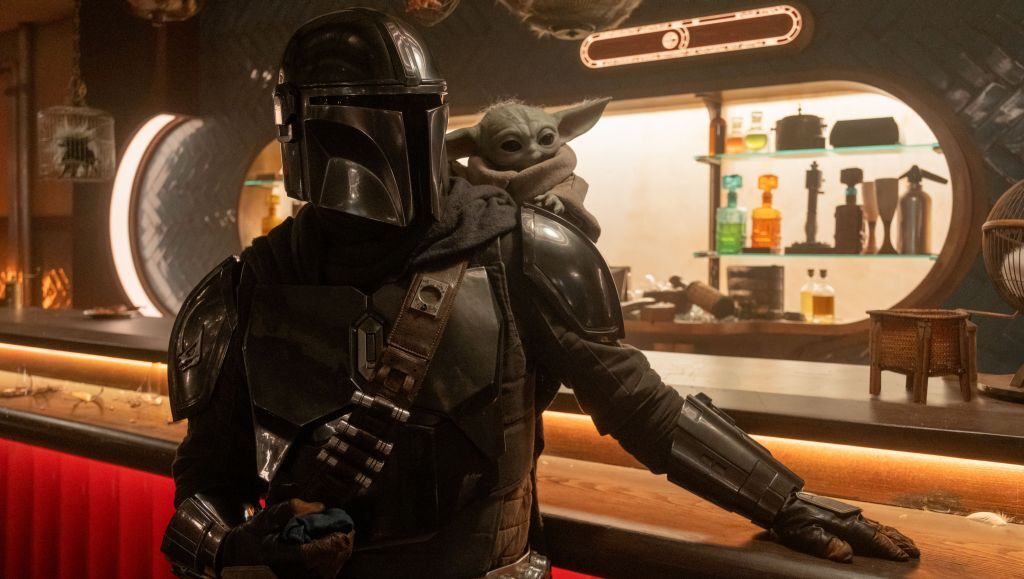

The fourth anthology film in the Star Wars saga from co-writer/director Jon Favreau and co-writer Dave Filoni, The Mandalorian and Grogu certainly carries on the spirit of the hit Disney+ series. It is spectacular in its first hour, but the second half grows exhausting, disconnected, and mechanical.
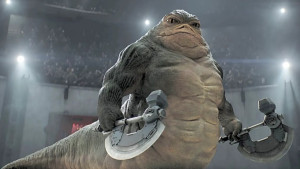
Pedro Pascal reprises his iconic role as Din Djarin, who continues his work as a bounty hunter for the New Republic under Colonel Ward (Sigourney Weaver). Ward tasks Djarin with visiting the Hutt Twins—relatives and successors to Jabba the Hutt—who offer the New Republic a high-stakes deal: they will reveal the location of a dangerous, uncaptured Imperial remnant leader, Admiral Coin (Jonny Coyne), if the Republic rescues Jabba’s son, Rotta the Hutt (voiced by Jeremy Allen White). Rotta is being held by a ruthless crime syndicate, forced to fight in a gladiator-style pit where a black-market dealer named Janu reaps massive profits off the brawls.
Courtesy Lucasfilm
Djarin tracks Rotta’s whereabouts by extracting some reluctant information from a sushi truck cook named Hugo (voiced by Martin Scorsese). When Djarin locates the cell, he attempts to persuade the captive to leave, only to discover that Rotta has developed a form of Stockholm syndrome; he refuses to go, preferring his new life as a celebrated gladiator. Janu soon informs Djarin that Rotta’s next match is actually a planned public execution. Before he can react, Djarin is captured and forced into the arena to fight Rotta himself. Djarin defeats the young Hutt but refuses to execute him. In retaliation, Janu unleashes a wave of deadly monsters and creatures, forcing Djarin and Rotta to fight side by side in a desperate attempt to escape.
The plot thickens once Djarin and Rotta escape, with Rotta revealing that Janu and Admiral Coin are actually the same person, using the arena’s black-market profits to fund his Imperial remnant faction. Rotta further explains that his aunt and uncle, the Hutt Twins, only want him back so they can assassinate him and seize complete control of the Hutt Cartel. When Djarin alters his route to protect the young Hutt, the furious Twins hire bounty hunter Embo to ambush them, capturing Mando and Rotta and expediting them to Nal Hutta. This leaves a rogue Grogu to track them down, shifting from the protected to the protector. When a severely wounded Djarin is forced into a pit to face a massive Dragonsnake, Grogu assists him, using the Force to break him out and heal his life-threatening injuries.
Courtesy Lucasfilm
The moments involving Djarin and Grogu are genuinely endearing. It is commanding how Favreau and Filoni utilize puppetry to convey character; Grogu never speaks a word of dialogue, yet everything is captured in his expressions. However, while the first hour is astonishing and offers plenty to enjoy, the final act derails. The film ultimately feels like two separate episodes stitched together, with a significantly stronger first half that leaves the narrative with no real emotional reward. The second hour grows tedious as Djarin is left battling an endless barrage of creatures. The Mandalorian and Grogu would have been far more successful had it stayed focused on the tension of the rescue mission, rather than retreating back to the familiar machinations of the Hutts.
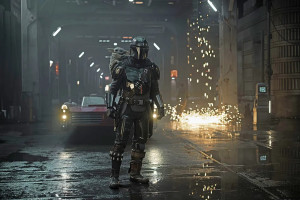
This approach leaves the narrative feeling unstructured and unrounded. While it offers some classic space-opera spectacle as Djarin and Grogu battle their way through the treacherous conditions of Nal Hutta, the story is far more compelling on Shakari, which boasts the conceptual beauty of Blade Runner. By contrast, the muddy jungles of Nal Hutta add very little visual flair, ultimately stalling both the aesthetic momentum and the narrative pace.
Courtesy Lucasfilm
Overall, Grogu and Rotta are the best elements of the film. The voice work of Jeremy Allen White brings a “gentle giant” quality to the character, and it is refreshing to see a Hutt framed as a hero rather than a villain. Rotta refuses to live in his father’s shadow, bonding beautifully with Grogu while fostering a compelling dynamic with Djarin. There is plenty of high-octane excitement early on, with Jon Favreau staging the initial set-pieces with precision and care. However, once the second hour kicks in, the pacing and energy derail as the narrative begins hitting the exact same beats and notes.
While Favreau has crafted successful adaptations of major pop-culture properties before—including The Jungle Book, Iron Man, and The Mandalorian series itself—and clearly shows a deep care and affection for this world, The Mandalorian and Grogu ultimately plays out like a bloated television arc. It feels like two or three episodes awkwardly stitched together into one long feature, where only the first segment impresses and the rest feel like mere time-fillers. Sadly, the Force just isn’t quite with this one.
Star Wars: The Mandalorian and Grogu is now playing in theaters.



Can we…just…be done? Star Wars, Marvel, DC, franchises. Not show 60 screenings of the same three movies a day per theatre?
Overall it was an adventure and it was mostly fun. The puppetry was amazing and I am glad to see it in film again, some of the best gems are those campy 80’s movies with puppetry. Grogu steals the screen every time. I felt as a fan of the show that they should have had Grogu scout it and then go get recon in Navarro from the other Mandalorians who settled there. Bo Katan one of my favorites from the show should also have been a part of the rescue operation. It would have been nice to see where the people of Mandalore, a peak in on Paz’s son, the armorer something with the characters we grew to enjoy on the show. Did Cob Vanth really die? What about Cad Vane? I felt like if you watched the show there are elements that it could have brought in. I do realize it was Grogu as Din’s apprentice. I hope that if they continue the series we see his growth. He for shook the Jedi path with Luke for the way. I want to see him through to the end when he can recite the creed and be not only the cute baby but the kick but Jedi/Mandalorian he will be.
My son whose 10 loved the show and movie parts of Grogu and Din together reminded him of how he and his dad are sometimes and that means a lot to a kid. Series like this build new fans. I am glad to see Star Wars looking at more than just Jedi/Sith.
We loved Clone Wars. If you have not watched that definitely give it a go. When we watched Revenge of the Sith so many pieces clicked as we watched it.
A very enjoayble film in the Star Wars universe. Great action scene. Interesting characters. And don’t forget Martin Scorsese is in the film. 3.5 of 4 stars