

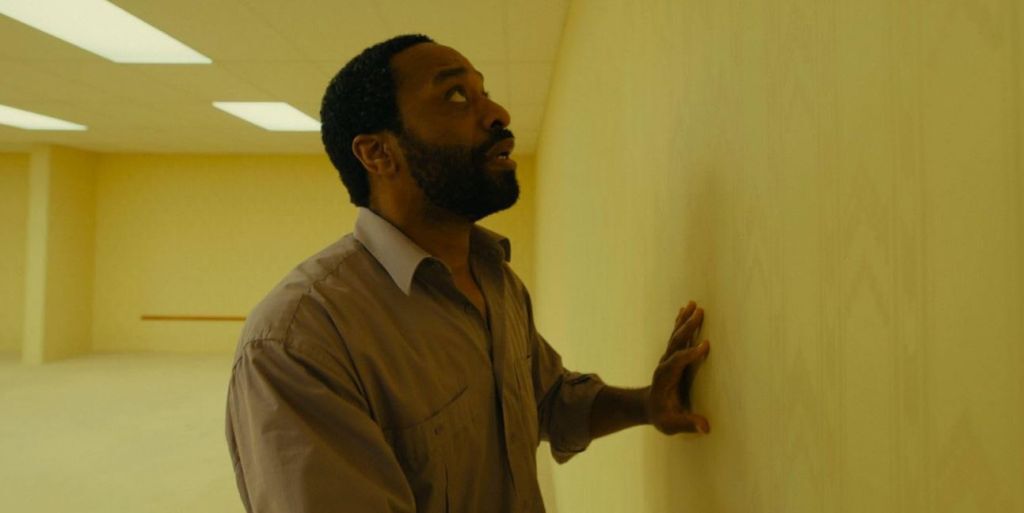

In the words of Clémence Poséy’s mysterious Barbara in Christopher Nolan’s Tenet, “don’t try to understand it, feel it”; the only sentiment I can think of to anyone not familiar with the lore of Backrooms. The debut feature from 21-year-old filmmaker Kane Parsons is an adaptation of a series of YouTube videos Parsons made after a viral creepypasta blew up online around 2019. Parsons’ videos have amassed hundreds of millions of views since his first video in 2022, which he made himself at just 17 years of age. These videos took viewers inside an abyss of unsettling and sterile series of liminal spaces with little context as to where they came from or who made them. Parsons’ videos helped create a shared universe among fans who have since turned the creepypasta into DIY video games, discord servers and fan wikis. Now, with the backing of A24 and producer/once wunderkind of horror James Wan, Parsons has adapted his viral videos into a feature length film. The film, starring two Oscar-nominees at the height of their powers, exists in a sparse, disquieting space somewhere between Skinamarink and The Blair Witch Project.
Courtesy A24
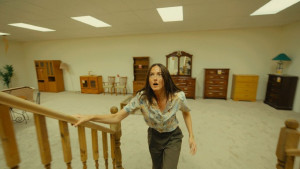
Set in 1990, Clark (Chiwetel Ejiofor) is the stubborn, bitter owner of Capt’n Clark’s Ottoman Empire furniture store. Struggling with an alcohol addiction and a recent divorce that he can’t seem to get over, Clark’s only window of openness comes from his discussions with his therapist Mary (Renate Reinsve). One day, as Clark wanders into the basement of his furniture store, he sees what appears to be a crack in a wall that turns out to be the door to an alternate dimension; Platform 9 3/4 this is not. On the other side exists the Backrooms, a dimension far beyond our reality that is seemingly never-ending and shrouded in wet, odorous-looking carpets, mono-yellow walls and lit with nauseating fluorescent bulbs. When Clark disappears alongside his two employees, Bobby (Finn Bennett) and Kat (Lukita Maxwell), Mary decides to enter the furniture store to look for Clark, only to find herself trapped in the terrifying labyrinth of liminal spaces and the overwhelming fear of the unknowable.
Directed by Kane Parsons, Backrooms is quite the feat for a debut filmmaker. No longer confined to the limitations of Blender software and operating under a (relatively) handsome studio budget, Parsons is able to expand upon his initial vision, displaying a genuine knack for world-building, tonal precision and crafting some downright unforgettable imagery. Despite comparisons to the work of Charlie Kaufman, David Lynch and a number of video games, most notably Portal 1 & 2, Parsons excels at making his debut feature distinctly unique and singular in its approach to abject horror. That isn’t to say Parsons’ film doesn’t directly borrow elements from previous films, it surely does. Backrooms is rather Lynchian in a more subtle fashion, both in its abstract concepts of horror and in the burning-hole-in-the-pit-of-your-stomach style sense of lingering dread. There’s a permeating melancholy that haunts, not just the film, but the characters in the film.
The script, penned by Ash vs Evil Dead scribe Will Soodik, is precise with its exposition, giving audiences just enough of an idea of the hellscape the characters are trapped in without over-explaining things. This allows the audience to also use the many metaphors at hand to guide them through a rather unexplainable nightmare realm. Are these Backrooms a metaphor for the barriers people put up in their psyche to block out their most traumatic memories? Are they representative of the inability to upend a stagnant lifestyle? Are they manifestations of fractured memories and the degradation of nostalgia? Or do they represent all of the above? The material shows a surprising level of emotional maturity from its young auteur filmmaker.
Courtesy A24
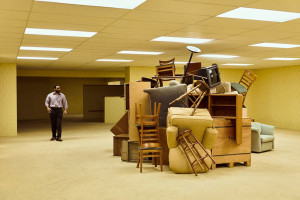
The film would not work as well as it does without the impeccable production design from regular Osgood Perkins collaborator Danny Vermette. The endless abyss of fractured architecture, furniture and partitions is downright mesmerizing to behold. Aided by Jeremy Cox’s enchanting cinematography, the craftsmanship on display in Backrooms helps create an uncanny sense of discomfort from the very first frame. The opening sequence puts the audience in a disorienting state of mind that doesn’t dissipate until after the credits have rolled. The more traditional scare sequences tend to feel like anxiety-relievers as the dread that Parsons and his team conjures up is simply rattling.
Where Backrooms comes up short is in its characterizations, which don’t feel as fully-sketched as they likely could have been. Clark’s recent life woes are all that plague him, but the audience doesn’t get a sense of the man he was before his divorce renders him resentful. Mary grew up in an abusive upbringing, living with an agoraphobic mother who forbade her to ever leave her home, forcing her to live in her own dungeon of sameness. These characters and their attraction to the Backrooms all fit thematically, but the characters themselves lack a specific definition that prevents the film from fully engaging in their deeper psychology.
Courtesy A24
Backrooms is a distinctly unnerving and vividly-imagined debut feature from director Kane Parsons. While its deeper glimpse into the psychology of its characters leaves a bit to be desired, Parsons shows a gifted ability in orchestrating tone, unsettling imagery and filmmaking prowess together to create a singular fusion of genre cinema. This is the kind of horror that worms its way into your subconscious and doesn’t leave easily.
Backrooms is now playing in theaters.



I’m unsettled just reading the review! I hope to get to the theater to see this one. Great review that makes me more interested to see this film than I was before reading it.
Really looking forward to this one