

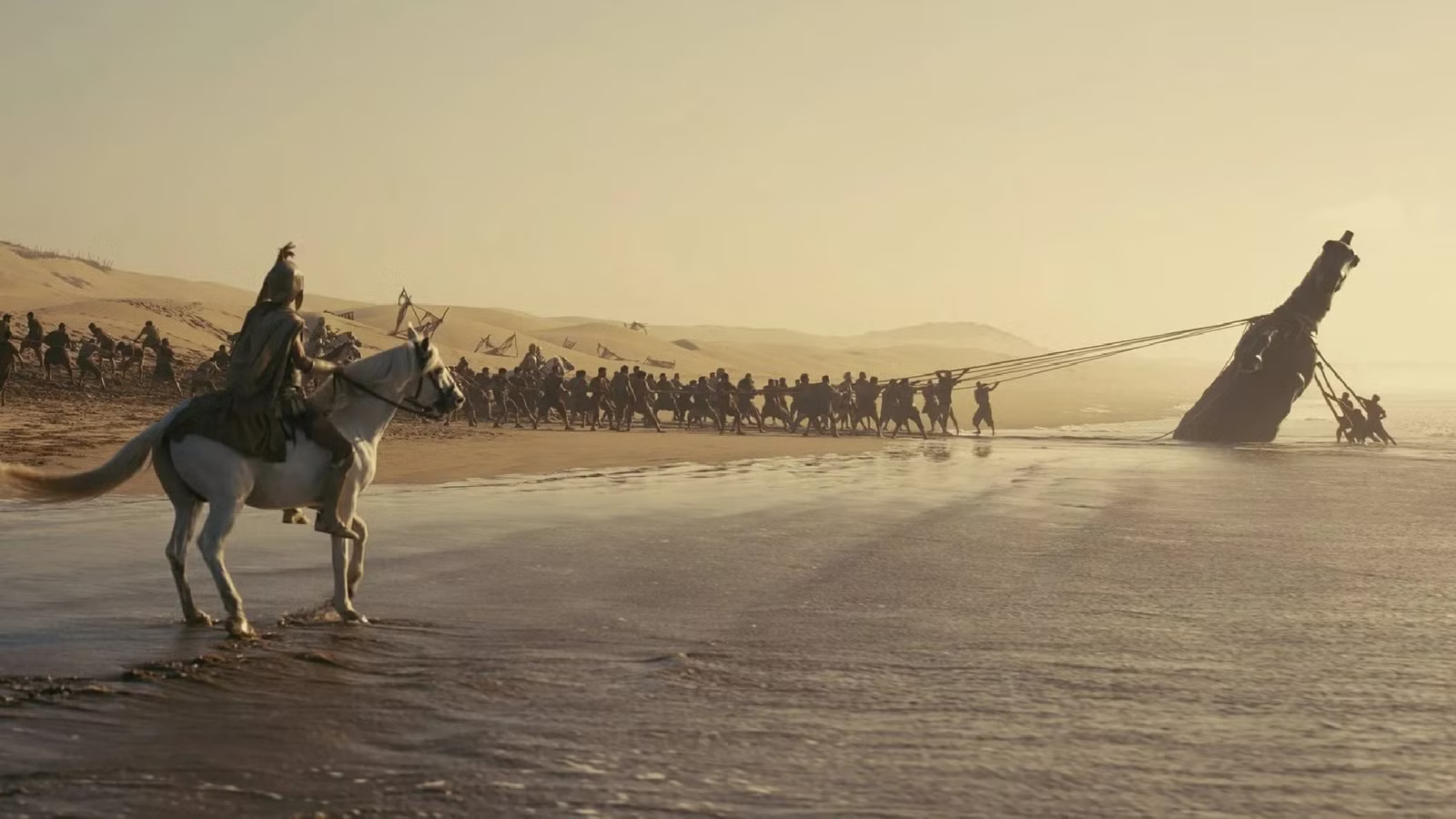

After finally winning his Oscar for Best Director and Best Picture for his near-billion-dollar grossing Oppenheimer, filmmaking titan Christopher Nolan returns with his most ambitious endeavour yet. Nolan, who has become this generation’s most eclectic filmmaker in regards to balancing blockbuster scale with complex, intricate themes often regarding time and destructive obsessions, cashes in his blank check, adapting Homer’s epic poem on a grand scale that modern Hollywood never sees anymore. His latest production is a staggering, extraordinary achievement that further cements Nolan as this generation’s boldest, most audacious filmmaker.
Courtesy Universal
In a time of apparent magic, the memory of King Odysseus (Matt Damon) lingers throughout his Kingdom of Ithaca. Having been gone from home for 20 years since leaving for the Trojan War, Odysseus’ wife Penelope (Anne Hathaway) and his son Telemachus (Tom Holland) are left to wonder if their king will ever make it back. Ithaca is now flooded with frustrated potential suitors attempting to marry Penelope, including Antinous (Robert Pattinson) and Polybus (Corey Hawkins). Telemachus, almost of age to take the throne, wonders if he’ll ever reunite with his father, leading him on a quest to find him. Meanwhile, Odysseus’ journey home has been intercepted by encounters with gods, monsters and witches, leaving him stranded in purgatory eating white lotus flowers alongside Calypso (a bewitching, but rigid Charlize Theron), while he attempts to regain his memory and finish crossing the seas to return home to his kingdom.
Nolan’s take on The Odyssey is by far the most gargantuan and epic undertaking of the Oscar-winning filmmaker’s career thus far. In many ways, this feels like the gradual culmination of Nolan’s entire filmography, even feeling like a companion piece of sorts to Oppenheimer. Odysseus — like Oppenheimer — is tortured by the guilt of his creation; in this case, the Trojan Horse. What was accepted under the false pretense of a peace offering, the Trojan Horse might have won them the war, but this also broke Zeus’ law, ushering in a furious wrath of the gods that subsequently robs Odysseus of time and his trusted crew as well. Odysseus is a man plagued by the horrors of war and the ensuing torment that comes with its cost. The Odyssey is a spectacular showcase of Nolan’s unrivaled ability to craft tense, gob-smacking sequences of action and mythic quests, but its sense of spectacle is deeply masked in terror and haunting visions of chaos.
There has been a great deal of focus spent on Nolan’s decision to shoot the entire film on 70mm Imax (alongside longtime cinematographer Hoyte van Hoytema), which lends the film to an even more immersive and tactile experience. While there isn’t a way to see this film that won’t be sweeping in its own right, the 70mm Imax presentation does give Nolan’s epic a larger-than-life quality that only enriches his massive vision. The filmmaker’s sprawling scope is so vast and consistently staggering that it manages to echo David Lean’s Lawrence of Arabia and the sublime locations recall the treacherous, earthy quality of Werner Herzog’s Aguirre, the Wrath of God. Even if Nolan’s usual sense of narrative momentum is occasionally stunted, The Odyssey features some of the filmmaker’s most immediately striking imagery. The shot of the Trojan Horse sinking into the sand is the kind of cinematic frame you can feel in your chest. The tense Laestrygonians battle contains more than a dozen moments of “how on earth did they do that?”, while the Cyclops sequence is entirely breathless in its methodical pacing and slow-creeping sense of dread. Borrowing equally from the likes of Guillermo Del Toro and Ray Harryhausen, this set piece is simply stunning, featuring as strong a mix of practical puppeteering, make-up, miniatures and digital effects work as you’re going to see all year. Samantha Morton is downright chilling as Circe, the vengeful witch who puts a spell on Odysseus’ crew. Nolan showcases a remarkably unsettling knack for horror here, blending a fairy tale sense of childlike horror akin to Roald Dahl and the queasy, goopy body horror similar to the work of Brian Yuzna. Yet it’s Morton’s performance that makes this sequence even more upsetting and effective.
Courtesy Universal
Nolan assembles such an array of cast members, he hardly has room to fit them all in. Matt Damon is exquisite as Odysseus, who is compelling as both a grizzled soldier attempting to come home and as a man reckoning with invoking the wrath of the gods and the decisions he’s had to make during and after the war. Damon and his fellow cast members clearly went through hell making this film and those physically-demanding challenges pay off. It’s not the showiest role Damon has ever had, but it’s certainly one of his richest and most layered. Anne Hathaway — whose Penelope is often hidden behind tapestries and weavings (Ruth De Jong’s production design is just immaculate), giving her a towering presence — brings a palpable intensity to the character. Robert Pattinson is having a blast channeling his inner Alan Rickman from Robin Hood: Prince of Thieves as the thoroughly sniveling asshole suitor that is Antinous. Key supporting roles that make sizable impressions include Odysseus’ loyal hand Eumaeus, played with wisdom and soul by John Leguizamo and Himesh Patel as Odysseus’ right-hand man, Eurylochus. Elliot Page is wrenching in a nightmarish scene set in Hades where his fallen Sinon emerges from the black sand and confronts Odysseus for leaving him to die. However, gifted actors such as Zendaya, Mia Goth, Lupita Nyong’o and Benny Safdie struggle to make much of an impression given the vast narrative.
Nolan opens the film with the words of a bard played by rapper Travis Scott, who previously contributed to the soundtrack of 2020’s Tenet, singing the song of Odysseus and the Trojan Horse. The filmmaker reaffirms the idea that this is yet another story passed down from generation to generation, even shifting narrators for large sections of the film. These different recollections change perspective as does Ludwig Goransson’s overwhelming score, which continuously evolves beyond its thunderous war drums to eerie synths and classical string and wood instruments. The film’s opening reel is surprisingly choppy for a Nolan film, one that’s also cut by Tenet and Oppenheimer editor Jennifer Lame. Thankfully, the disorientation settles down once Odysseus and his men reach the cave of the Cyclops. The final act wonderfully ties together the film’s many themes and payoffs, resulting in a satisfying conclusion, but one that doesn’t quite hit the emotional register it flirts with in previous standout sequences.
Courtesy Universal
The Odyssey is Christopher Nolan’s most epic film to date, but it’s also his massive, gargantuan anti-war cry. If Nolan’s Dark Knight trilogy was a mythic tale of heroism set in modern times, his adaptation of Homer’s poem uses the 3,000-year-old mythic text as a parable for today’s ongoing cycle of violence. A somber tale about the loss of time and a firmly disquieting rumination on the lingering effects of war, Nolan’s latest is extraordinary in both scope and scale, and textured in its display of melancholy and torment.
The Odyssey is now playing in theaters.


This movie deserves 4 stars! It is Christopher Nolan’s best!