

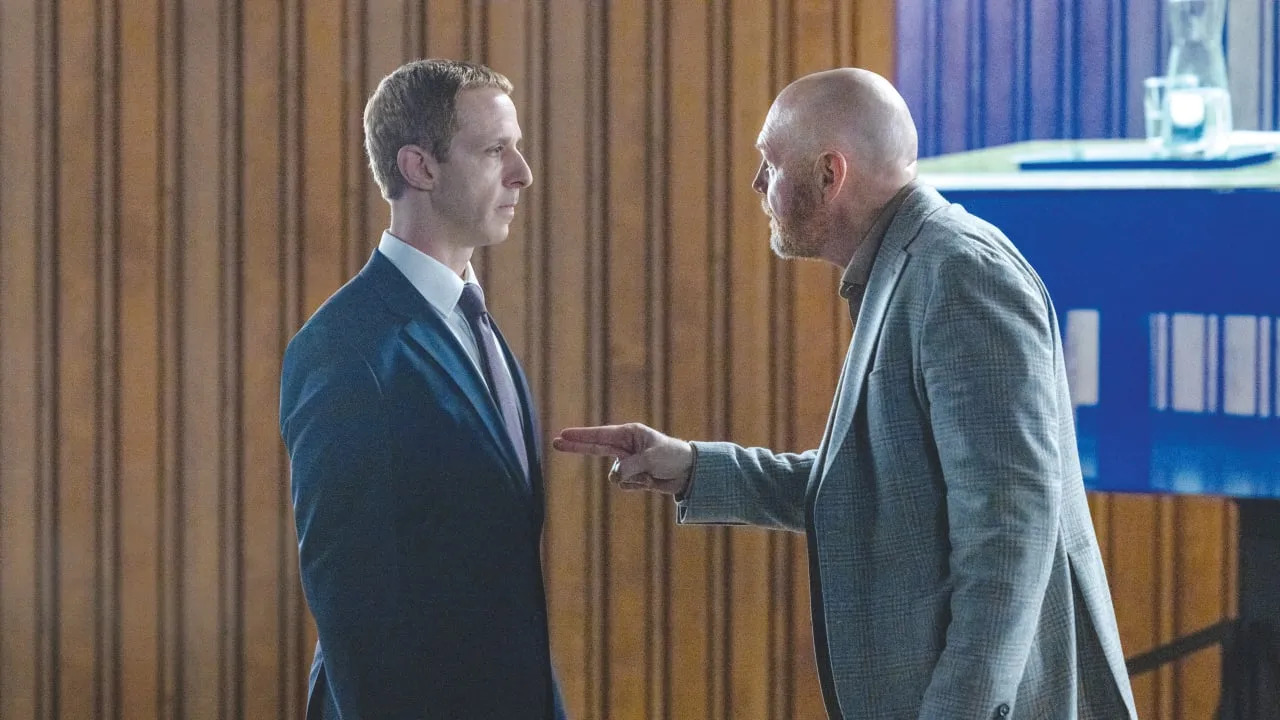

Sixteen years after The Social Network—the undisputed masterpiece that dissected Mark Zuckerberg, Facebook’s origins, and the treacherous deceptions behind the social media giant as Aaron Sorkin returns to the same terrain with The Social Reckoning, but with far less impressive results. Where David Fincher’s masterful 2010 film succeeded was in its deep humanism and subtle nuances, exposing Zuckerberg’s flaws in a way that made him a fascinatingly flawed individual rather than a mere caricature. In The Social Reckoning, that humanity is completely drained away. Sorkin presents a film made almost entirely of abstract ideas rather than real characters, reducing everyone on screen to one-dimensional postures for the modern political discourse.

Courtesy Sony
The film stands as Sorkin at his worst, indulging in over-written, showy dialogue without the steadying hand of a visionary director to balance it out. Fincher’s elegant craftsmanship in the original film allowed Sorkin’s rapid-fire words to breathe and permitted the characters to remain fully realized humans while maintaining a distinct visual style. Here, Sorkin attempts to imitate that cinematic slickness himself, but the end result feels visually flat, taking on the tone and aesthetic of a glorified television movie. The dialogue feels overly verbose and self-satisfied, lacking the thematic weight that defined his earlier work.
The cast, despite boasting incredible talent, suffers immensely under this approach. Mikey Madison, who previously delivered brilliant work in Anora, is entirely flattened here as computer scientist and whistleblower character Maya Lin. She never breaks through into three-dimensional territory, coming off merely as a archetype of an overly sophisticated, high-principled tech nerd with whom the audience never truly connects. Her dynamic with Jeremy Allen White, playing aggressive investigative reporter Dan McCraw, fares no better; their professional and personal relationship never fully comes to fruition or generates any real dynamic spark.
Courtesy Sony
Even Jeremy Strong, an actor capable of extraordinary depth, falls victim to the script’s rigid limitations in his portrayal of Mark Zuckerberg. Whereas Jesse Eisenberg brought dramatic humanism, vulnerability, and sharp nuance to Zuckerberg back in 2010, Strong is forced to play him as a lifeless, monotone robot.
The plot itself begins with a sequence that briefly promises a much more intense thriller than what actually follows. In a chillingly effective opening sequence, we see a young woman that is revealed to be a friend of Maya Lina finding herself interrogated by police authorities and masterfully gaslights the officers with an unsettling, calm precision to protect her data trove. It is a moment of genuine suspense and terrifying technical paranoia that sets an exceedingly high bar for the rest of the story. Unfortunately, that early dramatic momentum is never reached again, as the narrative quickly devolves into endless boardroom arguments and ideological posturing, abandoning the high-stakes tension established in those opening minutes.
As the central narrative attempts to tackle Facebook’s real-world impact on American democracy, the storytelling grows increasingly heavy-handed and visually uninspired. Nowhere is this failure more evident than in the film’s climactic depiction of the January 6th Capitol insurrection. Rather than capturing the chaos, terror, or psychological weight of the event, the sequence falls completely flat. The entire staging feels cheap and staged, resembling dramatic re-enactments from a low-budget History Channel special rather than a major cinematic work.
By failing to build on its terrifying opening or ground its major political set-pieces in authentic human drama, the film loses any sense of narrative urgency. Sorkin spends so much time explaining the mechanics of online disinformation that he forgets to make the consequences feel real to the audience. What could have been a sharp, kinetic thriller about the collapse of digital truth instead settles into a stagnant, lecture-heavy exercise that never recovers the thrilling promise of its first scene.
Courtesy Sony
Ultimately, The Social Reckoning feels surprisingly lazy in its execution. Sorkin structures the narrative into rigid thematic chapters, creating a heavy-handed debate piece about laissez-faire speech policies, corporate disinformation, and democratic decay rather than a compelling drama. By prioritizing political grandstanding over genuine human storytelling, the film forfeits the artistry that made its predecessor an enduring classic.
The Social Reckoning is now playing in theaters.



Leave A Comment