

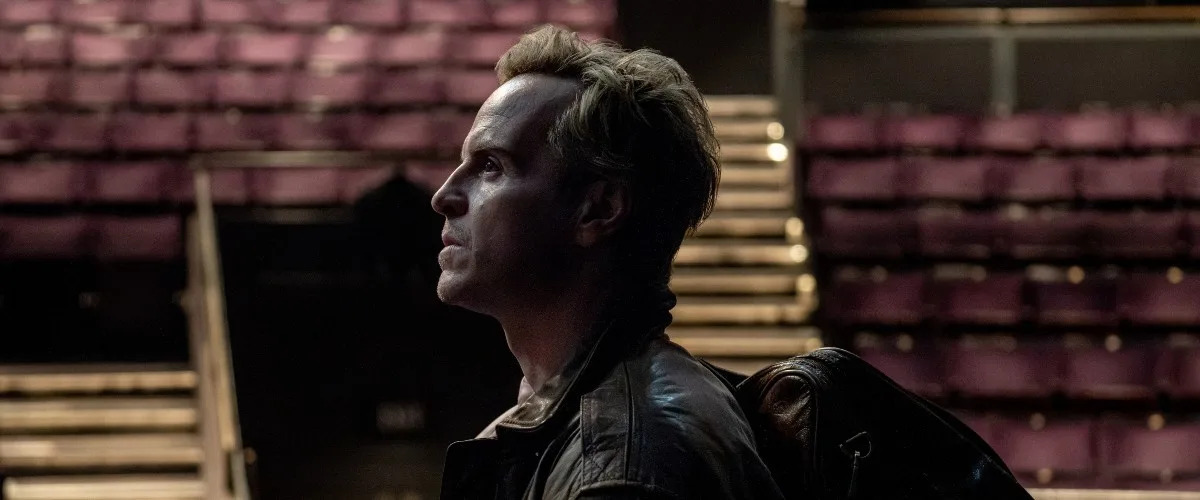

The actor, Ian Charleson, was forty years old when he died of complications from AIDS. He had a career in film and on stage stretching nearly twenty years. His most notable film role was Charles Lidell, in Chariots of Fire, but his final role, and the central drama in Elsinore, was that of Hamlet, which he performed at the National Theatre in London. As Charleson, Andrew Scott gives a searing, touching turn as a man who simply wants one thing, and really, only needs one thing, in order to feel alive.
Courtesy Focus Features
Indeed, that is the point, in many ways, of this film, directed by Simon Stone and written by Stephen Bereseford. Art can heal but it can also propel. Art is something which many may not understand the ways it drives those that create and participate. Art, be it painting, music, dance, acting, writing or any other number of things, is often as much a compulsion and need as anything else. Take away an actor’s stage and audience, or do the same with a writer’s pages and readers, and you will create misery. The tension in this film, therefore, is finding a way to not lose what means most to you when doing that means losing everything else.
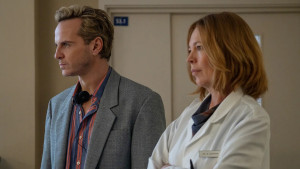
This is because, as doctor Margaret Johnson, played by Olivia Colman tells Ian, doing this is not conducive to living long. Given that Hamlet, a role Ian has long coveted, has finally become his, on the biggest stage in the world of classical theatre, Ian is disinclined to give up his once in a lifetime opportunity. He had, you see, become disenchanted with his career. And so, as the film begins, he is at an emotional and physical low.
Courtesy Focus Features
This is a film where emotions and especially desires, play a central role. Much like the play Charleson finds himself cast in, the film deals with issues of betrayal, death and grief, as well as the ways we convince ourselves things will be better, if only to keep on moving. Stone uses a lot of montage to convey the passage of time, the preparation of Hamlet and the clinical care Ian undergoes. Yet, he and Beresford never forget that this is about real people.
The entire cast does tremendous work. Even those with smaller parts, Georgie Glen and Peter Mullan, who play Ian’s parents. There is a scene with those two and another, who says something incredible about their child, which quite moved this reviewer. To say more would be to spoil the effect but the way the scene is shot, and the way the actors underplay the words in order to maximize the emotions, is nothing short of brilliant.
Of course, the film would not be what it is without Scott, and Colman. Scott, who has proven himself a major talent since before he appeared on Sherlock, seems like Charleson, to have been leading up to this. It is the sort of career defining performance, full of blood, sweat, tears and humanity, that come along very seldom, except when you are in the presence of someone who is as obviously talented and confident in their abilities as Scott. In the interactions with Colman, the two actors perform a sort of ballet where you, the viewer, come to understand and empathize with both sides of their debate, and to fully understand where each is coming from.
Courtesy Focus Features
Here, there are no villains. Only the harsh realities of a devastating plague, which we get to see in the rooms of a clinic, and among Ian’s friends and compatriots also dying from the virus, including the director Derek Jarman. As Ian’s best friend, Billie Piper is nearly unrecognizable in becoming a brassy, sassy casting director who refuses to give up on someone she loves. Indeed, that might be the other message of the film: The enduring power of love, both in motivating us to do things and in allowing us to continue. To say more would be to spoil the effect. Just see this one.
Elsinore is now playing in select theaters.

Leave A Comment