

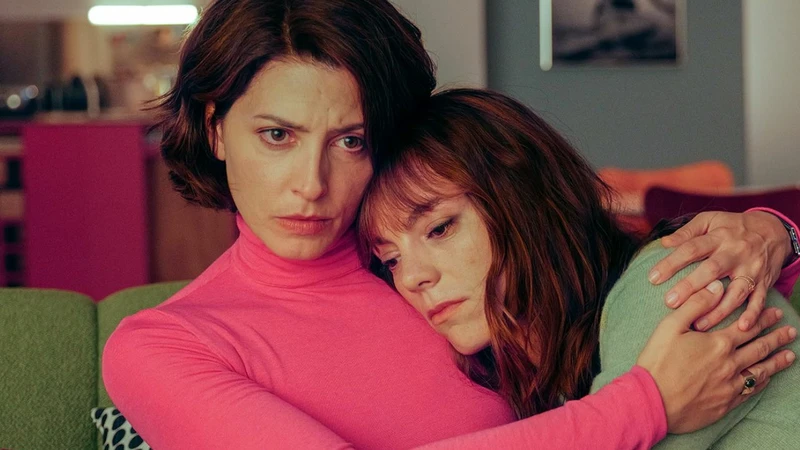

Pedro Almodóvar has always had an impressive career of making meta films that are a reflection of narrative filmmaking and artistry. He has executed this approach before with brilliant results in Broken Embraces and Bad Education, and he achieved solid results with Pain and Glory, which felt a little overpraised but remained well-acted and deeply personal, nonetheless. Now we have Bitter Christmas, which plays into similar themes with noticeably lesser results. For all of its structural ambition, the film is genuinely disappointing and dramatically inert. It proves remarkably difficult to get engaged emotionally with the material because the storytelling feels scattered and perfunctory, keeping the viewer at a clinical distance rather than pulling them into a lived-in human drama.
The narrative begins in Madrid during the December holiday weekend of 2004, centering on Elsa (Bárbara Lennie), a commercial director who has made only two independent feature films that earned modest critical praise without commercial success. Suffering from debilitating migraines and reeling from her mother’s death, Elsa is caught in a personal and creative crisis. Her primary anchor is her boyfriend Bonifacio (Patrick Criado), a sensitive firefighter and stripper whose presence highlights a quiet disconnect between Elsa’s self-absorbed artistic turmoil and his grounded affection. Seeking escape from her grief, Elsa travels to the volcanic landscapes of Lanzarote with her friend Patricia (Victoria Luengo), leaving Bonifacio behind in Madrid while she crosses paths with Natalia (Milena Smit), a troubled woman whose sudden suicide attempt forces Elsa to confront an emergency outside her own head.
Almodóvar then reveals that Elsa’s entire 2004 ordeal is actually a screenplay being typed out in the modern day by Raúl (Leonardo Sbaraglia), a veteran film director struggling to write his way out of a creative block. In the contemporary timeline, Raúl lives with his partner Santi (Quim Gutiérrez) while navigating a fallout with his longtime assistant and friend Mónica (Aitana Sánchez-Gijón). After Mónica resigns to care for a friend whose young son is gravely ill, Raúl shamelessly mines her real-life heartache and personal struggles to construct Elsa’s fictional narrative, turning Elsa into a hybridized avatar for both himself and Mónica.
 Courtesy Sony Pictures Classic
The intertwining of these two timelines is meant to spark a charged debate over the ethics of autofiction and the parasitic nature of mining real people’s pain for art, culminating in a sharp confrontation when Mónica discovers how Raúl has repurposed her life. Yet even with this layered framing and the clever transitions linking Raúl’s keyboard to Elsa’s scenes, the film fails to generate real emotional resonance. The meta-textual commentary on where reality ends and fiction begins feels well-worn, covering ground that numerous independent films and and Almodóvar’s own earlier work which have explored with far greater urgency and psychological bite. Rather than feeling vital or revealing, the parallel structure ends up making both timelines feel strangely weightless and emotionally flat.
Visually, the movie remains vibrant and radiant with color, boasting the unmistakable compositional polish and rich cinematography you expect from Almodóvar. However, the writing comes across as distinctly second-tier, cementing this as a minor entry in his filmography. Almodóvar even includes a self-aware joke in the dialogue about how Federico Fellini and Ingmar Bergman made lesser films late in their careers, a playful wink that turns into a sobering reality as the movie unfolds. That misstep feels especially surprising considering he just delivered two exceptional features back-to-back with The Room Next Door, a deeply underrated work that deservedly stood among the finest films of its year, and Parallel Mothers, one of the standout triumphs of 2021. With Bitter Christmas, Almodóvar takes a noticeable step backwards, and one can only hope he finds his footing again on his next project.
Bitter Christmas is now playing in limited theaters



Leave A Comment