

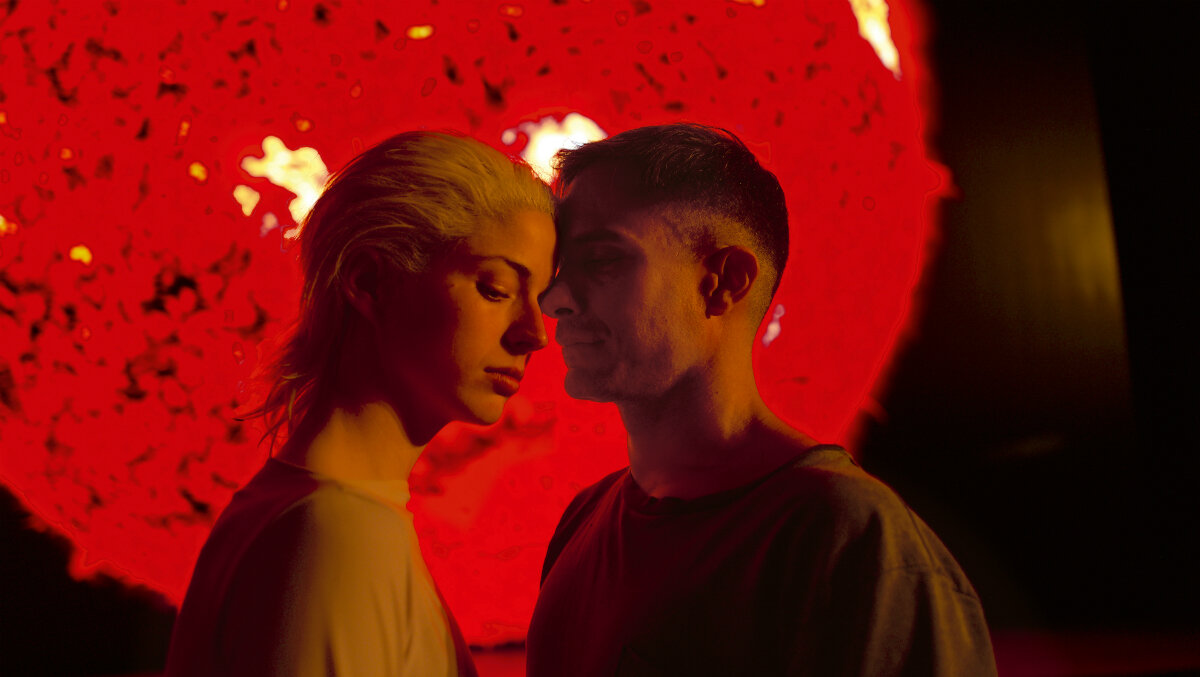

Though not entirely cohesive, Ema, Pablo Larrain’s Chilean drama, is a challenging, skillfully directed drama that showcases more of his artistry and elegant visual eye that hopefully more audiences will seek out and prepare themselves before or after they see Larrain’s highly anticipated Spencer. A superb cast of mostly Chilean talent is toplined by actress Mariana di Girolamo and Gael Garcia Bernal, the well-known Mexican actor whose charisma has pivoted himself starring in many notable titles throughout his career.
Bouncing between his native homeland and more pristine United States studio pictures, Ema is Larrain’s first feature film since his Oscar nominated film Jackie that was released in 2016, and Ema was released in 2019 at the Venice Film Festival which just recently received a limited release by Music Box Theater that is now releasing the film in more niche art-house markets and streaming service just before the release by his more commercial release of Spencer that features Kirsten Stewart as Princess Diana, in which Stewart is the current front-winner for the Best Actress Oscar. If Spencer does well commercially and continues with great buzz, that momentum might help Ema to be discovered by more diehard cinephiles, but even under the best circumstances, continued critical support and effective word-of-mouth buzz on Letterboxd will be crucial to the positioning of Ema into cult movie status. Anticipate the review for Spencer to drop later in the week.

Larrain’s artistry continues his sensibilities for visually bold, more formal daring, and complex yarns, which Lorrain proves he can be every bit as uncompromising with his bigger studio fare with Jackie and the upcoming Spencer. In many respects, Ema is perhaps Lorrain’s most peculiar and experimental work, as well as his most visually arresting work so far. Stylistically, the new film relies on a lot of neon lights, tightly constructed balanced frames, and elegant moving camera shots that showcase the landscapes of Chili in the most striking fashion.
Ema belongs to a cycle of domestic dramas that focus on the breakdown and trauma of a doomed and failed relationships, mostly Ingmar Bergman’s Scenes From a Marriage, John Cassavetes A Woman Under the Influence, Andrezej Zulawski’s Possession, Derek Cianfrance’s Blue Valentine, and most recently Sean Durkin’s The Nest and Noah Baumbach’s Marriage Story, an emotionally intense narrative that centers on the dynamics with a married couple in the last phase of their failed relationship as they attempt to find redemption or closure.

The film focuses on Ema (Mariana Di Giorlino), a passionate dancer and dancing instructor, who is married to choreographer, Gaston (Gael Garcia Bernal), who both hold a lot of hostility and regret towards each other they return their adopted child back to the orphanage for re-adoption that includes a lot of bribery and deluding. Reflecting back, they begin to feel it’s a defeat to their marriage as both Ema and Gaston hold a lot of bitterness towards each other. It also doesn’t help that the adopted child was a troubled child that once set a fire to the family home that led to great tragedy. Ema and Gaston find themselves on the verge of collapsing as their animosity and blame grows even deeper.
Lorrain makes the material hyper stylized as he shows his main protagonist enduring a nocturnal odyssey and fever dream of Ema rebelling against Gaston with many sexual experimentations with her fellow dancers and other types of men. It’s like Madame Bovary with Chilean landscapes that aesthetically happens to be bathed in neon lights. Ema also uses a flame-thrower that highlights her newly found anarchist spirit that leads to anarchy and some surreal and woozy moments. Di Ciorlamo delivers a fearlessly raw performance in her role. Whether it’s the superbly executed dance scenes on the rooftops of the city or to a glowing planet (which serves as a metaphor for her own liberation that a new way of life can emerge), Di Girolamo’s performance is filled with so much passion on both an emotional and psychical level.

Ema’s journey eventually has shades of self-destruction, but also holds some self-discovery and redemptive moments that prevent it from being an exercise in despair. The use of dance serves as a metaphor that she is also in control of being her own choreographer. She yearns for motherhood, but she also wants fulfillment in her career, and for Gaston not to be as pushy and controlling. Just about every moment in the film has something visually pleasing about it, even if some scenes might feel frustrating as they don’t fully not connect as well as other transitions in the film do.
The dancing choreography in this film is quite astonishing and marvelously staged, especially by Di Girolamo. While on a narrative level, the film feels quite preposterous and overstuffed with some tedious melodrama, there are also a lot of contrivances and some narrative loose ends that feel murky. However, Lorrain triumphs with the material due to his commanding vision and conceptual execution. Lorrain builds the world with a fever dream and dizzying style that is serviceable to the tone and psychology of what’s going on with Ema. This is not the first film to deal with characters living through the aftermath of trauma, Jackie (2016) which starred Natalie Portman as Jackie Kennedy was also a very spellbinding film about a woman living through the motions of sudden grief and emotional uncertainty.

Assisted by the supremely talented cinematographer Sergio Armstrong (Who also shot other Lorrain films such as Post Mordem and No), Lorrain employs a hyper-real style, staging his scenes with mostly wide shots and moving camera shots where he always moves in at the right moments of the dramatic beats, Lorrain’s vision is like a combination of Fellini, Kubrick, Bunuel, and P.T. Anderson where he favors the dolly and steadi–cam shots to stage the motion while still feeling singular. Ema demonstrates that Lorrain hasn’t restrained his energetic style down and that it’s still possible to return to your native homeland to make daring feature films while still being in between larger productions.



One of the best mubi exclusives of 2020.
Wasn’t to drawn into the characters as I was the visuals and cradt. It’s still a very impressive film.
I want to see this!
Hi defactofilmreviews.com administrator, Thanks for the valuable information!
Dear defactofilmreviews.com admin, Thanks for the detailed post!
To the defactofilmreviews.com owner, You always provide clear explanations and definitions.
Hi defactofilmreviews.com administrator, You always provide great examples and case studies.
Hi defactofilmreviews.com admin, Your posts are always informative.
Hello defactofilmreviews.com administrator, Your posts are always well structured and easy to follow.
Hi defactofilmreviews.com owner, Your posts are always thought-provoking and inspiring.
To the defactofilmreviews.com administrator, Great content!
Hi defactofilmreviews.com admin, Your posts are always well-referenced and credible.
Hello defactofilmreviews.com admin, Your posts are always well-written and engaging.
Dear defactofilmreviews.com admin, Thanks for the well-organized and comprehensive post!
Dear defactofilmreviews.com administrator, Great job!
Hi defactofilmreviews.com owner, You always provide valuable information.
Dear defactofilmreviews.com owner, Your posts are always well presented.
Dear defactofilmreviews.com owner, Thanks for the well-researched and well-written post!