

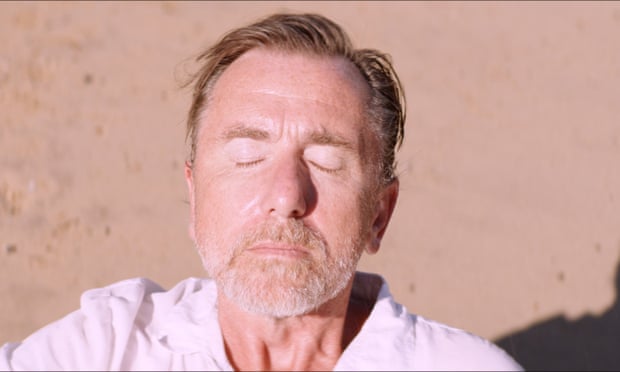

A very austere and deeply mysterious character study drama whose subtext is to expose the world’s haves and have-nots, Sundown is Mexican filmmaker Michel Franco’s most gripping and visually pleasing work to date. The mystery of an upper-class businessman who deceives his British family gradually turns into an existential journey filled with many satisfying surprises and a metaphor about class structure and the havoc it creates within society. The film is also a very liberating film about fulfilling life with experiences over materialism, as it becomes a portrait of a man attempting to escape his past while being caught up in the moment that inevitably passes by with tragic consequences.
While muted with deliberate ambiguity, some reviewers and audiences might feel frustrated by the ending, but if one looks closely, they will notice there are some very subtle character motivations in the film that highlight the purpose of the outcomes of the climates, as well as other underlying themes of Mexico’s endemic of violence and class division. With a more cerebral approach and subtext on its mind, Franco delivers an artful and hallucinatory glimpse into one man’s psyche attempting to live day-by-day in the chaotic and uncertain world around him.

The film focuses on its protagonist Neil (Tim Roth), who deceives his family about misplacing his part while they are on vacation in Acapulco, Mexico. The brilliance of the film is that we don’t know the motivation behind why Neil would deliberately lie to his family like that. With minimalism in both terms of tone and performance, Tim Roth delivers a very brilliant performance where he isn’t exactly the most outgoing and extroverted person, but his demeanor and expressions speak volumes that this is a lonely soul that is searching for some kind of joy while despair surrounds him.
The way the film unfolds is quite engrossing. As you watch the film, you have no idea where it’s going. The less you know going in, the more rewarding the journey and experience will be. Not only is the film captivating on a mysterious level with its layers, but the way Franco also stages his scenes, along with cinematographer Yves Cape, with an exquisite eye that echoes the work of Claire Denis. With elliptical visuals, there are some visually arresting images of beaches, neon-bathed hotels, sunsets, and close-ups of hot faces scorching in the sun where Acapulco feels both vivid and like a dream. There are also some long passes of minimal dialogue and visual observation that help create a more oblique and languorous narrative. With a running time of 83 mins, the film never feels hurried or overstuffed, where Franco has helmed a very unique and unforgettable journey that is quite remarkable.

The film opens with a family of four enjoying a very lavish vacation in a secluded beach resort off the shores of Mexico. Alice (Charlotte Gainsbourg) is easily distracted by her phone. Neil is more laid back and very relaxed with his surroundings, and we see Alice’s teenage children (Abertine Kotting McMillian and Samuel Bottomley), who are old enough to drink, at least in Mexico. Once Alice gets a call about a family emergency involving her mother, this suddenly puts the vacation on hiatus as Alice, Neil, and the kids find their first flight out of Mexico back to London. Neil uses the passport excuse, and instead of going back to the resort looking for the passport, he checks into a cheap hotel, as we see his passport inside his suitcase. Neil ends up walking along the shores of Acapulco while forgetting all about the family crisis that’s currently around him. As the film unravels with further details, there is a lot of psychology and motivation behind why Neil does this. To explain them in the review would be a great disservice to the experience of the film’s mystery.
Neil just relaxes, sits on the beach, eats good food, and gets calls from Alice, in which he claims he still can’t find the passport. While not concerned or worried about the family emergency, Neil just observes others, gets buddy-buddy with his cab driver, has beers with the locals, and yet with all the relaxation, you feel turmoil brewing. Sundown relies a lot on Roth’s performance to make the film compelling, and he does it with his almost restrained performance, yet he pulls it off. This is the second time Franco and Roth have worked together, the first being Chronic, which dealt with themes of mortality. The theme of mortality, in which Sundown opens with Neil observing dead fish on a beach, is a brilliant opening shot that thematically ties in why Neil makes the abrupt decisions he does. What seems outlandish, selfish, and uncaring at first ends up holding greater nuance as the narrative goes on.

As Niel sunbathes in the sun, drinks beer on the beach, and talks with the locals, he ends up forming a relationship with a shop owner named Bernice (Iazuu Larios), which takes off very suddenly. At first, you think he’s also dishonest to her about details until the secrets are revealed later in the film, which actually end up being true. The segments with Bernice are quite erotic and equally affecting, they also hold some subtext about class guilt that Franco hints at throughout the course of the story.
There is little that is reassuring in the film’s ambiguous final scene. There are some elements in the film that echo Ingmar Bergman, most notably Shame, as Franco builds a world in Mexico that is under the control of a police state. We see militarized police constantly on the beaches with guns, as there are some sudden bursts of violence that will certainly startle and disturb you. There is a startling scene on a highway that recalls the desolate car scene in Alfonso Cuaron’s Children of Men in just how exhilarating and anxiety-inducing it feels. As usual for Franco, he shines on a technical and thematic level throughout. The seamless pacing and compelling narrative are very focused and concise, and repeat viewings will only add more layers to Franco’s themes about a man attempting to escape, or rather, ignore the decline around him. In the end, Sundown is the year’s first great treasure, one that is delivered with depth, sophistication, and visual elegance.




Saw it, found it too lightly-sketched.
This movie went nowhere, we walked out!