



The kind of sci-fi film that can easily be labeled as a thinking person’s sci-fi, After Yang is a futuristic, emotionally tender sci-fi saga that merges innovative technology of the future with an emotionally genuine story about grief, that involves a family and the decay of their robotic song. In his sophomore film, writer and director Kogonada adapts the sci-fi short story titled Saying Goodbye to Yang by Alexander Weinstein with artfulness and grace, while Colin Farrell shines in his most empathetic performance yet.
After Yang is set in the near future, and it’s one of those rare sci-fi films that’s more in the vein of Spike Jonze’s Her, where the future doesn’t feel so bleak or dystopian. In fact, drawing on the novel, Kogonada creates a world in which humans put aside prejudices about technology, where man and machine can coexist, and where machines can clone themselves into humans, even becoming members of a family or companions to others. Kogaonada’s world building also shows a very clean planet or environment that appears to be free of pollution, poverty, and other forms of misery. It’s a world that appears to be more inclusive and diverse, and it’s a world where technological advancements have led to driverless automobiles, humanoids, and elegant architecture and decor. It’s also a world where the western world now feels more like East Asian countries, where decor, interior design, and wardrobe are more Eastern.

In the yarn, one can purchase a humanoid in case your child wants a sibling, in which case they become great friends, and Yang is also a mentor–but what happens if the humanoid begins to erode, and it moves past its warranty? Kogonda, whose debut feature film Columbus was a highly involving and visually impressive study about human connection, continues his humanism with After Yang. In his first film, you can sense he was a meticulous filmmaker who was fascinated with architecture, buildings, and the human condition. These sensibilities certainly reemerge once again with After Yang, though more deliberately placed and even more somber than Columbus, After Yang asks a lot of questions about what it means to be human. Thematically, the film on many levels’ echoes Blade Runner, The Final Cut, and Steven Spielberg’s 2001 exceptional sci-fi classic A.I. Artificial Intelligence, which also challenged the viewers’ perceptions of what it means to be human, and how the human experience can potentially be more universal than we realize. Just as Spielberg explored, Kogonada ponders whether artificial life can possibly hold human feelings and the possibilities of how they might even make an impact on others.
The film stars Colin Farrell, who’s already having quite a year. He currently plays Penguin, also known as Oswald Cobblepot, in Matt Reeve’s exceptional The Batman, which is a very menacing and riveting performance. Contrary to his performance in The Batman, Farell is very vulnerable, and he delivers one of his most sincere performances of his career. The film focuses on Jake (Farrel) and his wife, Kyra (Jodie Turner-Smith), who are a very loving married couple who have an adopted Chinese daughter named Mika (Malea Emma Tjandrawidga). They also have a recycled robot referred to as a “technospain”) named Yang (Justin H. Min), who is the older brother and son of Mika. He also serves as a wise mentor who gives Mika a lot of cultural insight on her heritage, as Yang was a robot built in Asia.

Once Yang begins to malfunction, he begins to erode from the rust and shuts down, Jake ends up taking him for a diagnosis where he remains defective. While in repair, Jake takes a memory cube out of Yang’s memory drive and pages through them to view some of Yang’s memories. While inside the memory bank, Jake is able to view Yang’s most affecting memories, which involve a mysterious young woman named Ada (Haley Lu Richardson).
Jake is able to view these memories through some advanced sunglasses that are like a computer monitor, where Jake can live through Yang’s memories through his perspective. It’s there where Jake realizes Yang was able to endure human experiences and emotions through Ada, and it’s a possibility that the emotional toll that he felt with Ada could have led to his robotic demise, which allows Jake to gain a further understanding of the human condition.

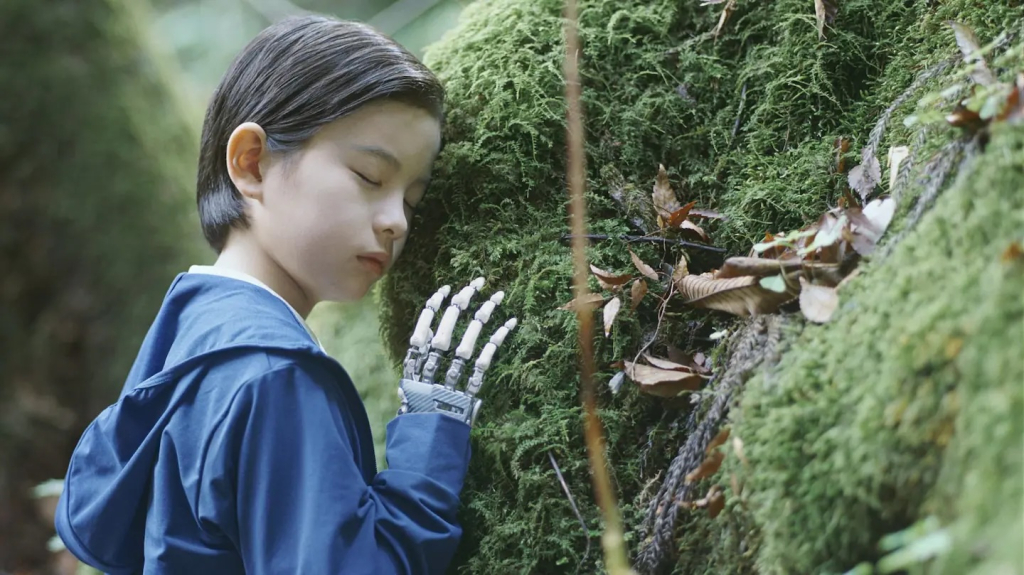
In essence, After Yang is a successful modernized spin on a story we have seen before. Nonetheless, Koganda incorporates themes of identity, race, and how certain emotional truths transcend artifice and the natural. Unraveled with visual poetry and many beautiful montages of Malickian nature shots, After Yang is exquisitely crafted with a lot of striking compositions and decor. There isn’t one shot in this luminous film that isn’t meticulous or stunning by cinematographer Benjamin Loeb.
While the film isn’t quite as successful on a narrative or storytelling level as it is on a visual level, After Yang does hit a lot of the same narrative beats and dramatic notes that prevent it from igniting on a fully engaging level. Ada’s character feels slightly underwritten, even though she does unlock some mystery and provide some insights to Yang on what it means to be human, allowing Jake to see him more as a human. Despite some of the film’s shortcomings, some of the other characters are underwritten as well, especially Kyra, who isn’t given quite as much depth as she could have been. Regardless, there are a lot of aspects where After Yang does work. Thanks mainly to his conceptual world building and affecting performances, there is a tenderness to the film that complements some of the film’s missteps. Ultimately, After Yang is a visually striking, emotionally moving experience that has first-rate cinematography, production design, and an impressive score by Ryuichi Sakamoto, but the film largely triumphs because of Farrell, a top-notch actor who has never been so sincere or vulnerable.


This flew under my radar. I am excited to see a vision of the future that ISN’T dark and depression! I think we could all use a movie right now that tells us everything might be okay in years to come.
I haven’t seen anything about this film yet but your review makes me want to watch it. Something about your description of the film made me think it would be a Malick like exploration of the human condition and then you mentioned the nature shots had Avery Malick like feel.
Another thought I had was the 1999 film, Bicentennial Man, starring the late Robin Williams. While it’s not the first film one thinks of in the conversation, “Can machines actually be ‘alive’?” I think it does well in discussing this topic. Your review reminded me of this film and that I had revisited it not that long ago.
I’m a huge supporter of treating A.I., robots, androids, and other non biological entities as living beings. They should have the same access to equity, equality, and justice as other biological beings. To that end, I’ve loved the conversation through TV and film on this topic. From Star Trek and the various non biological life forms they encounter, especially Data and the Doctor, to films like Blade Runner, A.I., and I, Robot. I look forward to this new film and what it brings to this conversation
if you wanna make a fortume come check me out
Hi defactofilmreviews.com webmaster, You always provide in-depth analysis and understanding.
To the defactofilmreviews.com administrator, You always provide clear explanations and definitions.
Dear defactofilmreviews.com admin, Your posts are always well-formatted and easy to read.
Hi defactofilmreviews.com admin, You always provide in-depth analysis and understanding.
Hi defactofilmreviews.com admin, You always provide useful information.
To the defactofilmreviews.com administrator, Your posts are always well-received and appreciated.
To the defactofilmreviews.com webmaster, Your posts are always well-referenced and credible.
Hello defactofilmreviews.com administrator, Well done!
Hello defactofilmreviews.com administrator, Thanks for the well-organized post!
Hi defactofilmreviews.com webmaster, Your posts are always well-supported by facts and figures.
Dear defactofilmreviews.com owner, Your posts are always informative and well-explained.
To the defactofilmreviews.com owner, Thanks for the well-researched post!
To the defactofilmreviews.com admin, You always provide clear explanations and step-by-step instructions.
Hello defactofilmreviews.com administrator, You always provide valuable information.
To the defactofilmreviews.com admin, Thanks for the great post!
To the defactofilmreviews.com administrator, You always provide great examples and real-world applications.
Dear defactofilmreviews.com owner, Your posts are always informative.
Hi defactofilmreviews.com webmaster, Great job!
Hello defactofilmreviews.com owner, Keep it up!
I am really impressed with your writing skills and also with the layout on your blog.
Is this a paid theme or did you modify it yourself?
Anyway keep up the excellent quality writing, it’s rare to see a nice blog like this
one nowadays.
Товарищи! Ищущие прекрасный сайт для игры? Вашему вниманию [url=https://1xslots-baq.xyz/]1xslots фриспины[/url] — ресурс, в которой любой найдет интересное по душе.
Возможности:
? Обширный ассортимент игр.
? Особенные бонусы для новых пользователей а также опытных пользователей.
? Надежность и комфорт по высшему разряду.
Просто перейдите по ссылке чтобы начать игру моментально!
Зачем терять время? Запустите вашу игру прямо сейчас а также получите удовольствие увлекательными моментами!
A limousine service offers luxurious, chauffeur-driven vehicles for comfortable and stylish transportation. In Washington, this chauffeur service is renowned for its professionalism and elegance. It caters to various needs, from airport transfers to special events like weddings and corporate meetings. The service ensures punctuality, safety, and discretion. Clients can expect well-maintained vehicles and courteous chauffeurs who are familiar with Washington’s routes. This [url=https://bdlxlimo.com/blog/2022/04/05/washingtons-finest-luxury-vehicle-service/] Chauffeur service in Washington [/url] provides a seamless experience, enhancing convenience and luxury for all travel needs.
Great news for all us