



In case you were wondering, Montana Story is in fact an American independent drama that’s setting is, well, in Montana. It’s smaller scale than the series Yellowstone, with just a few characters that take part in just a few locations, along with some stunning scenic scenery in and around Montana. Montana Story is an original screenplay by the filmmaker duo of Scott McGehee and David Siegel, who also produce and direct, and it has that style of intimate American independent movie that seems more of a rarity as time passes by. The story of two estranged siblings–a brother and sister who reconnect after many years after their father is in a coma from a severe stroke.
While Montana Story has all the makings of a TV movie, or a crowd pleaser, or an uplifting story, Scott McGehee and David Siegel, who previously directed such impressive art-house thrillers as Sature and The Deep End, as well as the engaging drama What Maise Knew, have helmed yet another low-key domestic drama that delivers an unvarnished insight into grief, familial reconciliation, and a compelling portrait of holding penance for past sins. Instead of playing the characters’ situations for sentimental manipulation, McGehee and Siegel take a much higher road, adopting a more restrained style that focuses on character and contemplative ideas over being overly earnest or mawkish.
![Montana Story Directors And Cast Talk Fighting With Nature And Building A Family [Interview]](https://www.slashfilm.com/img/gallery/montana-story-directors-and-cast-talk-fighting-with-nature-and-building-a-family-interview/l-intro-1652292186.jpg) Courtesy of Bleeker Street Media
Courtesy of Bleeker Street Media
More solemn in pace and meditative in tone, the writing and concept are perhaps a little too by the numbers. The style and approach certainly echo classic melodramas like Splendor in the Glass and The Last Picture Show, to name a few, but it also echoes other recently successful rural dramas as of late like The Rider and Lean on Pete. The film’s salvation comes from the gorgeous landscape scenery by British cinematographer Giles Nuttgens and the impressive lead and supporting performances that anchor the film away from feeling overly dry. With so many indies today aiming to go overly formal and stylized (like Men, Everything Everywhere All at Once), it’s a relief to still get a film that’s more in the vein of more traditional narrative storytelling and style.
The film focuses on a young man named Cal (Owen Teague) who returns to his family home as his dying father is on life-support and in a coma from a stroke. Eventually, his half-sister Erin (Haley Lu Richardson of After Yang, Columbus, and Support the Girls) arrives after being estranged from the family after being at odds with her father’s betrayal, and unethical business practices, one that gives a glimpse of our nation’s rampant individualism and just how coercive big business is on property rights and land grabbing of Native American land through big business interests.
The filmmakers are determined to deliver commentary on the economic surroundings of the community and how they impact the community. There are some compelling supporting characters introduced in the films that we see how their lives are impacted by Cal and Erin’s father’s recent stroke. The housekeeper, Valentina (Kimberly Guerrero), is trying to find new work; we’re introduced to their father’s caregiver; a Kenyan immigrant named Ace (Gilbert Owuor), as well as an old childhood friend named Joey (Asivak Koostachin), who was laid off from their father’s company upon the stroke and is searching for new work. Their father also has an older horse, which Cal is ready to put down until Erin decides to spare the horse and travel back to her house and property in upstate New York. The horse is certainly used as a metaphor in the film that reflects her anxieties towards her father.
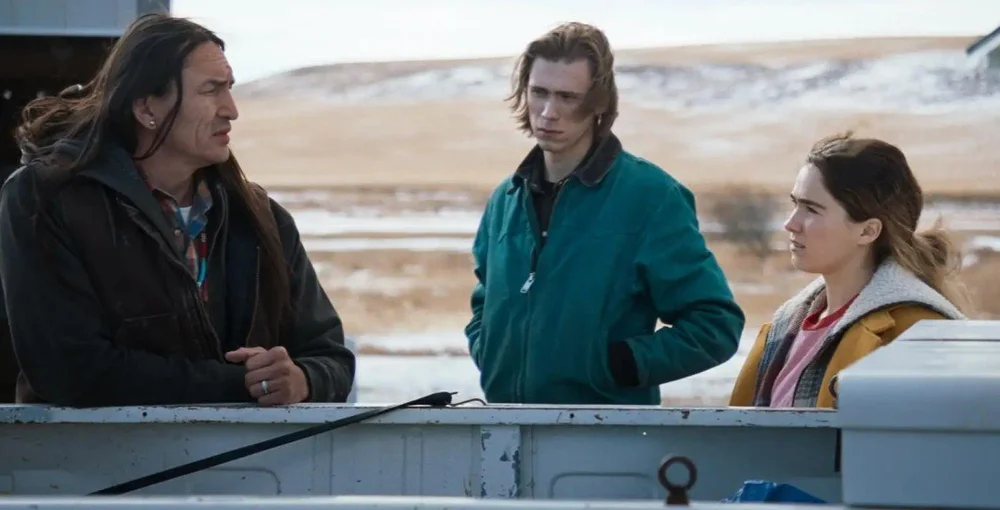
In desperate need of transportation, Cal and Erin end up finding a worn-out truck and horse trailer from a salvage seller named Mukki (Eugene Brave Rock). It is one of the sharpest scenes in the film. Eugene Brave Rock’s naturalistic performance is quite a scene stealer as it is also layered with subtle commentary as Cal and Erin negotiate the sale. Mukki, of Mohican descent, explains his roots and assures the truck is drivable as he does small repairs while Erin test drives it. It’s subtle, but you can certainly see the class and racial distrust with their transaction, but they end up finding respect and connection for one another once they move past the misconceived notion. It really is a very tenderly scripted scene you will see this year.
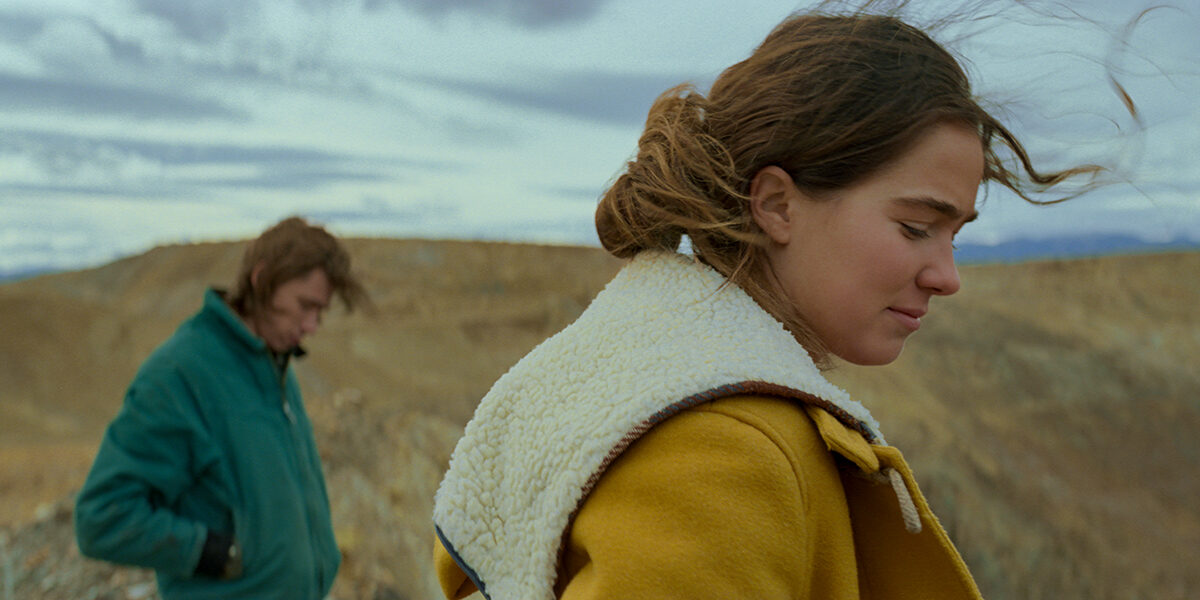
Another contemplative scene comes when Cal and Erin visit a massive hole beneath a cliff in the vistas of Montana. Their father was a business attorney who advised mining and gas pipe companies how to get around government oversight on Native American owned land that is now drilled and abandoned. Erin delivers a thoughtful monologue in which she connects the deception of her family and greed to the Inferno Poem by Dante Alighieri, which is a chronicle of the gates of hell and how it is reserved for humanity’s troubled and greedy souls. Erin goes over each gate of hell and how it represents the descent of different sins.
While it might take a while for the dramatic momentum to get going in Montana Story, the story is redeemed by the expertly scripted exchanges that highlight the bittersweet sibling relationship between Cal and Erin. The performances by Owen Teague and Haley Lu Richard are very delicate and reserved, yet so vulnerable. Their tension and eventually reconciliation generate some earned pathos. While tragic, the film makes a wise choice in not drifting into too much exposition or flashbacks of the father. While this creative decision serves its distancing style, it also serves in adding deeper ambiguities and layers for the sibling characters. We understand Cal and Erin hold moral and ethical disagreements with their father, but there is still an unconditional love that exists that gives the film a humanist quality. Filmmaker’s McGehee and Siegel certainly offer some socioeconomic commentary, but their approach doesn’t feel like a lesson either. It’s asking us to identify with these siblings, even though some of the supporting characters are a little underwritten. There are some missed opportunities, but the siblings’ journey to find atonement for their father’s betrayal and the courage to forgive will reverberate for a long time.


What a great cast, just looked up the trailer and it looks fantastic! Will be playing in Saginaw?
I had never heard of this movie until your review.
Who wants to follow me to get real value
Hello defactofilmreviews.com admin, Thanks for the well-researched and well-written post!
To the defactofilmreviews.com administrator, You always provide in-depth analysis and understanding.
Hello defactofilmreviews.com administrator, Your posts are always well thought out.
To the defactofilmreviews.com owner, Your posts are always on topic and relevant.
To the defactofilmreviews.com admin, Your posts are always well-written and engaging.
Hello defactofilmreviews.com admin, Your posts are always well-supported by facts and figures.
Hi defactofilmreviews.com admin, Your posts are always well-written and easy to understand.
To the defactofilmreviews.com administrator, Good job!
Hello defactofilmreviews.com admin, Your posts are always well-received and appreciated.
Dear defactofilmreviews.com webmaster, Thanks for the well-presented post!
Dear defactofilmreviews.com webmaster, You always provide clear explanations and definitions.
Dear defactofilmreviews.com administrator, Your posts are always well-supported by research and data.
Dear defactofilmreviews.com admin, Your posts are always well-supported by facts and figures.
Hello defactofilmreviews.com webmaster, Your posts are always a great source of knowledge.
Dear defactofilmreviews.com admin, Your posts are always well-delivered and engaging.
To the defactofilmreviews.com webmaster, Thanks for the well-researched post!
Hi defactofilmreviews.com admin, Your posts are always well-cited and reliable.