


The prospect of a new Resident Evil film adaptation may not be the most enticing to both film audiences and gamers alike. However, when news dropped that writer/director Zach Cregger, helmer of the beloved 2022 sleeper hit Barbarian and last year’s smash-hit and Oscar-winning horror film Weapons was at the helm, it felt like finally some good news had arrived. The Resident Evil franchise has seen its fair share of highs and lows, but has just reached its 30th anniversary and celebrated with the release of the newest game, Resident Evil Requiem, releasing earlier this year to great acclaim and successfully united both elements that made the franchise great, combing both survival horror and action horror. The film side of the franchise has been known for the six Paul W.S. Anderson/Milla Jovovich films which were schlocky fun at their best, but haven’t aged gracefully in the years since. The 2021 reboot Resident Evil: Welcome to Raccoon City, from director Johannes Roberts, was a more faithful adaptation of the first three games, but suffered from lackluster casting and the general feeling of being glorified fan-fiction. That film crashed and burned at the box office, paving the way for a new vision of the iconic game franchise. With this latest take on the material, Cregger, whose sense of theatricality makes him the perfect fit to adapt this world into film, has promised a more standalone foray, which has irked some of the more die-hard fans looking to see their favorite characters on the big-screen. With all that said, Cregger’s adaptation is a propulsive, wild and gnarly adrenaline rush that easily stands alone as the best video game movie ever made.

Courtesy Sony
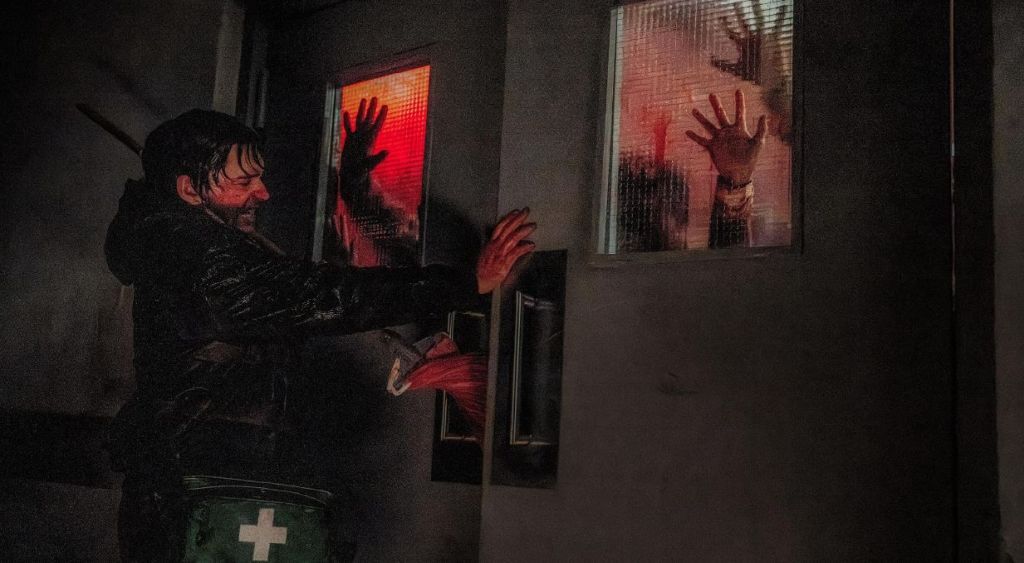
Bryan (Austin Abrams) is a wise-ass medical courier at the end of his long shift. After his girlfriend reveals to him that she is pregnant with his baby, Bryan doesn’t take the news well and just wants to get back home to make amends. Yet, when he’s offered one last job for the day, a run into Raccoon City to deliver a package to the Raccoon City General Hospital, Bryan simply can’t refuse the extra money. On his way into the city, Bryan hits a woman who stumbles into the road and who doesn’t seem quite right. From there, his night takes a nightmarish turn for survival as Bryan is chased by grotesque monsters that seem to be spewing out of Raccoon City.
Co-written and directed by Zach Cregger, Resident Evil is a lean, scrappy and non-stop thrill-ride that never takes its foot off the gas for the entirety of its 90-minute runtime. A departure from Cregger’s structurally intricate Barbarian and Weapons, his latest film singularly uses the language and mechanics of the games to bring the first true survival horror film to life. While angry game fans might be put off by a lack of franchise characters such as Leon S. Kennedy, Jill Valentine or the boulder-punching Chris Redfield, Cregger’s film is the most genuine Resident Evil adaptation in how he marries the tone and spirit of the games without defaulting to replicating iconic locations or shoehorning in lines like “what are ya buyin?” or “where’s everyone going? bingo?”. Cregger precisely understands how the games work and what makes them so scary beyond the cinematic set pieces and creature designs. He emphasizes the fact that Bryan is an average Joe with little to no experience in handling a weapon, so when he finally gets his hands on a gun, there’s no guarantee that he’ll even make any of his shots. The audience is carefully counting the amount of bullets Bryan has for each weapon he acquires and so much of the tension comes from knowing just how limited his ammo supply is.
Cregger has structured the film just like the games, with the lead character on the run, shifting locations quickly and never staying in the same place for more than a handful of minutes at a time. Each set piece not only grows in size and scale, but in absurdity and creative ingenuity. From a first act pressure-cooker that spans from a car crash to a run-down farmhouse, to a gonzo sequence with dozens of bodies falling off the tops of buildings all around our scared shitless hero, to a finale set in the Raccoon City General Hospital, Cregger elevates each sequence as if he’s progressing through one of the games. Cregger isn’t merely copying off the games as well, creating new, disgusting monsters that even hardcore fans wanting to see Nemesis or Lickers will appreciate. Even his zombies are downright frightening and provide some of the most effective jump scares in any recent genre film from this year or last. Yet, for as out there and wild as many of Cregger’s creations are, they still feel rooted in the world of Resident Evil. A thoroughly twisted set piece inside of a hospital maternity ward even suggests Cregger is a fan of the horrifying fetus creature in the Resident Evil Village game.
Courtesy Sony
Cregger once again deftly balances shocking horror with absurdist comedy, often in a single breath. What works so well is how the comedy never dilutes the dramatic stakes or the insane horror from each set piece. Much of the comedy comes from our protagonist’s reactions to the absurdity he bears witness to. Bryan is not some hero or gifted individual with an arsenal of tools at his disposal. He’s a fairly unlikable wise-ass who spends much of the runtime running, screaming and fumbling his way to each new location. Austin Abrams is an extraordinary avatar for Cregger’s sensibilities. Abrams, who played a brief, but pivotal role in Weapons, is given essentially a one-man-show to showcase his abilities. Abrams serves as the gravitational force that centers the film and although his character may not be the most likable protagonist, he feels inherently human. Abrams’ sensational comedic timing milks the humor out of each wild scenario, showing a level of commitment to physical comedy that warrants comparison to Buster Keaton and, more appropriately, Bruce Campbell.
Cinematographer Darius Wolski (The Martian, Prometheus) photographs a striking film with lots of skilled usage of shadows, creating an immersive, yet faithful visual language that replicates certain moods from the games, but never directly aping from them. Cregger carefully implements the usage of first-person POVs that only enhance the terror of the scene and doesn’t use these shots as cute callbacks. For as relentless and breakneck as the pacing as, the film does certainly stop rather than conclude, which will surely leave some viewers feeling unsatisfied. Even as the finale gets a bit too smashy smashy for its own good, Cregger keeps his protagonist at the forefront, concluding precisely at the moment the story requires.

Courtesy Sony
Resident Evil is an incredible time at the movies. Director Zach Cregger has finally cracked the video game movie curse with an adaptation that makes the viewer feel like they’re holding the controller. Cregger focuses on translating the experience of playing the games, rather than adapting one of the many stories in the franchise. It’s a survival horror film to the max, one that consistently features a breathtaking display of technical prowess and genre filmmaking at its near peak. You’ll scream, laugh, wince and gasp, all while knowing that someone finally made the first great video game film adaptation.
Resident Evil is now playing in theaters.





Another gem from Zach Cregger. Film doesn’t take itself too seriously and that is what makes it work. Austin Abram’s is top notch as the hero. Don’t go see it if you have an aversion to the f word!!! 3.5 of 4 stars
I’ve heard nothing but good things about this. Might need to check it out.