


Director Brian Duffield’s Whalefall delivers an ambitious and visually compelling survival thriller that transforms one of the ocean’s most extraordinary creatures into an unimaginable prison. Adapted from Daniel Kraus’ novel, the film explores the terrifying circumstances of a young man swallowed by a sperm whale while simultaneously examining grief, unresolved family trauma, and the instinct to survive. Its breathtaking underwater imagery and increasingly desperate survival sequences provide moments of genuine suspense.

Courtesy 20th Century Studios
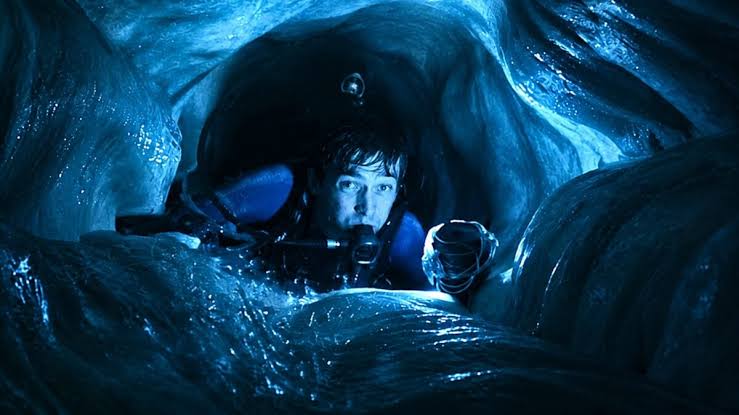
Austin Abrams stars as Jay Gardiner, a young man haunted by the death of his father, Mitt (Josh Brolin). Hoping to recover his father’s remains and find some sense of closure, Jay ventures into the waters off California’s coast. What begins as a personal journey quickly becomes an extraordinary struggle for survival when he is swallowed by a massive sperm whale. Trapped within the creature’s body with a rapidly diminishing oxygen supply, Jay must rely on his instincts and the lessons of his past to escape an almost inconceivable situation.
One of the film’s most impressive achievements is its underwater cinematography. The ocean is presented as an expansive and beautifully realized environment, with remarkably convincing marine life that lends authenticity to the setting. The visual effects create a believable underwater world, capturing both the extraordinary beauty and inherent danger of the deep sea. These sequences establish an immersive atmosphere that makes Jay’s circumstances feel increasingly unsettling.
The film becomes particularly captivating once Jay finds himself trapped inside the whale. Duffield transforms the creature’s interior into a claustrophobic environment filled with unexpected dangers, forcing his protagonist to confront one seemingly impossible obstacle after another. Each new challenge introduces another layer of urgency, while the constant threat of running out of oxygen creates an almost relentless sense of tension. These sequences are undoubtedly the film’s greatest strength. The increasingly complicated circumstances of Jay’s survival generate genuine suspense, keeping the audience invested in how he might overcome each terrifying predicament.

Courtesy 20th Century Studios
However, the film’s performances are considerably less memorable than its technical achievements. Abrams delivers an adequate portrayal of a frightened and desperate young man, but his performance rarely elevates the material beyond what the circumstances already provide. Brolin brings an appropriately imposing presence to Mitt, exposing a complex relationship between father and son. Through a series of flashbacks, Whalefall attempts to explore the complicated relationship between Jay and his father, suggesting that his physical struggle mirrors a deeper confrontation with grief and unresolved emotional wounds. At approximately 105 minutes, the pacing allows the story to unfold without unnecessarily extending its unusual premise. There is sufficient room for both the emotional narrative and the escalating survival challenges, resulting in an experience that rarely feels excessively drawn out.

Courtesy 20th Century Studios
Ultimately, Whalefall is a moderately successful thriller elevated by its convincing visual effects, atmospheric underwater cinematography, and genuinely suspenseful survival sequences. Although the performances and emotional storytelling fall short of leaving a lasting impression, Duffield still manages to deliver an entertaining cinematic experience. The film may not reach the emotional depths it strives for, but when it concentrates on the sheer terror of survival, Whalefall proves that sometimes the most captivating drama lies in the simple desperation to stay alive.
Whalefall is now playing in theaters.






Leave A Comment