

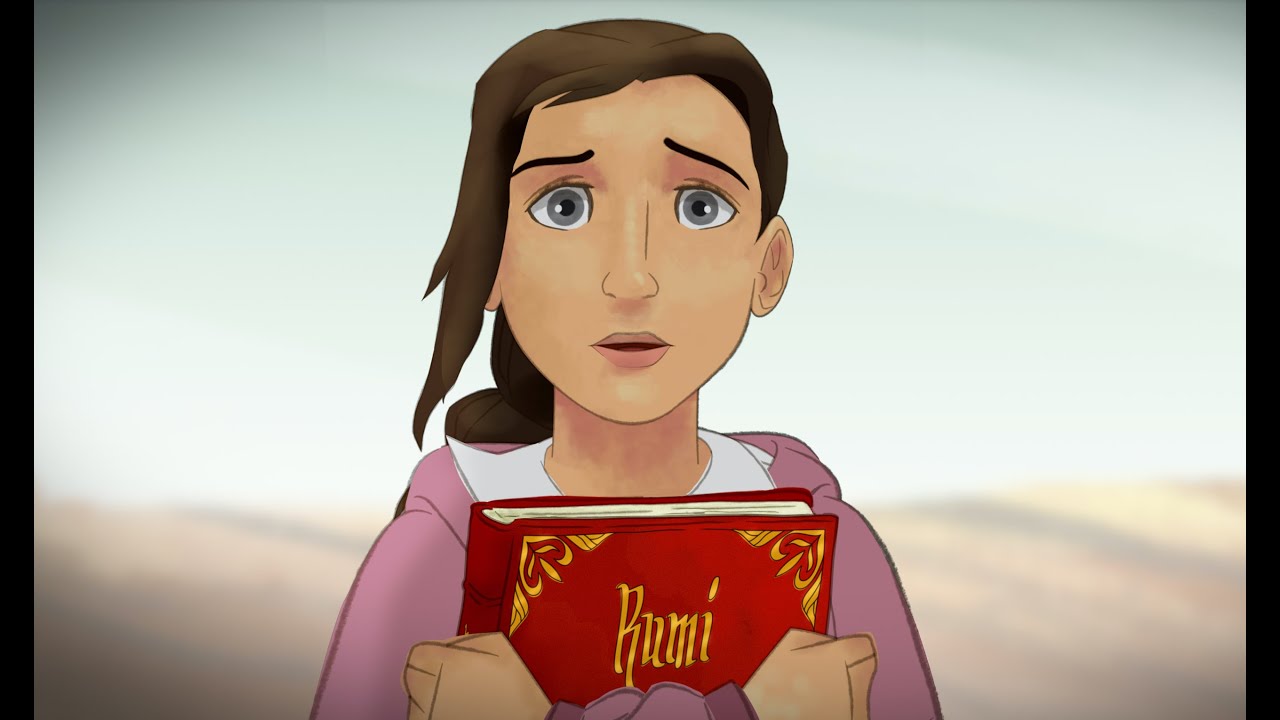

The power of the written word and the stories of our cultures are monumental building blocks to people everywhere. This is true across all races, creeds, and religions. Our stories are different, but the depth they bring to our lives is shared the world over. Stories can help get us through the hard times, and can help us teach the lessons of our culture to the next generations. The new animated film Lamya’s Poem from writer/director and religious scholar Alex Kronemer explores the strength of the legacy of thoughts and writings to a people, and does so with a very interesting structure.
The film begins in Aleppo, Syria in 2016, during the Syrian Civil War. The battle is nearing its end, as evidenced by the Russian airstrikes seen in the film, which occurred during that year. Parts of the city are in ruins, but there are still civilians living in the area. Two of these people are young Lamya (Millie Davis) and her mother (Aya Bryn). Lamya’s father died during the fighting, and so her mother keeps her close to home. Because the schools aren’t operating, they are visited sometimes by a traveling professor, Mr. Hamadani (Raoul Bhaneja). He assigns homework to keep the children learning. He also brings books. Because Lamya is a voracious reader, he brings her a book from his own library – a collection by poet and teacher Jalāl al-Dīn Muḥammad Rūmī, known more simply as Rumi.
While the modern characters are representative of the lives of those in Aleppo at the time, Rumi is a real historical figure. When Lamya’s backpack, and the book, are stolen while she and her friends are at a shop, she almost dies in an airstrike trying to retrieve it. Her mother decides they must leave the city, and they become among the many refugees of Aleppo. From here, the film’s interesting cross-structure begins. From Lamya’s story, the film also cuts back hundreds of years to the story of Rumi’s (Mena Massoud) life. Like Lamya and her mother, Rumi and his father are escaping violence. They are trying to stay ahead of the Mongols who have driven them from their home. This two-pronged story would be interesting enough, but the film introduces a third story.
 Courtesy West End Films
This is a fantasy story where Rumi and Lamya meet outside a walled city surrounded by airships – a city which is soon attacked by an invading army of hyena-human hybrids. Back in the modern day, Lamya is separated from her mother and living in a makeshift refugee camp designated as illegal by the country they are in. All she has left of home is her book and a young boy named Bassam (Nissae Isen), who was the one who had stolen her backpack, unbeknownst to her. Meanwhile, Rumi and his father decide to join a group of pilgrims heading to Mecca, making the best of their bad situation. The film culminates with cross-cutting between Rumi deciding if he will commit an act of violence against a Mongol soldier who has turned fellow pilgrim, Lamya turning against the words of Rumi after the refugee camp is raided by the police, and the fantasy Lamya falling into despair and becoming something monstrous as Rumi tries to rescue her.
As evidenced by the somewhat complicated plot synopsis, Lamya’s Poem is a film that is full of ideas. It is very thoughtful and does an enthralling job of connecting the ideas, though it does feel a little slow-going at times, even at less than 90 minutes. It is helped greatly by the structure of the three stories, as we see parallels in the events of Lamya’s and Rumi’s lives. The fantasy story seems oddly separate for much of the running time, but it ties together very well at the end using Rumi’s words as a catalyst for overcoming pain and grief. Kronemer’s script is very engrossing overall.
:no_upscale()/cdn.vox-cdn.com/uploads/chorus_asset/file/24456103/2jy5S9Tj.jpg) Courtesy West End Films
Courtesy West End Films
There are certainly aspects of the film which show that it’s coming from an animation studio without the resources of the medium’s big guns. The voice acting sometimes feels disconnected, especially in the early scenes of the film. Characters take unnatural pauses before responding, and things just feel off at times. But this doesn’t mean that individual performances aren’t solid. Millie Davis has a lot of work to do in the film, and she does a superb job of portraying Lamya’s range of emotions, both in the real world and the fantasy sequence. Raoul Bhaneja’s Mr. Hamadani only has two scenes, but he conveys such warmth in the performance that he really stands out. The animation itself is something of a mixed bag. Much of the film is done in an interesting storybook illustration style, with thick pencil lines which lend a charmingly simple look to the film. But for sequences with more action, such as an airship being downed in the fantasy sequence, it becomes reminiscent of 90s-early 2000s Flash animation, which looks jarring compared to the rest of the film. A highlight of the film is the music from Christopher Willis, which is excellent throughout. While Lamya’s Poem is not a complete success, it brings a lot of illuminating ideas to the table, and it makes for a substantial alternative to the bright popcorn junk so often dropped in the animation medium.
Lamya’s Poem is now playing in Limited Theaters and is available on VOD


This looks really powerful!
Looks really good
I’ll check it out. I’m very happy for Sam Kadi producing this.
I found out this movie was produced buy former MPI students. I will definitely be seeing this.
Thats a very powerful story to read about and to watch it in animated form. I like the plot. It very well thought out and directed.