

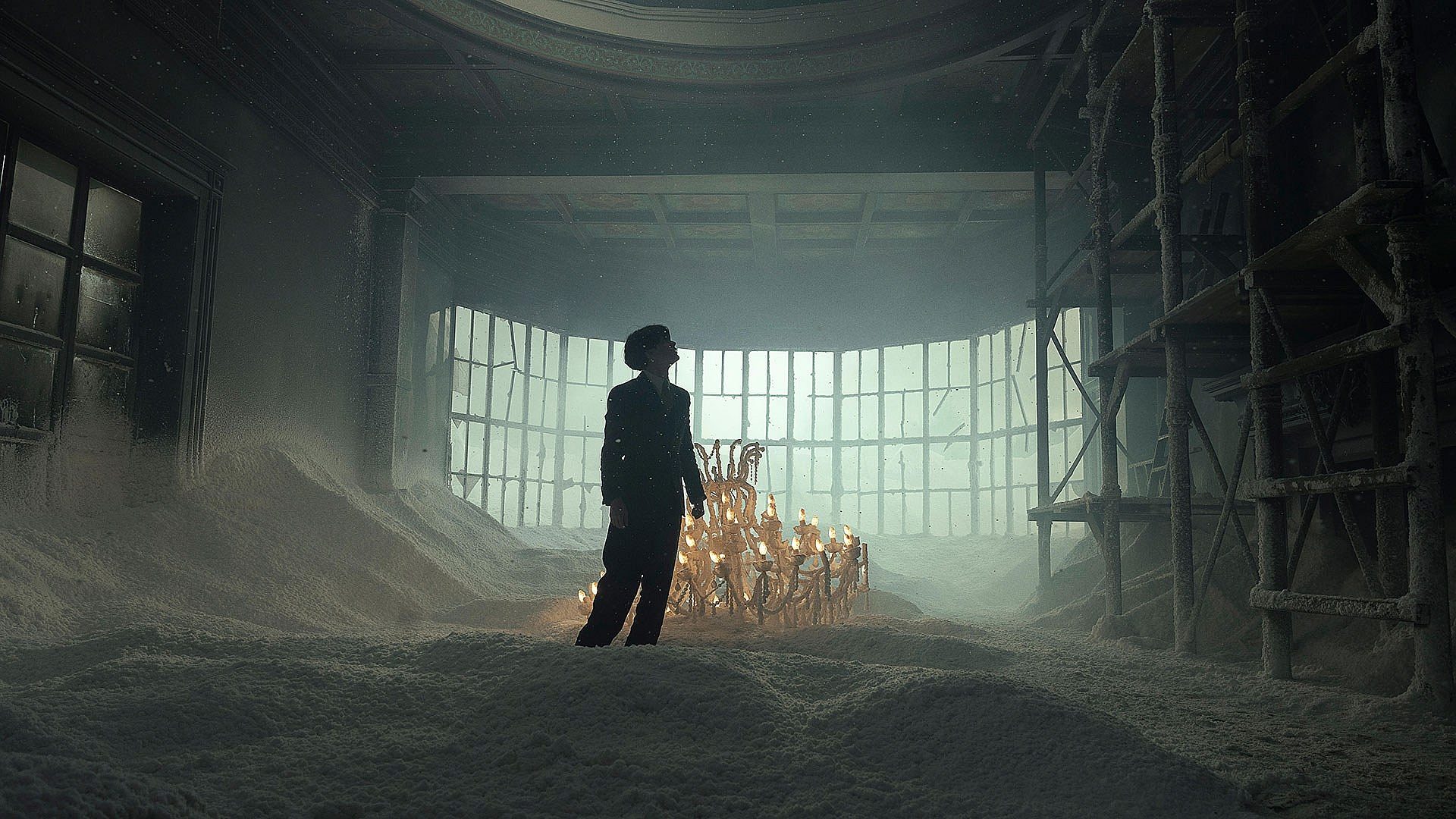

There are certain films that demand you sit back and ponder—movies that require days to marinate in your mind after leaving the theater before you can even attempt to process them into a review. I have had this happen in the past with pictures like Pedro Almodóvar’s Talk to Her, Spike Jonze’s Adaptation, Gaspar Noé’s Irreversible, Steven Spielberg’s Munich, and Clair Denis The Intruder which were all works where you immediately know you need a second viewing, where reflection over time completely shifts your appreciation, and where the film’s haunting, personal power only expands with distance. Having had the privilege of experiencing La Bola Negra on the big screen at the Windsor International Film Festival, I feel that exact same undeniable pull.
Fresh off taking home Best Director at the Cannes Film Festival, Spanish directors Javier Calvo and Javier Ambrossi (“Los Javis”) have crafted an extraordinarily ambitious, unique movie that has haunted me continuously since I first sat down to watch it. It is a work that may hold slight structural complexities across its runtime, but it is so undeniably polished, ambitious, and deeply human that I can easily see it gaining legs in my mind for years to come.
What makes this multi-generational epic work so magnificently is how its structural architecture directly mirrors Steven Daldry’s The Hours. Like that film, it operates across three parallel timelines (1932, 1937, and the modern day in the year of 2017) to explore how deep-seated queer identity, societal repression, and the sacred nature of the artistic process ripple across generations. The film’s thematic text draws directly from real-world queer lineage, basing its core structure on an unfinished, four-page play manuscript of the same name by Spanish poet Federico García Lorca—who was brutally murdered by fascist forces at the dawn of the Spanish Civil War—intertwined with elements of Alberto Conejero’s play La piedra oscura.

Courtesy Netflix
The contemporary thread grounds the entire film in a deeply moving emotional reality. When we first meet Alberto (Carlos González), he appears profoundly isolated and lonely, cycle-driven by hookup apps and compulsions that verge on a sex addiction. The twist—that he actually has a live-in boyfriend—only deepens his alienation, framing a man whose emotional life feels fundamentally incomplete. He finds himself constantly at odds with his mother Teresa (Lola Dueñas) while she undergoes a chaotic, exhausting renovation of her home. Yet, as Alberto uncovers forgotten newspaper clippings, old letters, and historical artifacts belonging to his grandfather, the dam breaks. Watching his arc shift from internal disconnection into a genuine self-discovery and fulfillment offers one of the most stunningly human and victorious payoffs in recent cinema. It reframes the artistic process not just as self-expression, but as a sacred act of making amends with generational ghosts.
The historic timelines are equally staggering in their tragic weight and performative grace. In 1932, Carlos (Milo Quifes) captures the raw, aching vulnerability of a young man wrestling with his identity amidst elite aristocratic rejection, anchored by the literal, crushing weight of the exclusionary “black ball” vote at his father’s private club. This foundational trauma ripples directly into the subsequent eras, establishing the generational seed of secrecy and shame that the later timelines grapple with. Shifting to 1937 at the height of the Spanish Civil War, the central dynamic achieves a crushing emotional intensity. A wounded soldier, Sebastián (Guitarricadelafuente), is captured and held guard by a young fascist soldier, Rafael (Miguel Bernardeau)—a reluctant captor who isn’t a fascist at heart, but fights out of sheer necessity and impartial self-preservation after being thrown into the conflict. What begins as a tense, hostile captivity gradually dissolves into an unexpected, tender bond. As Rafael tends to Sebastián’s wounds, their mutual isolation gives way to a profound intimacy and deep affection, carrying their quiet love right up to the story’s devastatingly tragic conclusion.
 Courtesy Netflix
Looming over this dramatic tapestry are showstopping centerpiece turns. Nené (Penélope Cruz) delivers an awe-inspiring, electric spectacle in her dazzling burlesque sequences, commanding the screen so intensely that you remain glued to her every gesture. Meanwhile, Isabelle (Glenn Close) provides an authoritative, formidable anchor that binds the visual scale together.
Elevated by cinematographer Gris Jordana’s painterly work which deserves immense praise for capturing the sweeping, tactile beauty of a 1970s Bertolucci epic infused with the surreal grandeur of Tarkovsky, Iñárritu, and Malick—La Bola Negra stands as one of the year’s supreme artistic achievements. It is a stunning, patient triumph of artistic memory over fascist repression, and I cannot wait to experience it again.
La Bola Negra is now playing in limited theaters and will be released to stream no Netflix on December 2nd


Leave A Comment