


Throughout cinema history, film courses have frequently explored the minds of the mentally deranged characters who are cold, calculating, and deeply unsettling. From Alfred Hitchcock’s seminal Psycho, Michael Powell’s clinical Peeping Tom, and Charles Laughton’s chilling The Night of the Hunter to Brian De Palma’s Dressed to Kill, Martin Scorsese’s Cape Fear, Lars von Trier’s The House that Jack Built, John McNaughton’s Henry: Portait of a Serial Killer, Rob Reiner’s claustrophobic Misery, and Mary Harron’s American Psycho—not to mention Anthony Minghella’s The Talented Mr. Ripley, Abel Ferrera’s Mrs. 45, Dario Argento’s Tenebrae alongside classic domestic nightmares like Whatever Happened to Baby Jane? and The Stepfather—these movies dig deep under our skin with terrifying portraits of human instability. Entering this rich, macabre lineage is Victorian Psycho, the stylish new thriller from director Zachary Wigon (known for The Editor and Sanctuary). Starring scream queen Maika Monroe whose celebrated genre work in features like It Follows and Longlegs has cemented her status—the film offers an astonishing showcase for its lead. Monroe delivers an exceptional, multi-layered performance that shifts seamlessly from histrionic outbursts to chilling vulnerability, anchoring a picture that is as visually sumptuous as it is deeply terrifying.
Adapted from the 2025 novel of the same name by the book’s original author, Virginia Feito, the screenplay surprisingly comes up a bit slight in spots, needing a little more narrative finish to feel completely realized. Even without having read the source material, it is clear that while Feito’s writing captures a biting, darkly satirical tone, the script never quite takes a deep dive into the protagonist’s psyche as much as one might expect. Instead, the narrative unfolds in an episodic manner, structured across distinct chapters that chart her calculated descent into the household. While these chapter breaks give the story the formal cadence of a serialized Victorian novel, the connective tissue between segments occasionally feels thin, leaving certain psychological transitions abrupt rather than fully earned.
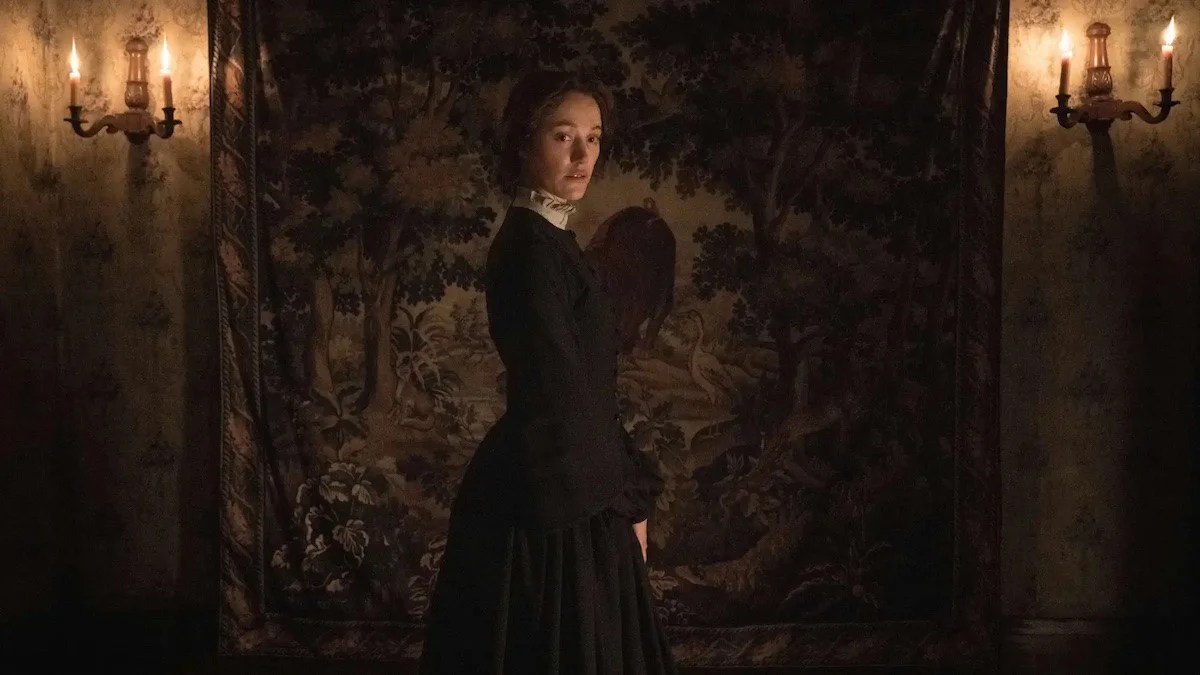
The story follows Winifred Notty, an eccentric young governess who arrives at the remote gothic estate Ensor House to care for two children, Andrew (Jacobi Jupe) and Drusilla (Evie Templeton), under the roof of wealthy parents Mr. and Mrs. Pounds (Jason Isaacs and Ruth Wilson). As Winifred settles into her duties, she begins ruthlessly eliminating anyone who crosses her path, systematically removing obstacles with chilling precision. What makes her character so profoundly sinister is that her violent rampage is not intended to tear down the system; rather, she uses murder to uphold the patriarchal hierarchy in aggressively traditional ways, aligning herself with the very structures of power that oppress her.
 Courtesy Bleaker Street
Adding sharp dramatic friction to the estate is Agnes (Thomasin McKenzie) as fellow staff member and rival, whose tense, acid-laced exchanges with Winifred stand out as some of the finest moments in the entire film. Trapped in a mutual wariness, McKenzie and Monroe play off each other with exquisite psychological claustrophobia; their simmering antagonism stems from conflicting loyalties and competing survival instincts within the rigid domestic hierarchy. It is a thrilling dynamic that leaves you wishing the screenplay had leaned even further into their rivalry, as it serves as a major narrative highlight. Near the end, this escalating tension also boils over into a gripping cat-and-mouse confrontation between Winifred and Mr. Pounds, in which she directly challenges whether or not he is her biological father. While the film weaves in a subplot suggesting he is indeed her estranged father, the screenplay leaves the details murky and unresolved, robbing the climax of some of its dramatic weight even as the actors play the scene to perfection.
Even when the writing leaves certain threads hanging, the film remains firmly anchored by its powerhouse performances and Wigon’s assured direction. Wigon deserves immense praise for the film’s aesthetic execution, utilizing painterly cinematography that bathes the gothic interiors in rich, chiaroscuro shadows, opulent period textures, and symmetrical framing. The camera lingers on long, claustrophobic hallways and candlelit corners, turning the estate itself into a visual cage that mirrors Victorian repression and heightens the macabre atmosphere. Moving chapter by chapter through Winifred’s escalating reign of terror, this deliberate visual pacing traps the audience inside the warped logic of an unhinged mind operating within a rigid society.
Ultimately, Victorian Psycho succeeds because it marries high-art elegance with pulpy, transgressive thrills. Despite a script that could have benefited from sharper psychological depth and clearer narrative resolution, Monroe and McKenzie’s magnetic face-offs alongside Zachary Wigon’s visually intoxicating direction make it a standout modern addition to the psychological horror canon, proving that the scariest monsters are often those wearing the politest and most pristine smiles.
Victorian Psycho is now playing in theaters everywhere


Leave A Comment