


Horror films come in all shapes and sizes, either featuring creatures of dark descent or even the horrors of modern discrimination, but there are times when both elements clash together to create an out-of-the-ordinary film. Mariama Diallo’s directorial debut is an example of said elements with her new film, Master, and there is much to say about it. Now, there are some things Diallo’s film gets right but there are many times when the film can also feel much like a confusing arthouse horror film that comes off like a didactic campus lecture that disguises itself as a horror film. And when covering a topic such as racism and discrimination, it is important to make certain the point of the film does not stray far away but is strengthened by the plot as a whole. And what’s unfortunate about this film is that the point is a bit lost in the midst of the multi-faceted plot, by calling attention to small details that seem important at the time to basically never touch on again. The film spotlights three young women, all equally attempting to find where they will fit in at a highly reputable New England university. Though, as days begin to elapse, stories containing sinister pasts begin to take a toll on our characters and their futures. So with a story with a whiff of potential, watching the film reveals the many trips and quibbles the film makes along the way.
I would say what is worth praising and mentioning should be directed towards the technical elements and the performances cushioning some of the mistakes the film ends up making. In terms of technical aspects, Charlotte Hornsby handcrafts beautiful scenes, effectively building tension with simplistic yet meaningful shots to convey the eerie environment. Hornsby’s talents almost create an illusion for the film, making Diallo’s debut feel like a fine grain rather than the rough sandstone it actually is. Fortunately, there are pockets of sunshine poking through the darkness that is this film, such as the production design fluently blends with the cinematography, using specific colors to emphasize a sense of danger and a harrowing atmosphere. The beauty of this film welcomes itself subtly, not to overpower the screenplay or story itself, but instead as a supporting crutch of some sort. It’s these elements that will restrain you from switching off of the film after the first 20 minutes, and as the film climbs further down the rabbit hole of poor execution, you will almost wish the entire story was thrown out the window to enjoy the technical qualities. It is crucial to recognize those who delivered fine work even if the entirety of the story itself is ratcheted brutally and without Hornsby’s talented mind, I would say Master would be much more of a dud than it has already pawned itself as.
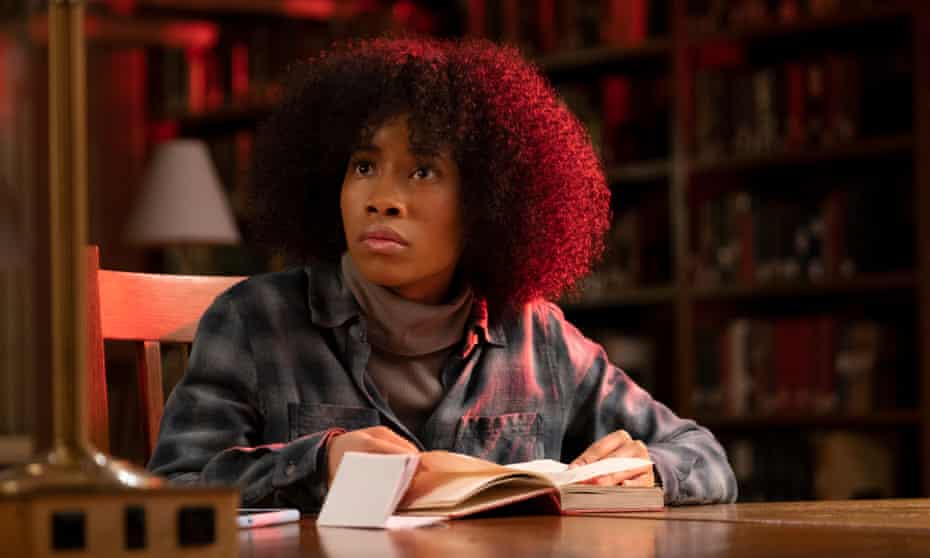
As for the performances alone, the three women front and center deliver their roles tastefully. Starting with Regina Hall, who has come from a number of comedies (Girls Trip, Little, Scary Movie), her performance alone is due for a deal of acknowledgment as she displays her range as an actress beautifully. For example, her character Gail Bishop begins to discover ties with recent events, so as time passes, her overall mentality is shown as a steady decline and Hall pulls it off quite well. Now to mention her counterpart Liv Beckman, played by the immensely talented Broadway actress Amber Gray, her overall performance is handled beyond adequately. Since her character is largely cut from the horror aspect of this film, it’s impressive to watch Gray subtly act in almost every scene she’s in. As the late Stella Adler has said, “acting is reacting”, and I reference the specific quote because Gray takes reacting to a new level. As a seasoned stage actress, she has mastered the art of reacting subtly on-screen, supporting scenes and elevating them to the highest intensity. It is without a doubt an impressive performance from Amber Gray. Finally, Zoe Renee (Jinn, The Quad), plays a freshman who is fresh out of the suburban environment and now smack dab in the middle of an odd school. Renee is a skillful actress, to begin with, referencing her role in Nijla Mu’min’s coming-of-age film, Jinn where she plays a teenager who must endure the upside-down changes due to religious conversion. What’s imposing about her performance here is that the screenwriters give exceedingly little character writing for Renee to play off of overall, forcing her to make do with what she’s given, but she is somehow able to lay hold of the minimal writing and create something believable. Her raw panic throughout the film is realistic and completely seducing to watch.

But it’s sad to say that even the performances and cinematography are not enough to save this film from the lack of writing surrounding the film. Dull horror elements are brought into the mix, whisking along with the social commentary in a confusing manner. The film feels as if two people decided to write their own script and clash them together without making any revisions to the story since the film uses a modicum of horror but then interjects social commentary during points of the film that make no sense. The story would have benefited without the horror nonsense as it ultimately becomes an afterthought, with the storyline tripping and stumbling on itself. The film’s concepts are buried below the multitude of confusing horror subplots, unable to save itself from the convoluted mess the film has dug for itself. And since the film’s runtime is somewhat short, running at a quaint 131 minutes, there is a complete lack of clarity offered.
So what is to be expected from Diallo’s directorial debut? I would say lengthy and towering aspirations are what kill the rhythm and flow of the film, aiming to please horror fans while also layering social commentary within the story. But how can one enjoy a proper story when the story itself seems to be lost within itself? It is with a heavy heart to say the film is completely lackluster, devoiding audiences of any character writing or even answers to many questions. Master is, at the end of the day, a b-class horror film looking to point out the effects of social hierarchy-based discrimination, but also chooses to opt-out of constructing a well-balanced plot and any cohesive arcs.


Leave A Comment