


Five-time Oscar nominated and problematic filmmaker David O. Russell promotes love, art, peace, and combats fascism in a web of conspiracy in his ninth feature (10 if you count Accidental Love that he used under a pseudonym) titled Amsterdam, a zany and disarranged period piece murder mystery-comedy that magnifies and chronicles the Business Plot of 1933, that aimed to co-opt WW1 retired generals and veterans to hold a coup against the United States government led by Franklin D. Roosevelt. Set between the years of 1918 in Europe and 1933 in New York City, the deadpan and idiosyncratic conspiracy farce has all the jarring and manic sensibilities found in his films before about anxiety, self-loathing, and other types of neuroticism.
Recent headlines lately have resurfaced the abrasive records of David O. Russell’s ongoing abuse and backstage drama that date back to a leaked YouTube link of O. Russell verbally abusing veteran actress Lily Tomlin on the set of I Heart Huckabee’s to many other incidents as recent as the film Joy. Perhaps a lot of the negative reviews are more of a condemnation of O. Russell itself, but then again, there certainly is a lot to opine about with his latest film.

However, there are some well-intended aspects to the film. It has a stylish stamp, a combative approach to fascism, offers some idealism about kindness, and there is some self-awareness of old school detective films and artificial Hollywood movies from the 30s and 40s. If anything, O. Russell’s latest film plays close to P.T. Anderson’s equally messy but fascinating Inherent Vice, which transports us back to an era that draws parallels between our past times and the ongoing issues and threats we face in the modern era.
Russell’s original script of its protagonists is loosely derived from historical events and people. Its fictionalized characters are a dynamic duo about a pair of wounded World War I veterans of noble professions that utilize their skills to foster humanity rather than for personal gain in New York City circa 1933. We meet Burt Berendsen (Christian Bale), a doctor who treats fellow wounded war veterans, and his best friend, Harold Woodaman (John David Washington), is an attorney who represents the disenfranchised who can’t defend themselves. After being notified about the sudden death of their former commanding officer from the war, the respectful General William Meekins (Ed Begley), who mysteriously died on a ship returning from Europe to New York, they are ordered by his daughter Liz (Taylor Swift) to perform an autopsy in a short period of time.

This leads to Burt and his medical assistant Irma (Zoe Saldana) conducting the autopsy, and Irma finding poison in his organs that caused the death. Eventually, Burt and Harold are pulled into a web of conspiracy once they are accused of murder, and they attempt to piece the investigation together themselves to prove their innocence. Bale is quite fitting as a detective, with a thick New York accent and a glass eye that becomes an ongoing gag that has some hilarious moments in some areas but eventually grows tiresome.
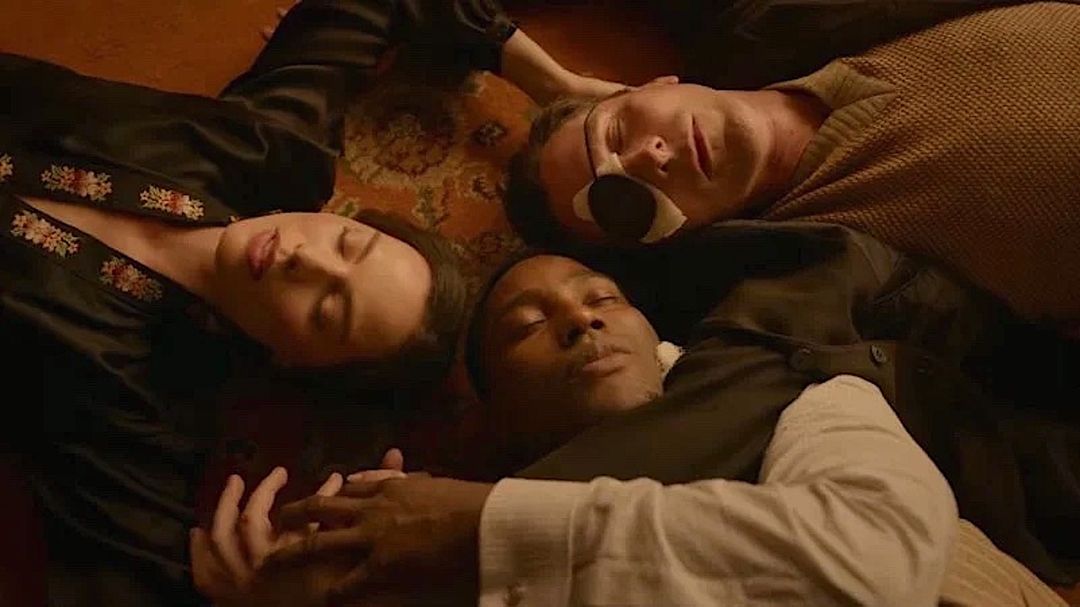
Right in the midst of the film’s opening set-up, the film pulls you in for a lengthened flashback to 1918, where Burt and Harold are serving under Gen. Meekins. Both men get severely wounded in the war. They are treated by Valerie Voze (Margot Robbie), an American nurse that’s also a free spirit that has a passion for creating surrealist art. All three end up traveling together to bohemian Amsterdam for joy after a long-endured battle and bloodshed. Robbie is terrific here, but this really is the only segment of the film where she’s given the most depth. All three form a strong bond together, in which Harold and Valerie form a romance. Eventually, they all part ways to embark on their own passions and careers as the war ends.

We cut back to 1933 and learn of Burt’s practices and what led to his profession and career struggles. Burt’s estranged wife, Beatrice (Andrea Riseborough), comes from a family of wealth who also practice medicine but aren’t too supportive of Burt. In fact, they pressured him to serve in War and scolded him for practicing medicine and providing healthcare to sick and poor veterans in their wealthy neighborhood. Burt also gets addicted to morphine to relieve his back pain from the war. Eventually, the narrative catches back to the beginning of the film. In the middle section of the film, the film begins to collapse as it grows very convoluted with an overabundance of lightly sketched and quirky supporting characters and subplots that resurface throughout the course of the film. Burt is clearly disconnected from Beatrice, while his attraction grows closer to Irma. We’re also introduced to a pair of detectives, Getwiller (Matthias Schoenaerts) and Hiltz (Alessandro Nivola), who are convinced that Burt and Harold are guilty. We also have two top-secret agents (Michael Shannon and Mike Myers) that Burt encounters back in Europe, where he bought his glass eye, who are back in New York and disguise themselves as offbeat bird watchers.
Eventually, Burt and Harold reconnect with Valerie, who is now looked after by her sister Libby (Anya Taylor-Joe) and her ultra-wealthy husband Tom Voze (Rami Malek), who has ties to the real-life Committee of Five, a shadowy oligarchical cabal that profits off the misery of war and has an agenda of installing a militarized fascist dictatorship in hopes of co-opting and buying General Gilbert Dillenbeck (Robert De Niro) in hopes of throwing a coup against FDR as fascism is at its dreadful peak in Europe with the rise of Mussolini and Hitler.

While O. Russell has a lot on his mind, and the film holds some visual energy, it is certainly shot in a backlot that vividly recreates the 30s by gifted cinematographer Emmanuel Lubezki, that holds a wide variety of textures and colors that range from bright tones to muted grays. Visually, it seems like Lubuzeki is at odds with the aesthetics of the film, in which everything feels mismatched and displaced by O. Russell’s jarring style. Outside of the three main protagonists, Amsterdam fails to ignite. Roughly all of the supporting characters come off as caricatures; Riseborough is underwritten and sadly one-dimensional; and the narrative feels disjointed and relies on too much exposition.
On top of these quibbles, Amsterdam is an exceedingly idealistic picture. In the last 10 minutes of the film, we get a heavy-handed message of kindness that becomes obvious in drawing parallels to Donald Trump and his enablers in its condemnation of how the rich and powerful attempt to overthrow democracy.
While Amsterdam certainly has moments that work, so much doesn’t work. So much potential sadly goes to waste in one of O. Russell’s weakest films of his career—in which his filmography holds some very impressive gems like Three Kings, I Heart Huckabees, and Flirting with Disaster. The idealism is certainly earnest, and there are some visual flourishes to be found with the impressive performances by the trio of Bale, Robbie, and Washington, but the result ends up being messy and just a signpost of missed opportunities.
AMSTERDAM opens in theaters Friday, October 7th.




How disappointing. I was looking forward to this.
I’m no David O. Russell fan. I pretty much only liked Silver Lining’s Playlist and that’s it. This seems quite par for the course when it comes to his films
While not David O. Russell’s best work, the chemistry between the three leads save the film.
I saw this quote online written by Kyle Smith the esteemed film reviewer of “The Wall Street Journal,” and I am copying it verbatim; “To describe Amsterdam as an unfunny comedy would be unfair, because it’s so much more than that. It’s also a non-thrilling thriller and a not particularly mysterious mystery.” Brilliantly harsh yet funny critique…
This film had an 80 Million dollar budget. The buzz on this comedy mystery is that it is filled with a cadre of stars, which does not make up for it’s bloated, overcomplicated script set post WW1. I am looking forward to seeing this film anyway, because I like David O. Russell movies, the wardrobe looks authentic and the cinematographer Emmanuel Lubezki has won many awards. The star power of Christian Bale, Mike Myers, Margot Robbie, Chris Rock, John David Washington, Zoe Saldana, Robert DeNiro, Taylor Swift and more, makes up for the price of admission for me.
This sounds like a great cast, hobbled by a so-so film, from an @$$#0!€ director.
I’m still going to give this movie a shot. The cast is too great to not watch it.
Disappointing that this film underperformed from your point of view Robert. Will still watch it given the cast and storyline. Thank you for another great review.
I’m sorry to see this. I’ve been a fan of Russell’s since I first saw Three Kings.
Just saw this. Have to agree with the reviewer. This movie has a great message, but it’s delivered in a ham handed fashion. Christian Bale odd amazing, but the rest of the cast wastes their talent on a convoluted script
I’m still looking forward to seeing this one for the cast but am disappointed that it may not be the best written film. Thank you for your review!
Dear defactofilmreviews.com admin, Keep it up!
Dear defactofilmreviews.com owner, Your posts are always informative.
Dear defactofilmreviews.com admin, Your posts are always informative.
Hi defactofilmreviews.com admin, Excellent work!
Dear defactofilmreviews.com administrator, Your posts are always on point.
Dear defactofilmreviews.com administrator, Good to see your posts!
Hi defactofilmreviews.com admin, You always provide great examples and real-world applications, thank you for your valuable contributions.
Hi defactofilmreviews.com administrator, Your posts are always well-supported by research and data.
To the defactofilmreviews.com owner, Thanks for the well-organized post!
To the defactofilmreviews.com webmaster, Your posts are always well-written and easy to understand.
Dear defactofilmreviews.com webmaster, Your posts are always well structured and easy to follow.
Dear defactofilmreviews.com webmaster, Your posts are always thought-provoking and inspiring.
To the defactofilmreviews.com owner, Thanks for the well-researched and well-written post!
Dear defactofilmreviews.com administrator, You always provide helpful diagrams and illustrations.
Dear defactofilmreviews.com owner, Your posts are always well-timed and relevant.
I’m just here to see it becuase I’ve got nothing to do.