

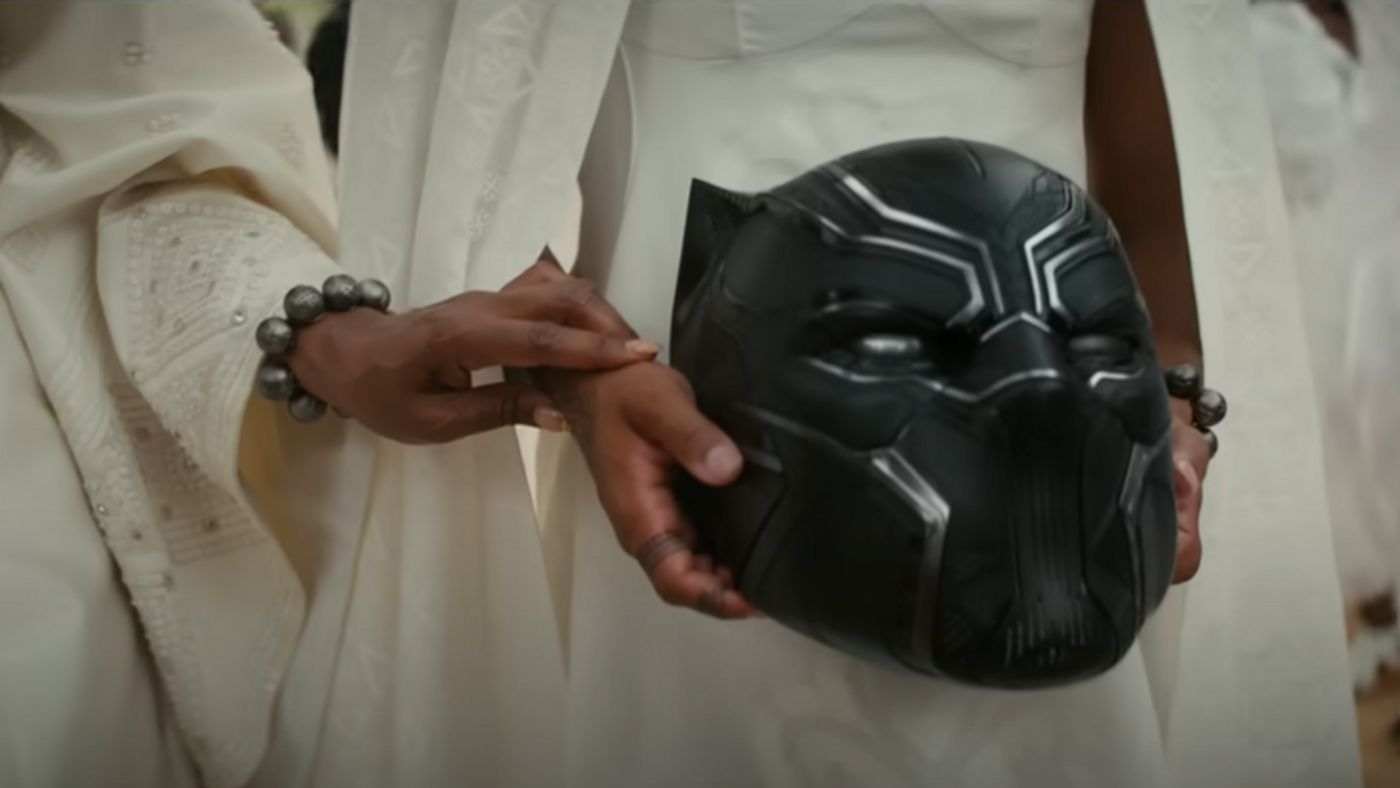

It’s hard to overstate just how much of a phenomenon Ryan Coogler’s Black Panther was. A sea-changing moment in Hollywood for representation in film and a billion-dollar grossing blockbuster that instantly became a cultural touchstone. At the heart of all that success was, of course, star Chadwick Boseman. When news hit of his tragic passing in the summer of 2020, after a private battle with colon cancer, it was a shock that was felt throughout the world. So the decision to move forward and continue the legacy of the Black Panther was always going to pose an uphill battle for director/co-writer Ryan Coogler and his creative team after writing a draft of the script before Boseman’s passing. Coogler and co-writer/longtime collaborator Joe Robert Cole take the real-life tragedy and weave in into the narrative of the film, using the sequel as a tribute to Boseman’s legacy. Given the circumstances at hand, the filmmakers have accomplished a miraculous feat. This is a sequel rich with poignancy and emotional intelligence.
Boseman had quickly become one of the more important and influential artists of his time, and the world didn’t get to realize that until he was suddenly gone. Wakanda Forever tackles those themes of grief and serves as both an examination and a reflection of the ongoing process. The film finds T’Challa’s mother, Queen Ramonda (Angela Bassett), and sister, Shuri (Letitia Wright), attempting to move forward, maintaining bureaucratic diplomacy since revealing Wakanda’s resources to the world and leading their nation without its king. For much of the first act, we spend time with the ensemble, also including Winston Duke’s M’Baku, Danai Gurira’s Okoye, and Lupita Nyong’o’s Nakia grappling with T’Challa’s passing. It’s these moments of genuine grief from both sides of the camera that make this so emotionally impactful.
There are some vulnerable and complex performances here, with Letitia Wright and Angela Bassett carrying the brunt of the emotional heft. Lupita Nyong’o brings an infectious warmth and grace to the screen and Danai Gurira continues to show more layers and unbelievable charisma. Tenoch Huerta’s Namor is easily one of the more interesting antagonists Marvel has introduced in some years. Not a true villain, this character occupies similar traits with that of Tom Hiddleston’s post-Avengers Loki. This isn’t a character so much set on the destruction of the world, rather the safety of his people. Huerta’s quiet intensity and nuanced portrayal makes for a unique new presence in the Marvel universe.
Winning an Oscar for his work on the first film, returning composer Ludwig Göransson’s score is more melancholic and experimental with its mix of African Drums and Latin Instruments. The introduction scene to Namor is highly suspenseful and the score in this sequence adds a heightened sense of unease with distorted choir vocals haunting the background.
Coogler is given the unfortunate task of not only having to reckon with the loss of his star while moving the story forward, but introduce a major new world and establish a new phase in the MCU. It’s impressive with how much Coogler is able to weave together, even if the film can sometimes feel overstuffed. The segments where the narrative wanders off to connect to the next Phase of the MCU feel strained and awkwardly wedged in. Notably, the return of Martin Freeman’s Agent Ross is wholly unnecessary and sucks all the weight and momentum out of the narrative, further bloating the 162 minute runtime.
Coogler’s precise filmmaking craft is largely why these films feel so much more sweeping and vibrant than the glut of typical Marvel flicks. Even at the films messiest points, Coogler is delivering more casually dynamic characters, urgent dramatic stakes and tangible character depth than most of the now-30 MCU spectacles. In that first film you felt as though you were transported to a breathtaking new world in Wakanda and were surrounded by a plethora of exciting new characters. Here, Coogler brings some of that sense of wonder in the further exploration of Wakanda and the introduction to the undersea nation of Taloken.
The water-heavy effects give Coogler, and cinematographer Autumn Durald Arkapaw (Teen Spirit), new avenues to differentiate from the usual Marvel color palette. Coogler is notably taking a page or two from James Wan’s filmmaking playbook after the success of Aquaman, but with an added emphasis on practical water effects more akin to Waterworld — and that is meant to be taken as a compliment. Unfortunately, the action sequences don’t stand anywhere near the swift style of the first film. However, the climactic battle in the final act is quite visually dazzling and finishes with a dramatically potent conclusion.
Black Panther: Wakanda Forever is a deeply moving tribute to the legacy of Chadwick Boseman. While a bit bloated and overstuffed, this is a stirring and dramatically rewarding follow up that is among the most emotionally resonant blockbusters.

A well thought out tribute to the late Chadwick Boseman even if it’s about it 20 minutes too long
Excited to see it I want a tribute to Boseman.
I thought every scene and moment as necessary to the movie. I can’t imagine cutting 20 minutes out of it.
Nice! I plan on seeing it this weekend if all pans out.
Reviews have been all over the place on this one. Still, the trailers for it look absolutely stunning.
Cooglers worst film to date but a lovely send off to his friend.
Wakanda Forver is a Masterpiece and a Revelation!! Leticia Write is now a superstar, and deserves an Oscar Nomination for this. Ryan Coogler continues to prove why he is The Steven Spielberg of this generation. I hope to see Wakanda Forever be nomination for Best Picture as the Original. This time it will have a shot at winning it. Chadwick Boseman is looking smiling for his Kingdom is in good hands. Wakanda Forever!!!!
It sounds like one of the more thoughtful and politically minded MCU films, reminiscent of the first Black Panther and Captain America: The Winter Soldier. The grief angle is also not dissimilar from the theme of WandaVision, although obviously handled in a much different way than that.
By no means a bad film to me, but it was okay at best. A lot of the character journey didn’t feel earned as much from a thematic viewpoint, but overall I’m glad I saw it.
Well-written and thoughtful review – I’m definitely looking forward to seeing this.
Original should stay original. But if this film was made as a tribute to Chadwick Boseman it would very thoughtful of them to do so. I have to be honest, I have not seen the first sequel yet, therefore, I wouldn’t be able to comment on it yet. I did see the trailer of the film, it looked beautifully made and very well acted.
Sorry if my comment fells more like review. Wakanda Forever was a beautiful tribute to the late Chadwick Boseman the opening had me in tears right away. I was wondering how they were gonna showcase how he dies within the MCU and rather than just saying he dies having T’Challa die from an illness was the best way. Namor as the villain was brilliant to me. The best villains are always the ones speaking the truth also having him drop the word mutant got me excited as Namor is considered the first mutant marvel comic. Shuri showing that anger doesn’t allow you to think clearly and not killing Namor at the end preventing a never ending war between her and his people sets up the future for Namor to become an anti-hero. I’m excited to see Sheri’s future as the black panther and queen. Also love Riri excited to see her when she interacts with the Tony Stark AI as she becomes Iron Heart in her Disney+ series. Although the Subplot with Ross and Val felt out of place, being more of a Thunderbolts set up. I heavily enjoyed Wakanda forever and it was a great end to Phase 4.
Initially I was wondering how were they going to incorporate Chadwick presence into the film after his transition, I can say I was pleased and pleasantly surprised how they incorporated him in the beginning and at the end, it brought tears to my eyes, bravo . The suspense of the underwater people kept me on edge , the drama that they brought to the Wakanda tribe and the demise of the Queen was tough but excellently executed, have me anticipating the next sequel for real, and that surprise during the credits is a must see, a great set up put in place, brilliantly done kudos to all the writers, directors, actors and costumes designers.
I do hope to see this one soon. The first one was absolutely fantastic.
I enjoyed the first film but I’m going to wait on this one until it comes to streaming.
I can’t wait to see it! I’ve just been way too busy right now x_X
Such a shame we lost him so soon
I really liked it! It’s one of the most politically charged Marvel movies alongside the first Black Panther, and I found the pathos surrounding T’Challa’s death genuinely touching. Loved Namor and thought the actor did a great job at showing off the character’s arrogance and nobility.
Wow, this is a very nice article it contains everything that I was looking forward to…I really liked the way you composed the article and it is really well-detailed. It’s nice so keep up the good work I look forward to checking out the whole of your website.