

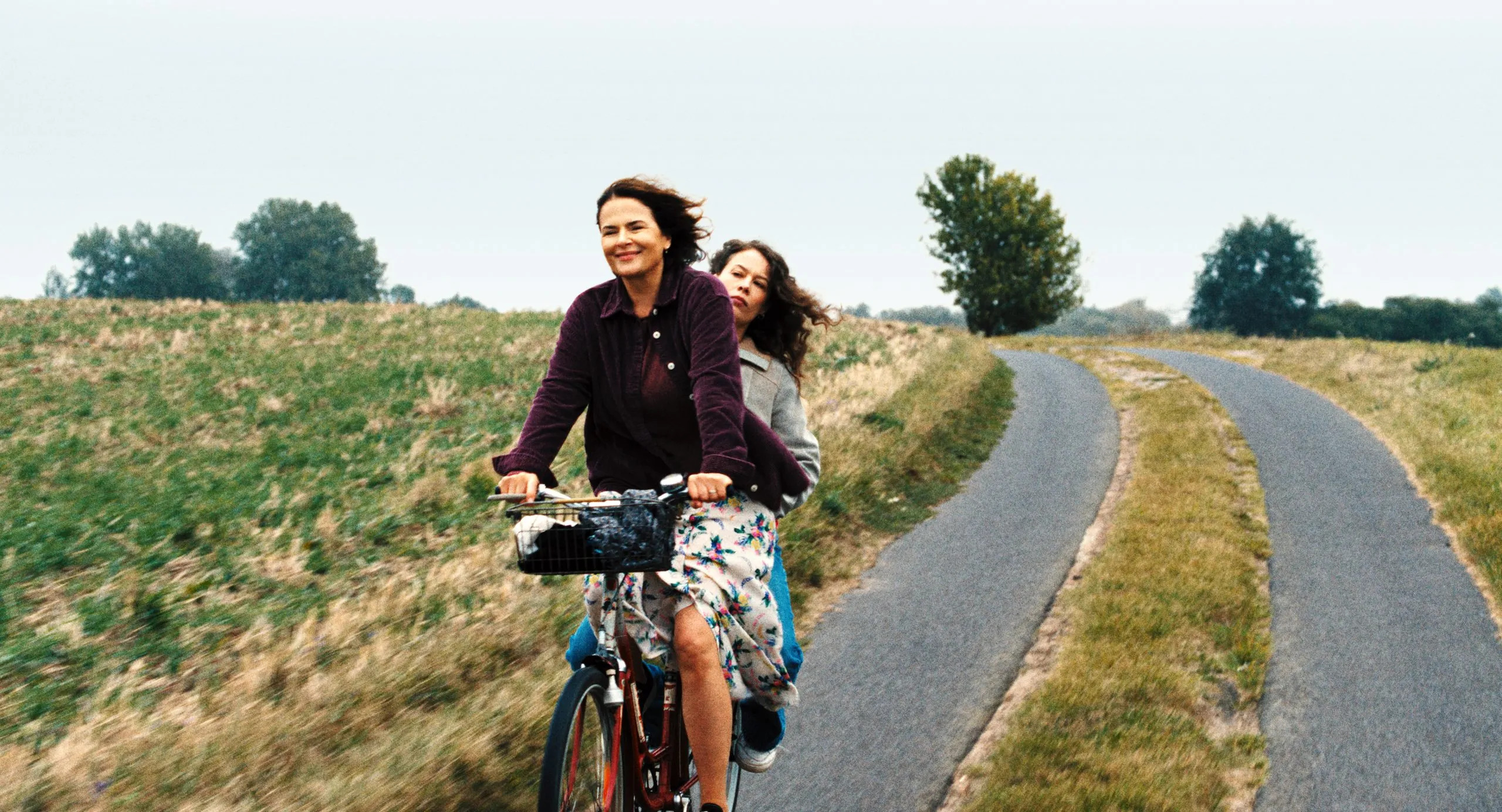

Miroirs No. 3 is a lyrical, unusual work that contains a lot of rich emotions, done in a way where not much seems to happen yet each moment is packed with such eventfulness, it may take multiple viewings to realize what you have seen. Indeed, the experience of the film, when it finishes, and you reflect upon it, alters your perception immediately. As is usual with director Christian Petzold’s work, the film takes place in the summer, in German, where you can sense a certain arid atmosphere, in scenery populated by complex yet simple and superbly drawn characters.

Courtesy 1-2 Special
Here, a couple, a man and woman, go to meet friends but soon after arriving, the woman, a college student studying classical piano, has an intense desire to leave, to go home and not interact with her companions. Her boyfriend reacts poorly, and one of their friends gives him the keys to his very fast car, in order to drive her quickly to the nearby train and come back. On the way there, they pass by a woman with a haunted expression and, seconds later, the car overturns, killing the boyfriend, and leaving the woman on the roadside to aid the young woman. The survivor decides to stay with her savior, and they develop a special bond, one which is only slowly understood to have other layers than mere kindness, when her son and estranged husband arrive to meet the girl.

Courtesy 1-2 Special
That much detail is needed in order to understand what this review is about to explore, which is the ways the film explores those relationships and interactions, and how the every day occurrences carry double meanings. We are thrown, at first, into the middle of obviously fraught relations, and see the immediate resolution. This is subtle yet important because the film is ultimately about the ways in which endings are really a chance at fresh starts, and how trauma can lead to learning and growth. This happens through the interactions with both the women as well as the girl and the woman’s son, who has perhaps the strongest reaction to all the events.
While much of the film seems to be just living a semi-idyllic life, there is the question of what really motivates these people, not in the sense of some sinister and mysterious twist about to unfold but rather in a manner similar to the works of Kelly Reichardt or Jane Campion. This is not quite slow-cinema, but it exists in the same part of the filmic universe. Here, it is about the looks, the silences, the moments where people do not say anything, that matter the most. It is about the sets and costumes and the ways in which the story is not explicit.

Courtesy 1-2 Special
When the resolution comes, and truths are told, what happens is catharsis and explosion, yet cold distant. Given what has happened and why, this is understandable, but it is because of the folly of the human condition and how authentic it feels, that it works as well as it does. The acting is delicate, and the photography careful. This is not a film where one will be drawn in because of flash, at least not visually. It is a naturalistic film in some ways and yet also has elements of a fairy tale. The script is replete with moments of wisdom, not in what is said, or lessons being taught, but rather in how exactly it understands the ways in which human beings interact. Petzold allows his actors and camera to tell the story, not through seeking attention but by paying attention to what matters. It is a film where interiority is allowed to be glimpsed in a way which is rare on film. To say more would be to spoil a special film, yet one that, because it is told as it is, may not work for everyone.
Miroirs No. 3 is now playing in select theaters.


Sounds like it has a lot of potential