


Adding another film to his deconstructionist portrait of American celebrity and lore, Andrew Dominik’s fourth feature film, Blonde, explores the self-destructive traumas within Marilyn Monroe’s character, to very divisive results that are already alienating mainstream critics and will inevitably polarize audiences once it drops on Netflix. A film that offers many high points in terms of visual style and ambition that goes to extreme lengths in chronicling the iconic actress, singer, and model’s fragmented and wounded psyche. Blonde, at its core, is the year’s most formally daring and uncompromising film; it increasingly awes on a technical and visual level but disturbs with its lurid subject matter. The film could easily be accused of growing tedious with its affliction, but Dominick’s film is endlessly engaging, heartbreakingly tragic, and emerges itself as an extraordinary cinematic feat that is both technically astounding and superbly acted.
Although a fictional account of Marilyn Monroe’s life that dramatizes her life with real events and tabloid rumors, Dominick also serves as writer as he adapts Joyce Caral Oates’s 2000 fictionalized novel, Blonde, perfectly suits Dominik’s fascination with American myth and celebrity, including how history is often sugarcoated and whitewashed with how society wants to perceive them, whereas Dominik prefers to be more contemplative and evocative in his approach. Dominik examines the consequences and compulsive impacts of misogyny and trauma. With Blonde, one can easily accuse Dominik of being exploitative, but Blonde at its core is about Monroe’s trauma and despair, which fulfills enough empathy to prevent it from being an exercise in depravity. Remarkably, the film possesses a fragile and vulnerable side along with all of Dominik’s visual flourishes, thanks to Ana de Armas’s central performance, where she brilliantly embodies Marilyn Monroe’s, and she elicits a valiant and emotionally raw performance.
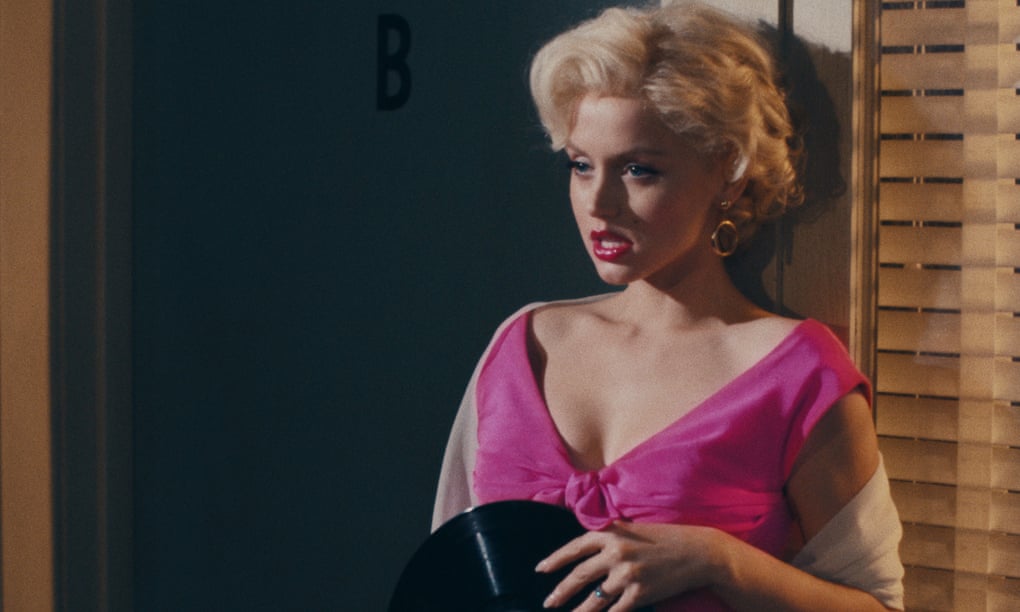
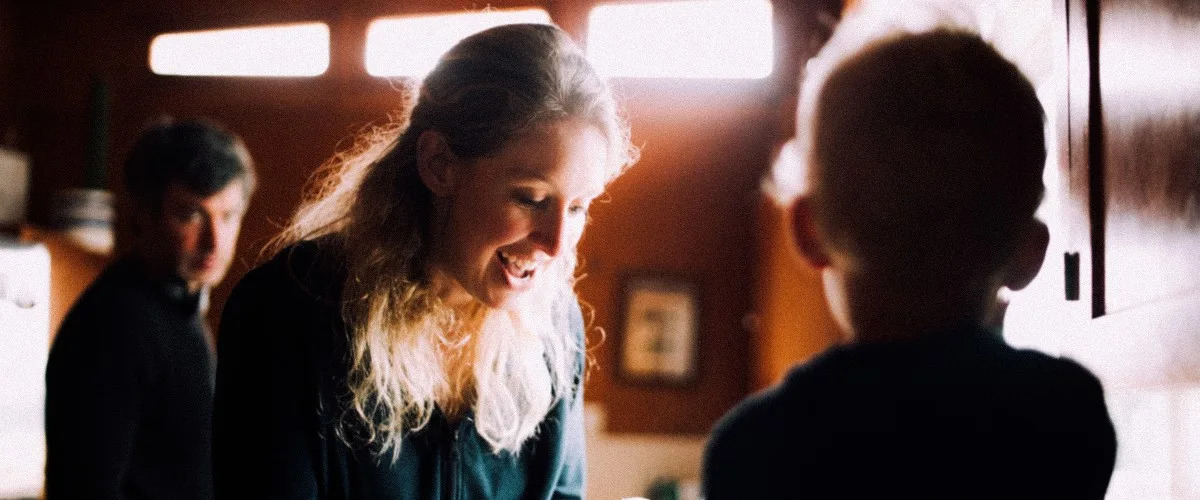
During the film’s prologue, which begins in 1933 Los Angeles, you know it’s going to be a distressing experience. We follow Norma Jeanne Mortenson (Lily Fischer), a child who suffers emotional and psychic abuse at the hands of her emotionally disturbed single mother, Gladys (Julianne Nicholson), who even attempts to drown young Norma Jean in a bathtub during the night of a wild L.A. fire. This leads to Norma Jean becoming an orphan and Glady’s being institutionalized into a ward. She is always yearning for the father that she never had. In which Glady’s proclaims a picture on her mother’s wall of a man she used to date, on the wall that resembled Clark Cable, her father, begins a rhythm and motif in the film. Throughout the film, we hear letters being read by a man claiming to be her father, claiming to be her son, and every time a shimmer of hope begins of her father returning, she experiences even deeper affliction along the way. Dominick doesn’t quite structure the film in familiar biopic territory; he mends the narrative transitions with fragments of Norma Jeanne’s life, with memories, and hallucinations. The Marilyn Monroe here is a determined artist who experiences an array of objectification and distress from her dual life of being a celebrity and Norma Jeanne when the cameras aren’t rolling both on set and in the public eye.
While blending fact with fiction, rumor and hearsay with history, the supporting cast in Blonde are also real-life people and tabloid rumors. While there isn’t despair on screen, we do find some joy in the film. There is an interlude in the film where Marilyn has ménage à trois with two sons of movie stars: Charles Chaplin Jr. (Xavier Samuel) and Edward G. Robinson Jr. (Evan Williams), who both bring Marilyn pleasure and joy, intimately and romantically. After proving to be a box-office draw, Monroe ends up being impregnated during the early stages of her career. This pregnancy can jeopardize her career. Based on rumors, Dominick stages the abortion (which was illegal at the time) as if it were a surrealist nightmare, as Marilyn Monroe screams in hysteria, escapes the room, and runs down a vacant hospital hallway.

As the film progresses, Dominik uses more interludes to show Marilyn’s love interests and how her longing for her father carried through with her relationships. Eventually, the men she encounters play out like father figures, in which she even calls them “daddy.” We’re introduced to Joe DiMaggio (Bobby Cannavalle), the legendadry baseball hall-of-famer who recently retired in the 50s with the New York Yankees. He ends up sparking a connection with Marilyn once he expresses the loneliness he feels always being in the public eye. After the premiere of Gentleman Prefer Blondes, Dimaggio ends up proposing to her in a hotel room, in which Marilyn is let down after thinking it was going to be her father in the room. She ends up reluctantly agreeing to the arrangement. Dimaggio promises to rescue her away from all the vanity and stardom. Eventually, the marriage between Joe Dimaggio and Marilyn Monroe were short-lived after jealousy and psychological abuse.
In one of the film’s most poignant segments, is the scene she encounters Arthur Miller (Adrian Brody). Miller’s character is the sincerest character in the film who truly loves Marilyn. There are some very tender and ravishing exchanges Brody and Armas share together, especially the beach scenes that appear to be shot with film stock. However, their relationship is doomed after a miscarriage happens after Marilyn trips on the beach. This leads to Marilyn back to being single and alone.

In one of the film’s most artistically and impressively staged sequences, the film also becomes one of the most unsettling. After Marilyn receives a phone call from someone important, we cut to Marilyn on a plane, where she is exhausted and fatigued. The plane stops in New York City, where two secret servicemen board the plane and escort her from the plane, and drive her through the city, and finally trek her through the back entrances of a hallway, and finally through the hotel room of President John F. Kennedy (Caspar Phillipson)—the last of Monroe’s daddy relationships—who objectives and exploits her in the most degrading way. Meanwhile, a secret serviceman just outside the room with the door open can hear every word. This particular moment, and the way it is staged with the TV playing a rocket launch, along with an extreme close-up of just the eyes of Monroe giving a fellatio, can easily be dismissed as self-indulgent, over-the-top, unsubtle, and unnecessary. It can also be rationalized as having a very suffocating effect, which leaves the viewer feeling deeply disturbed and queasy from the abuse.
On a visual and technical level, Dominik once again delivers astonishing craftsmanship. Just as he did with The Assassination of Jesse James by the Coward Robert Ford, he blurs the sides of the frame around Monroe to illustrate her fantasy of wanting to escape her alter ego of Marilyn and reclaim her past self of Norma Jeanne. We also get striking compositions throughout thanks to Chayse Irvin’s rich cinematography. We also have meticulously calibrated cuts and transitions that merge color in some scenes into a high-contrast mix of black-and-white. Not since Oliver Stone or Steven Soderbergh has a film brought such a strong, wide variant of different film stocks and aesthetics to the frame. Dominick’s stylized world alternates between dreams, nightmares, fantasy, hallucinations, and desires.

Blonde is a very visceral and emotionally challenging film. It’s a film that some may never want to revisit again due to how distressing it is. However, there will certainly be champions that will be ready to watch it again for even deeper meaning in terms of style and theme. I just might find myself falling into the second camp. There is a deftness to Dominik’s approach where so much of the drama reaches the pinnacle of what a biopic can achieve. With that, Blonde is certainly going to be a film that will be dismissed by many at the moment. Blonde is far from an Oscar contender, but it is a challenging and cinematic feat that will inevitably gain traction over the course of time. For all its profane scope and boldness, Blonde is an undeniably ambitious framework about a tormented and idolized icon we have all become to know. With Dominik’s skillful direction and Armas’ riveting performance, they both deserve high praise for taking their art to arduous places. It is problematic and, at times, vulgar, yet compassionate. For the more advantageous filmgoer, it’s worth the uncomfortable journey.

I really wanna see this film. I’ve always been infucatuated with her whole Hollywood story. I will most definitely see this!
Looking forward to this one. Superb review, as always.
I’ll definitely be watching this based on the directors track record. It sounds like an interesting take on her life story and I’m glad it’s not restrained by age ratings
Idk. Seems like a standard biopic but the story may be interesting
Great review! Another film on my list to checkout.
This looks amazing! I’m looking forward to seeing it!
Will be watching
Always excited to see something by Andrew Dominik. Looking forward to this one for sure.
Looking forward to see this film. I tried to visualize the plot as I was reading the reviews, I can see this film is emotionally at its gore.
Good review. You piqued my interest.
I am definitely going to be in the second camp team. You described this film perfectly. I have the Marylin Monroe book with all the copies of her birth certificate and marriage certificat.
They are dead on the story of Norma Jeanne and not really Marylin Monroe (she is the shadow for once).
The film name ‘Blonde’, says it all and she says in the scene trying to fit in with ‘normal women’. The hair is fake! Everyone one likes the glits and the glam but we all know about the demond that is Hollywood.
Well done to the director to push the envelope when everyone is afraid to be canceled.
This is a must have dvd.
Fantastic review, Robert. Will def be watching this film.
I didn’t know the film was released. Thank you for the great review!
Fantastic review Couldn’t have said it better myself. You pretty much articulated my entire thoughts and feelings towards the film from front to back. Very much co-signing this review after finishing it now myself. Armas in the least deserves a nomination even if the academy probably won’t care for how Dominik displays old Hollywood and shows it’s nasty underbelly.
Great review! I totally agree that from a filmmaker standpoint, it’s great visually but the story lacks heart and humanity. Glad I watched it but probably wont rewatch. They miss the mark with the writing for me.
Brilliantly-written review, Robert! One of your best! You really peeled off the gauze!!
I’m well-aware of the largely mixed-to-negative responses to Andrew Dominik’s new Marilyn Monroe movie, “Blonde,” which I watched on Netflix last night after another decent film recommended to me by a relative. A few close friends have also panned it. Alas, I have to join those who found “Blonde” a mostly riveting, audacious and surreal experience that requires a kind of intimate immersion. I have not seen a more extraordinary performance this year than the one delivered by Ana de Armas as Marilyn, who burns holes in the screen. I’m still taking in what I saw, and I am certainly aware of the charges made against the film as being dehumanizing, exploitative and abortion propaganda. Hmmm. Not buying into any of that either.
Great review of this truly remarkable yet, as you noted, also divisive film. It’s unfortunate that there is so much hatred and misinformation being thrown towards this film, as I think it will stand the test of time and be considered a classic. It will be interesting to see how Blonde fares during the 2023 Academy Awards season.
I still can’t form a solidified opinion on this film. There were moments where it is certainly a 3-4 star film. Then there were moments where it was nowhere close. But one thing is certain, it has stuck with me.
terrific review – an amazing film!
Dear defactofilmreviews.com webmaster, You always provide great examples and case studies.
Hello defactofilmreviews.com admin, Thanks for the comprehensive post!
Hello defactofilmreviews.com administrator, Your posts are always well thought out.
Dear defactofilmreviews.com administrator, Thanks for the in-depth post!
Dear defactofilmreviews.com administrator, Well done!
To the defactofilmreviews.com admin, Your posts are always well written.
Dear defactofilmreviews.com administrator, You always provide in-depth analysis and understanding.
Hello defactofilmreviews.com administrator, Keep sharing your knowledge!
To the defactofilmreviews.com administrator, Thanks for the well written post!
Hello defactofilmreviews.com owner, Thanks for the well-researched and well-written post!
Hi defactofilmreviews.com admin, You always provide clear explanations and step-by-step instructions.
Hi defactofilmreviews.com admin, Thanks for the educational content!
Dear defactofilmreviews.com webmaster, You always provide useful information.
Hello defactofilmreviews.com administrator, Thanks for the well-organized and comprehensive post!
Dear defactofilmreviews.com administrator, Thanks for the well-organized and comprehensive post!
Wow, great blog article.Thanks Again. Awesome.
Hi defactofilmreviews.com administrator, Thanks for sharing your thoughts!
Thanks-a-mundo for the blog.Thanks Again. Really Cool.
a brave film on marilyn monroe. we pick a lot of beautiful things on this review