

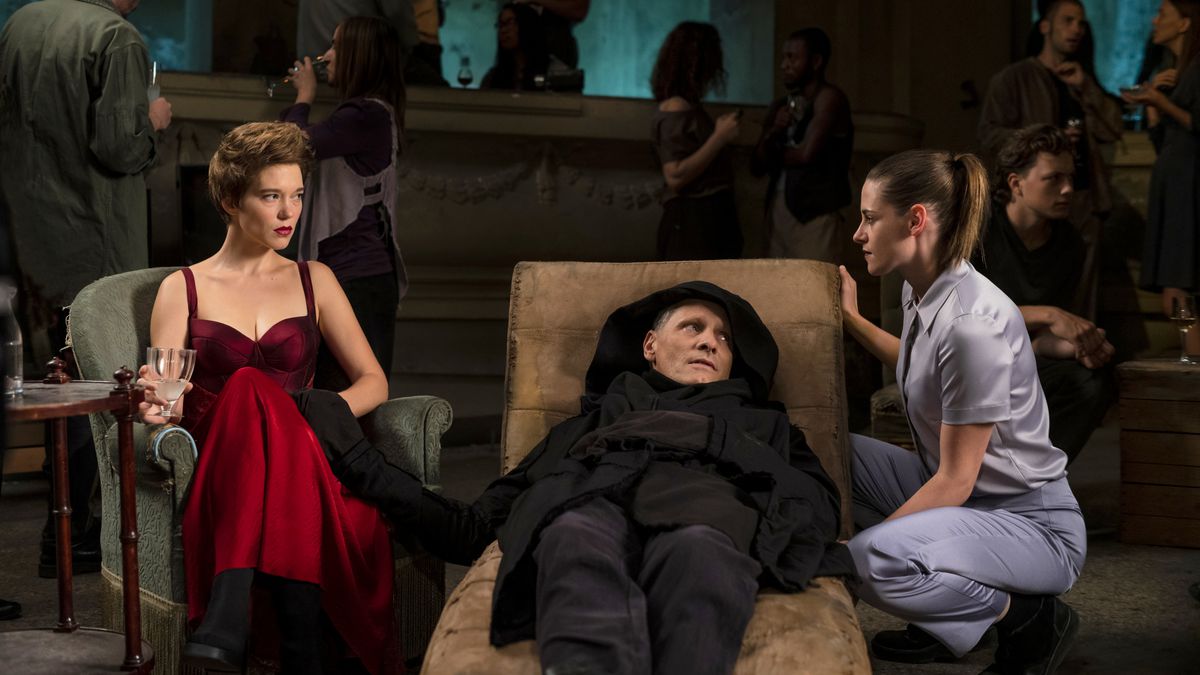

A dystopian planet where the human population is nearly extinct and human autonomy is transforming, or rather mutating, is just the starting point for David Cronenberg’s provocative and effectively grotesque body-horror sci-fi thriller. More in the vein of his past body horrors such as Videodrome, Dead Ringers, and eXistenZ, and very likely to garner a new following among a younger generation, Cronenberg’s latest once again delivers all of his commonalities of haunting imagery, visual metaphors, rich satire, and high-minded ideas that bounce between the opaque and the surreal. Cronenberg once again ponders, in the most abstract way, deep questions about the human race and our environment’s conditions, as well as the possibilities of where human evolution can lead. A challenging, complex work that evokes a visceral experience from the audience to mentally shift and immerse themselves in a singular vision of interior and exterior experiences with its characters, the film will certainly polarize, but it will please die-hard Cronenberg fans, and it also has great potential of being more appreciated as years go by. The film will inevitably satisfy art-house, horror, and grindhouse movie lovers as well.
Cronenberg’s inspiration is reminiscent of his other horror and sci-fi films, most notably Videodrome and eXistenZ, both futuristic sci-fi films that cast a satirical spotlight on humanity’s overstimulation of technology and how corporations control humanity and society. His latest film, whose setting is a complete societal collapse, feels like a tragic aftermath of a trilogy, or rather a companion piece to Cronenberg’s body-horror masterworks with some elements of Dead Ringers and his controversial anti-erotic film Crash. Cronenberg moves past the cautionary stage to a place of deeper wisdom of a hyper-real world of just how things can eventually become as society continues to feel on the verge of collapse these days with global collapse from climate catastrophe, diseases, civil unrest, economic uncertainty, polarization, and the rise of fascism. Cronenberg is set on hitting a nerve, and the film is at times shocking and cerebral, but it’s also thoughtful, darkly comedic, and well-scripted.
![Crimes Of The Future Footage Reaction: David Cronenberg Returns To Body Horror [CinemaCon 2022]](https://www.slashfilm.com/img/gallery/crimes-of-the-future-footage-reaction-cinemacon-2022/l-intro-1650996114.jpg)
The film also shares the title of Cronenberg’s sophomore feature film, the 60-minute Crimes of the Future (1970), which also takes place in the future but is about a virus plague caused by skin products that killed off the female population where the virus mutates and begins attacking men. Cronenberg’s latest film isn’t a remake, or even a continuation, but it is quite interesting how he chose that title again as if he wanted to rework his original roots.
Cronenberg, who has mostly directed other writers’ original scripts (Eastern Promises, Maps to the Stars, Spider), graphic novels (A History of Violence), and even plays (A Dangerous Method), so far this century, returns back as a solo writer on an original screenplay for the first time since eXistenZ. Cronenberg also served as a writer for Cosmopolis, but that was based on the acclaimed Don Delillo novel. Cronenberg certainly indulges in his body-horror here and don’t believe all the hype, while grisly its nowhere near as disturbing as the Cannes crowd claimed it to be. Cronenberg also offers some fascinating and thoughtful ideas about body dysmorphia and just how compulsive and extreme individuals get with their bodies. We see this in society today with weight-loss, tattoos, plastic surgery, and other cosmetic procedures where individuals push themselves to appear “perfect.” It’s as if their bodies become canvases where they lose all self-control, which leads to desperation, obsession, and extremes. The themes of desperation, obsession, and taking things to the extreme are also found in Cronenberg’s 1996 indie classic Crash, which has now gone on to become more celebrated than Paul Haggis’s Best Picture winner of the same title.

With all the past themes, the setting is the not-too-distant future. Society has collapsed, humanity has depopulated, and body surgery is the new sexual encounter. It’s also a world where humans no longer feel pain or pleasure. We see many abandoned ships in the harbor, and technology seems to regress back to retro 80s camcorders and unpleasant decor and uncomfortable highchair that helps humans’ digestive system as eating appears to be an unflattering task. The setting feels right out of a Franz Kafka or William S. Borough novel. Like many high-minded sci-fi films, we are given very little exposition as to what allowed the planet to decay, but it’s clear that humanity’s changes and demise are from climate change. It’s a world where children eat plastic containers for a snack, and there is a small community where a few have survived, and somehow, they begin to grow new body parts and transform physically from a disease known as Accelerated Evolution Syndrome.
The film opens with a young 8-year-old boy observing out in the ocean a sunken ship near the shoreline. His mother signals him to come back inside and warns him to not eat anything. The mother ends up killing the young boy after she catches him eating plastic, simply because she rationalizes to herself that he is inhuman. This ends up becoming a pivotal subplot in the film that introduces frequent Cronenberg collaborator Viggo Mortenson (A History of Violence, Eastern Promises, A Dangerous Method). Mortenson delivers an extraordinary, unique, and seething performance as Saul Tenser, a subterranean performance artist who collaborates with his partner Caprice (Lea Seydoux), where they perform an act that consists of Caprice operating a jellied remote control that controls sharp objects that slice open Saul each time, she performs these performances on an operating table. Think of a live-action version of the board game Operation, but with odd Cronenberg organs instead, as she endlessly cuts the new body organs that keep growing in Saul’s body. Saul feels great pleasure each time she does this, which is referred to by a character as “the new sex.”

The Franz Kafka literary influences really begin to come into play, especially with the introduction of two eccentric bureaucrats who work for the underfunded National Organ Registry. We meet Wippet (Don McKellar), who heads the department, and he has an assistant, Timlin (Kristen Stewart), who is very drawn into Saul. Timlin even suggests she wants to observe these performance art shows that Saul and Caprice perform together. Wippett and Timlin end up attending the underground shows, which only furthers her attraction to Saul. She even suggests that she wants to do surgery on Saul, as we observe some jealousy brewing from Caprice. Meanwhile, a local detective named Cope (Welket Bungue) of the New Vice Unit of Justice, is investigating the murder of the little boy and ends up prying Timlin and Wippet into giving more information on the underground cult that attends the performance art shows that look like Saul as a messianic precursor of what lies in store for humans in the future.
Meanwhile, we see another subculture, a more anarchist cult group, that has undergone their own form of human evolution, which is eating plastic candy bars that are covered in chocolate. The father (Scott Speedman) of the deceased boy, Brecken, who died at the hands of his mother in the opening scene, tries to persuade Sual and Caprice to perform an autopsy to demonstrate how evolved the boy was with his organs. This leads up to a very mesmerizing moment in the film that ties Cronenberg’s ideas and themes together.

While the film will require time to process, as well as repeat viewings for the ones that you admire, the narrative is fleshed out with many ideas–at times underdeveloped–blending a fascinating experience with its hypothetical future. Cronenberg’s films often get more appreciated as time goes on, whose focus is on relevant ideas and haunting imagery juxtaposed to maximize Cronenberg’s ideas and subtext.
As a cerebral and surrealist director, Cronenberg has an impressive track record of forging futuristic settings with complex characters who wrestle through their psychological conflicts stemming from the physical. Here he casts his favorite muse, Viggo Mortenson, in their 4th film together, again limning a complicated protagonist of deep complexity and inner turmoil trying to gain control of his altering body. The film ends on a very abrupt but ambiguous note of an artfully framed close-up of Mortenson, as his emotions pour out of courage and uncertainty that feels like it is straight out of a Carl Dryer or Fritz Lane silent film from nearly 100 years ago. Some audiences might leave the theater perplexed or even grossed out by the body horror, but you can always depend on Cronenberg’s vision and impressive directing skills to carry out a sophisticated and thoughtful movie.
Cronenberg’s 22nd feature isn’t great Cronenberg, but it’s still an interesting and visionary framework. A sci-fi epic with memorable world-building and astonishing Kafkaesque interiors and decors, a very unique film, where the imagery (cinematography by Douglas Koch), along with another woozy score by Howard Shore, and impressive performances from Mortenson, Seydoux, and Stewart, along with the juxtaposition of everything else, tells a darkly alluring story.




That’s how I felt.
It’s a good movie, and has some damn good performances, but it was a weaker Cronenberg.
Not his best, but good performances all around. Visually entertaining for sure!
From what I read the movie sounds like it could have an interesting plot, but it’s “artsy fartsy” nature may take me out it. Love the review though
Oooo, I’m excited to see this. I love dystopian films about societal collapses. The take sounds interesting from the first part of the review I read. I stopped reading before too many details and subjective perspectives were discussed as I like to go into films clean of outside opinions. What I read made me wonder why Tetsou: The Iron Man was left out of this discussion of body horror films that question humanity’s love of technology and the destruction of our current environment That film definitely still feels relevant as the argument is currently being made that we are already a ‘cyborg being’ in the way we utiliza our handheld technology. It’s strength grows annually as we find new ways to interact with technology specifically designed arpund pur personalized handheld devices. Smartphones and tablets are already an extension of our physical bodies.
What I read also made me wonder about the juxtaposition of a film like Begotten in relation to this new film of Cronenberg’s. Begotten’s themes of death, rebirth, and religion might have a place in this discussion of humanity’s love of technology and how we’re systematically destroying ourselves. Will we be reborn again, but better, or will we just continue the cycle of destruction. Will our presence ever be a benefit to the earth and environment?
Thank you for the review, Robert. Will check out Cronenberg’s latest film.
The best news is that David Cronenberg has not mellowed at all. Crimes of the Future is an oddly comforting film. All the things I have loved about Cronenberg are on full display here. Howard Shore delivers another wonderful score! How wonderful is it to see David Cronenberg direct Viggo Mortenson again. There partnership should up there with Scorsese/ DeNiro, Scorsese/DiCaprio, John Woo/ Chow Yun Fat and Chow Yun-Fat/Ringo Lam. Seriously when Viggo teams up with David Cronenberg, magic happens! Kristen Stewart and Lea Seydoux are equally wonderful! In David Cronenberg We Trust! Surgery is sex!!
Checking this one out this weekend! Ready for some existential dread well Sauceda with body horror!
Pretty cool flick! I was drawn in by both its central premise and its dark, desolate depiction of a surreal future. Like many of Cronenberg’s past films, the overall tone is somewhat cold & distant yet there actually is an emotional core to the story that gradually reveals itself as the narrative progresses. Also, as expected, there’s a lot of graphically disturbing imagery on display that’s wildly creative (dare I say… kinda fun at points? and something only Cronenberg can deliver in this way.
The acting is solid across the board, ESPECIALLY Kristen Stewart who goes all out with her supporting role and gives possibly the single horniest performance of the 21st century so far. Really wish she had more screen time (whenever she wasn’t onscreen I kept thinking “Where is she?!”).
That’s kinda my one setback with the movie as a whole: I really enjoyed just about everything here but I also wish there was more of it! When it ended I felt a little unsatisfied, not because I didn’t like the ending (far from it), but because I felt like there was more to this world that could’ve been explored. But still, I had a good time with this one and I have a feeling I’ll be seeing it again since there’s a lot of substance & complexity here to chew on
I saw it this week too and feel the same. I wanted more depth and world building. Ideas were introduced, floated and abruptly dropped. Same with a few characters. I liked the Dave Bowman moment at the end.y
Very frustrated by the ending. The plot progression and the score left the final act feeling so incomplete
I don’t think the title of your article matches the content lol. Just kidding, mainly because I had some doubts after reading the article.