

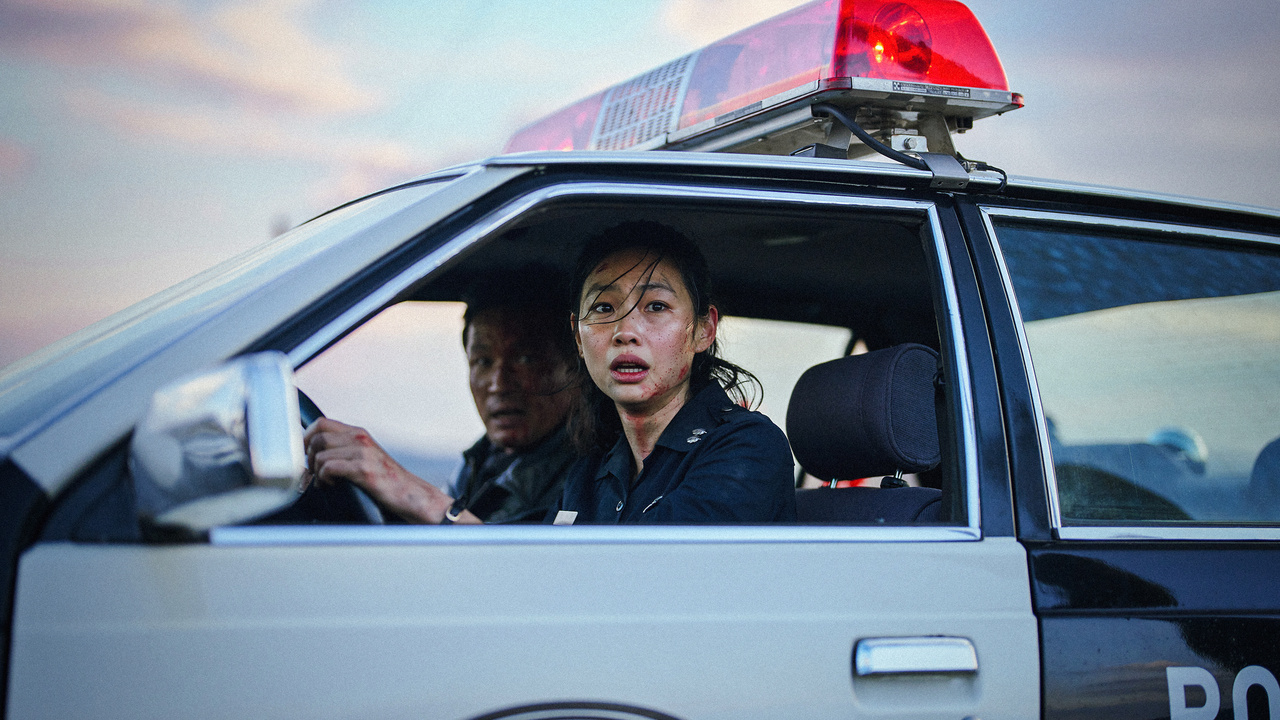

Na Hong-jin’s Hope marks the celebrated director’s long-awaited return, arriving a full ten years after his highly impressive and much celebrated 2016 horror thriller The Wailing. Known for his unmatched ability to weave bone-chilling dread with propulsive cinematic bravura, Na constructs a film that begins as a deceptive slow burn before exploding into uncharted genre territory with his fourth and latest film Hope.
The narrative opens in a straightforward, routine manner, taking its time to establish the atmospheric dread of a remote rural community. Once the primary threat materializes, however, the film shifts into high gear, delivering relentless thrills anchored by a masterclass in tension. The centerpiece of this early onslaught is an absolute tour-de-force chase sequence featuring the massive, ogre-like creature violently pursuing speeding vehicles through twisting roads with a sequence executed with staggering practical and visual effects integration that leaves viewers breathless.
The plot of Hope unfolds in the remote South Korean village of Hope Harbor, where a localized crisis quickly spirals into an interstellar conflict. The narrative is anchored by three primary local figures, beginning with Ko Bum-seok, played with desperate, everyday grit by Hwang Jung-min, who serves as the village police chief thrust into chaos when mysterious livestock mutilations turn into a full-scale massacre, forcing him to try and protect his isolated community as communications are cut off by nearby wildfires. Alongside him is Ko Sung-ki, played by Zo In-sung, who acts as Bum-seok’s second cousin and a local hunter initially venturing into the dense, foggy woods to track what he thinks is a stray beast, only to find himself and his fellow hunters hunted in return.
 Courtesy Neon
Rounding out the local trio is Sung-ae, played by Hoyeon, a sharp, level-headed rookie police officer who assists at makeshift field hospitals and helps piece together the terrifying reality of what is hunting them. As the local investigation deepens, the film pivots into massive sci-fi terrain, revealing that the earthly terror is tied to an extraterrestrial arrival featuring the towering, armor-clad alien leaders J’aur, played by Alicia Vikander, and Ma’veyyo, played by Michael Fassbender, who lead the cosmic intrusion alongside subordinates like Ai’dovor, played by Taylor Russell, and Va’migere, played by Cameron Britton. Through a blend of precise motion-capture and foreign-tongue voice work, Vikander and Fassbender portray the alien couple searching for their lost infant, turning an isolated rural tragedy into a sprawling, high-stakes war between bewildered humans and unstoppable cosmic forces.
The heart of the narrative relies on its grounded human anchor, most notably embodied by Ko Bum-seok, played with desperate, everyday grit by Hwang Jung-min. As the small town grows vacant and mutilated bodies begin to pile up, Bum-seok and the surviving townspeople must band together to track the looming threat. The character dynamics ground the high-concept terror, making the escalating panic feel immediate and visceral.
Yet, just as the audience settles into the rhythms of a conventional creature feature, Hope boldly evolves into expansive sci-fi terrain. The ogre creature gracefully takes a backseat as the narrative reveals its true, cosmic origins: an alien invasion orchestrated by a presence by Fassbender as Ma’veeyrro and Vikander as Empress J’aur over impressive CGI bodies. The third act reaches stunning artistic heights, introducing armored alien warriors adorned with striking alien iconography that elevates the visual spectacle. Special commendation must be given to the forest sequences, where Na utilizes dense foliage, creeping shadows, and atmospheric sound design to forge a sense of profound isolation and dread.

Courtesy Neon
As the isolated village’s communications are completely severed by raging wildfires, the frantic execution brilliantly captures the sheer panic of an unequipped community stumbling blindly into an interstellar war they are entirely unready to fight.
While the relentless creature feature action delivers plenty of pulse-pounding spectacle, the film occasionally leaves you wishing it spent a bit more time deepening its human characters and exploring their emotional arcs. Compared to sprawling genre epics and classic monster movies like Predator, The Host, The Mist, and the chillingly suspenseful indie creature feature End at Oak Street, Hope leans much heavier into cosmic ambition than intimate character study, yet it remains a towering visual achievement that leaves a lasting mark on modern monster cinema.
Back to Fassbender and Vikander who deserve high marks for delivering an eerie, detached, yet commanding personality to Hope through a hybrid of precise motion-capture performance and chilling vocal work. Rather than relying on generic monster roars, their vocalizations utilize their native languages and calculated cadences to imbue the towering, armor-clad CGI bodies with an unsettling, intelligent presence. Their facial performances which captured meticulously via head-mounted cameras on a mocap stage—transfuse human micro-expressions and fluid psychological weight into the digital creation. This gives the alien couple a distinct personality that oscillates between terrifying cosmic detachment and a tragic, almost sorrowful vulnerability as they navigate an unfamiliar world. Adding to the dynamic, it must have been a uniquely fun and creatively liberating experience for Michael Fassbender and Alicia Vikander to share the screen—or rather, the motion-capture stage—considering they are married in real life.
 Courtesy Neon
Admittedly, the film is quite lengthy and occasionally hits the same narrative notes more than once as it stretches its runtime. Yet, Na’s undeniable skill as a director paper over these pacing hurdles. From the white-knuckle car chases to the haunting wood scenes, his command over the frame never wavers. Beyond the interstellar terror, the film quietly weaves a poignant allegory through its cosmic arrivals, functioning as a nuanced metaphor for migrants and undocumented immigrants navigating fear, hostility, and the painful struggle for displacement in an unwelcoming land.
Ultimately, Hope succeeds not merely through its blockbuster visual effects or its star-studded voice performances, but through Na’s singular vision. It is a bold, uncompromising epic that takes narrative risks few directors would dare attempt, proving that the decade-long wait for his follow-up was more than justified.
Hope is now playing in theaters



Hope is a wild ride. Great action, sound and cinematography. Sags a bit in the middle. But the two long fight scenes at the beginning and end make this film great. 3.5 of 4 stars