



Peter Hujar was a photographer in New York, most prominent in the 1970s and 1980s. Before dying, as far too many artists of that era did, of AIDS, he left behind an unusual project, recorded in 1974. His friend, the writer Linda Rosenkrantz, had asked him to participate in a complete recounting of a single day. December 18 1974 had been selected by her for him to tell her everything he did that day. It was selected because at the time it was decided, it was simply an ordinary day. Sadly, the audio recording of the conversation no longer exists. The film we have is based on the complete transcripts.
Courtesy Janus Films
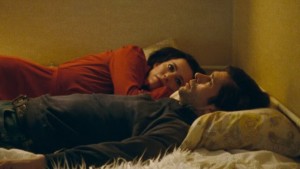
Here, in writer and director Ira Sachs new film, Peter Hujar’s Day, Ben Whishaw and Rebecca Hall play Peter and Linda. There have been many films about two people talking, such as Linklater’s Before trilogy and Malle’s My Dinner with Andre, but those films were much more interested in characters and ideas. Here, it is about moments and personality, beyond “character” because what we have is essentially a reconstructed documentary. This should not work nearly as well as it does, but it succeeds because it accepts the limits of the premise, embracing them to the fullest and not trying to do more than tell what transpired.
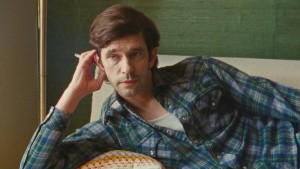
What did happen, you might ask? More than we might have imagined. Peter is shown, at times, to be an unreliable narrator. Not because he is trying to embellish, but because of his memory, and an initial hesitance to open up. As the film progresses, he gets into the mood and becomes quite a raconteur. Hall, opposite the loquaciousness of Wishaw’s Peter, is a model of quiet listening, taking in what her friend is saying and not so much guiding him as pressing him to clarify or detail new dimensions of the day he is recounting.
Courtesy Janus Films
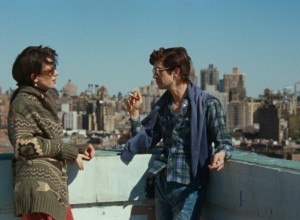
What begins as Peter getting dressed soon becomes a tale of his meeting Alan Ginsburg, being told what to expect with William Boroughs, and navigating several moments of professional pride or crisis. We meet nobody else. Yet, we get to understand and see it unfold, so vivid are the words and the expressions on Wishaw’s face, and the tone of voice he uses. The film is also mainly set in his apartment, with a few shots on the roof or in front of his building, but that is all the better. Instead of seeing the outside world, we hear about it, and know it only from his telling.
The period detail is astonishing, including a photographic appearance that evokes the films of the 1970s. The colors are muted varieties of beiges, browns, yellows and greens, with dashes of brighter colors. The apartment is cozy, lived in and yet not messy. There appear to be no anachronisms, and the recording equipment we see is all large and bulky. Indeed, there are times where the audio in the film almost sounds like the quality of audio you might expect to hear from old professional tapes. All of this helps immerse the viewer, as surely as the cigarettes Pete smokes or the clothing he and Linda wear, tell us something of the time, place and people.
Courtesy Janus Films
At the same time, despite all the great work on display here, the film is perhaps too simple to be recognized as truly great. It is, without a doubt, superbly made, and it is a very good viewing experience that tells a small, intimate story very well. Yet, it does not access any further layers, which was never its purpose. Its ambitions are too small despite the quality with which they are executed, to push this to the next level. If you like such films, or are interested in slices of life, New York in the 1970s, views of the artistic community of New York in the second half of the twentieth century or admire the work of Hall or Whishaw, see this one.
Peter Hujar’s Day is now playing in select theaters.




This sounds like it could be interesting
Very well done film consisting mainly of Ben Wishaw discussing the previous day. If you ever wanted to know about Allan Ginsburg, this is the film. Wishaw fills the role of Peter Hujar’ wonderfully. 3 of 4 stars