


 GRADE A
This first half of the decade has been quite notable for female directors, especially for fresh voices. The debut feature written and directed by its lead, Eva Victor, is deeply personal about female trauma—one akin to Eliza Hittman’s masterpiece Never Rarely Sometimes Always and Emerald Fennell’s Promising Young Woman, which were both released just five years ago. Victor, who starred in the Showtime series Billions, self-stars in this independent film, which generated huge buzz out of the Sundance and Cannes Film Festivals. The film hits with deep humanism. It’s structured similarly to last year’s Strange Darling, as it’s divided into chapters that are non-linear to capture the fragmented mind state of Victor’s protagonist. Its structure begins after the traumatic event, in a more therapeutic state. Then the film goes back to the events that led up to the incident, and the third act catches back up to the present. When it ends, you walk away deeply absorbed by the film’s deep empathy, and you will be pondering it on a deeply emotional level in just how personal the film goes.
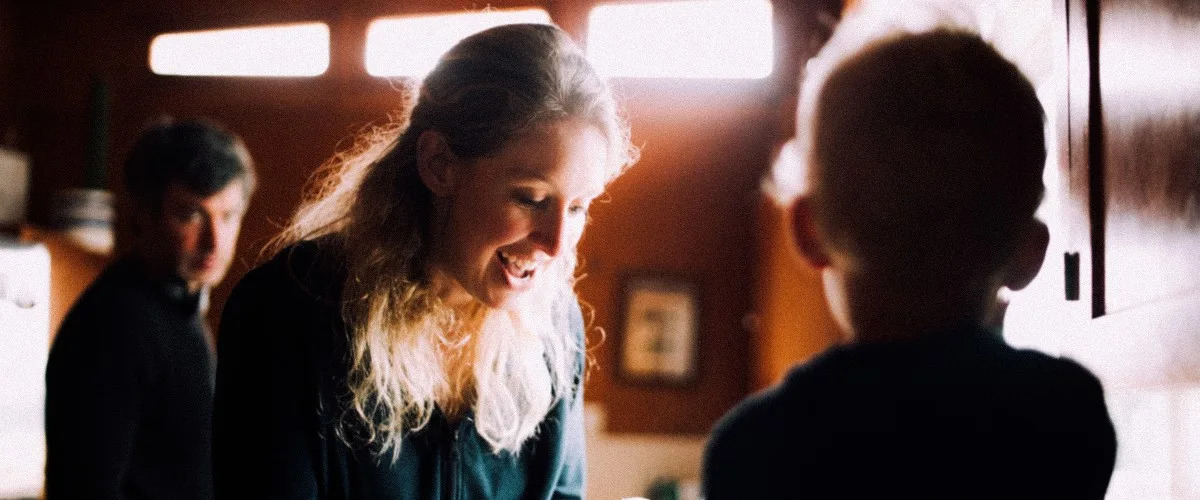
The film begins very joyful and comedic. It appears to be a film about the power of friendship, as two besties, Agnes (Victor) and Lydie (Naomi Ackie), are casually hanging out at Agnes’s home in rural New England. We learn that Lydie is in town visiting from New York. They start off making jokes about relationships and their sex life, and we are introduced to Agnes’s neighbor Gavin (Lucas Hedges), who knocks on the door for a quick hello, and things get socially awkward once Lydie notices that Agnes is clearly attracted to him. It’s revealed later in the film, before the events, that she indeed has a relationship with him that Agnes doesn’t reveal to Lydie, as she is a very discreet person. Lydie ends up revealing that she is pregnant by a sperm donor. Agnes is very supportive of her, and they walk to a beach off the shores of New England when the news is revealed that Lydie is 10 weeks pregnant, in which Agnes says the fetus is probably the size of a mouse, in which a mouse begins a very powerful metaphor later in the film that I will not spoil. The two end up at a dinner with their colleagues, including Natasha (Kelly McCormack), who holds a lot of animosity towards Agnes for her getting a full-time teaching professorship at the college Agnes now teaches at. Triggers begin to brew during the dinner, in which Natasha and her fellow colleagues remind her of the traumatic incident that occurred to Agnes.

Courtesy A24 Films
The film’s structure reverses back to the past to examine the build-up during Agnes’s graduate time, in which they are part of a writing advising group led by a literature professor, Preston Decker (Louis Cancelmi). When they first encounter, you can sense that Agnes has an attraction and fondness for Preston. She admits to really enjoying his writing style, and Decker praises Agnes’s writing and thesis, even calling it “extraordinary.” He even offers her a first edition copy of Virginia Woolf’s To the Lighthouse before he is disrupted. Later, Agnes ends up meeting at Decker’s house. In a brilliantly staged sequence, the camera stays in a static shot of just an establishing shot of Decker’s house, and we see a time lapse throughout the night until Agnes leaves the house very distraught and in a traumatic state. She slowly walks home in a striking tracking shot and takes a bath and reveals to Lydia that she had been sexually assaulted by Decker. Even though she was attracted to Decker, during the exchange Agnes reveals that he was very aggressive and domineering during their intimate encounter, making her very uncomfortable, which tragically leads to sexual assault.
Upon the incident, we follow Agnes through the aftermath of the crime. The film subtly examines a system already stacked against her from the university disciplinary board (who are both female), who appear supportive of the incident but claim it’s out of their hands now since Preston is no longer employed. When she goes to a doctor to get tested for STDs, you can sense the patronizing attitude from the doctor (Marc Carver) that begrudges her for taking a bath and not getting tested for rape right after the incident, as he treats the incident more mechanically than with empathy. Agnes is still numb from the encounter, but she ends up finding a stray kitten that brings her some joy. In one of the film’s highlights, Agnes is selected for jury duty, and she admits that she isn’t sure if she can be impartial due to her experience of the assault. She is dismissed by the prosecutor Eleanor Winstone (Hettine Park) in a brilliantly scripted scene that has a hilarious non-verbal performance by the clerk (Alison Wachtler) that will remind you of the work of Alexander Payne. The film proceeds with many other superb scenes that deliver genuine pathos.
Agnes gets a full-time job as a professor, and her feedback is “extraordinary,” which leads to a subtle trigger. Another great moment of the film includes a scene where Natasha has a skewed perception of Agnes once she admits she is envious of her success and reveals that she also had sex with Decker while they were students, thinking Agnes only “got ahead” because of Decker. Agnes has a panic attack, and she is calmed down by a driver on the road named Pete (John Carroll Lynch), who gives her a delicious pastrami sandwich at the construction grounds of a store he is about to open.

Courtesy A24 Films
Sorry, Baby is a film that is a lot to process emotionally. This film will be very personal for many viewers as well. It’s an honest look at trauma and what it does to our psyche, coming from a fresh voice whose first film feels like the work of a seasoned veteran. The film finds a disarming sorrow, but there is a lot of joy to be found as well. Sorry, Baby takes a little more to unpack than Promising Young Woman or Never Rarely Sometimes Always, probably due to the structure and the powerfully moving final scene that reminded me of a Robert Bresson or Dardennes ending. While Sorry, Baby is released in these Trumpian times, where victims who speak out are considered “woke,” and many people downplay sexual assault, and even worse, when a small majority of people hijack genuine movements to weaponize the movement for their own personal vendettas, or even for their own narcissistic gain, Sorry, Baby plows through all of that as Victor’s vision generates a reflective film that examines trauma and the human complexities that circle around it. Between the ethereal score by Lia Ouyang Rusli, the luminous cinematography by Mia Cioffi Henry, and Victor’s incredible writing, direction, and performances, this is a cinematic poem about enduring affliction, and it’s an unflinching portrait of the disconnection, alienation, and suppressed emotions of human trauma.
SORRY, BABY is now playing in theaters


Sounds very promising
Great review! I’ll check it out.
Wow! Definitely have to check this out!
Предлагаем вам высококачественный тротуарный бордюр – идеальное решение для обрамления дорожек, газонов, цветников и других элементов ландшафтного дизайна.
Наш тротуарный бордюр отличается прочностью, долговечностью и устойчивостью к воздействию внешних факторов, что делает его идеальным выбором для любых условий эксплуатации – [url=https://telegra.ph/Kak-trotuarnaya-plitka-izmenila-moj-uchastok-lichnyj-opyt-vybora-i-ukladki-06-26]Тротуараня плитка листопад[/url]
Extremely well written review and a movie I will definitely be seeing. The content sounds like the type of material that really moves me in a film. Grief and trauma provide great subject matter for a film if utilized correctly and you have demonstrated that to be true in this movie. It may have slipped by me if not for this review.