



Hong Sang-soo’s latest small-scale and intimate art-house truffle feels like a continuation from his previous film, In Your Face, in which an aging artist takes a casual visit to Seoul and gets whisked away by encountering old friends, fellow artists, and other acquaintances during the course of a day. Certainly, a companion piece to In Your Face, Hong’s latest offering of The Novelist’s Film plays like a variation of many other of his films, at least technically and tonally. The South Korean auteur continues on with his charming sensibilities, which consist of emotional resonance and wit that you half expect to see in his filmography by now. Yet and still, there’s an undeniably poignancy that feels both light and sophisticated as the film marches on.
Where the plot in In Your Face involved an actress visiting her sister in Seoul and running into an old filmmaker (Kwon Hae-hyo), this time the story is about an author named Jun-hee (Lee Hye-young) who returns to Seoul to visit an old colleague (Seo Young-hwa), who now co-owns a bookstore. Their encounter appears to be passive aggressive as Jun-hee belittles her about her weight gain and has not kept in contact with her over the years. Like the sisters in In Your Face, both characters go on a walk and have coffee together, and eventually meet a filmmaker friend, Park Hyo-Jin (Kown Hae-hyo reprising his role). Jun-hee’s tension carries on, and she confronts Park for not adapting one of her books, to which he rebukes that he couldn’t get the project greenlit and other projects took precedent due to their commercial viability.
 Courtesy of the Cinema Guild
As mentioned above, this film is certainly a companion piece to In Your Face, Hong’s film is about an aging artist, in her 60s, who is trying to restore her creative energy. Where In Your Face was about an aging actress trying to find closure with her artistry, The Novelist’s Film is about the artistic struggles of writer’s block and being an artist who is rejected by outside forces that claim to champion you. Hong channels these frustrations through his protagonist, and the results are sincerely heartbreaking. Her interest in seeing her words translated into a visual medium is cleverly expressed earlier in the film when Jun-hee has one of the book store employees, Hyun-woo (Park Mi-so), translate some passages of her book into sign language. Once she learns she does that as a side job, she translates her words into sign language, which elevates Jun-hee’s creative spirits once she is satisfied with observing her prose being expressed on a visual level.
Jun-hee’s creative energy intensifies once she encounters a famous actress, Ki-Soo (Kim Min-hee), in a park. The two quickly bond after Jun-hee confronts Park on the spot after he begrudges Ki-Soo for temporarily stepping back from acting. The two end up spending the day together and exchanging ideas, and Jun-hee gets the creative urge once she encounters Ki-Soo’s husband’s nephew, a film student named Gyeong-woo (Ha Seong-guk), in which the author pitches an idea for a short film that she would like to co-direct with him. The idea is mostly a collection of images and characters interacting that is self-reflexive of the movie we are watching.
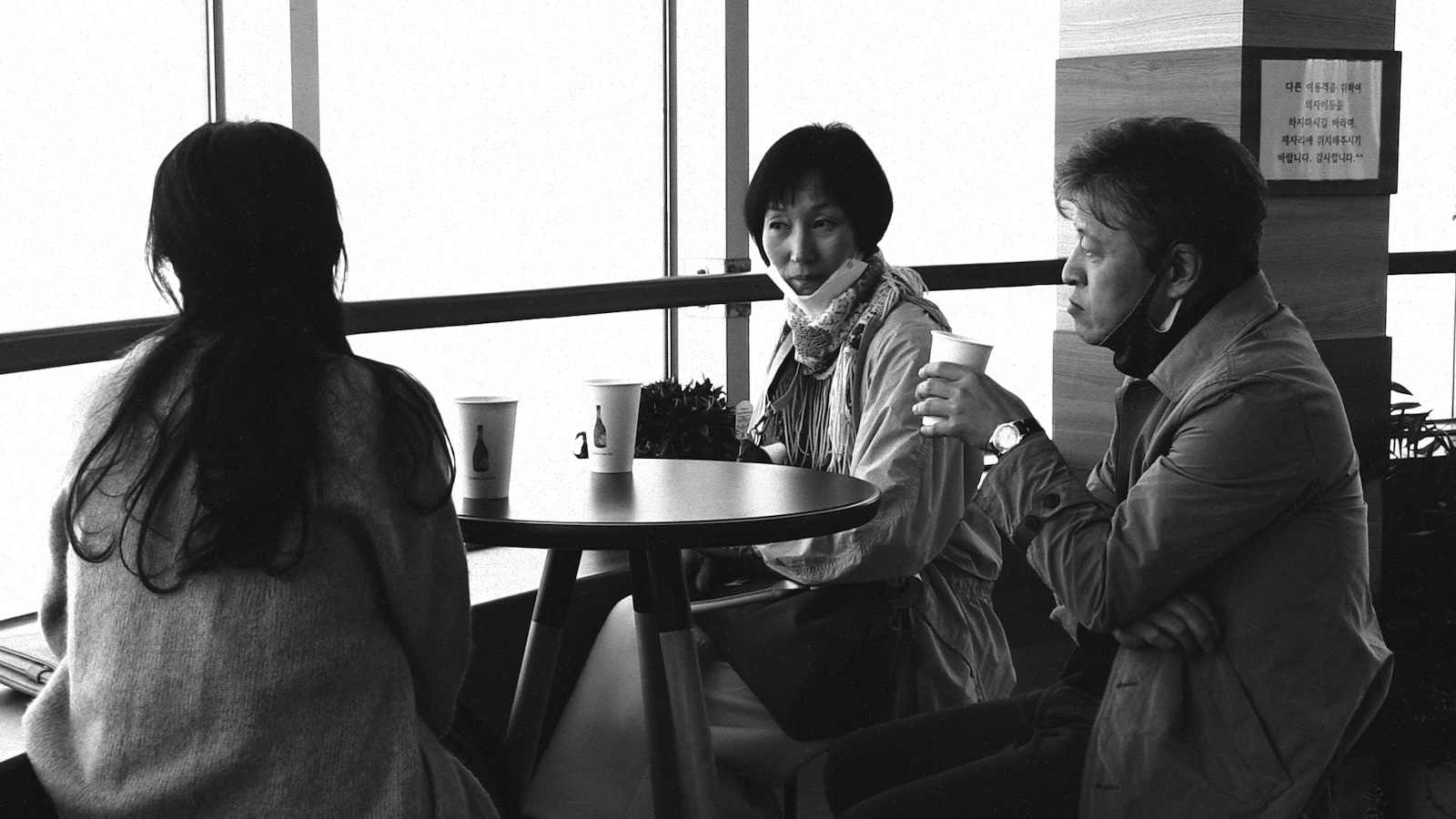 Courtesy of the Cinema Guild
Returning to black-and-white cinematography, Hong also serves as his own editor and cinematographer. He once again shoots the striking black-and-white frames where the characters are often in the corner of the frame or within spaces to give the sky and other backgrounds just enough spaces to show the infinite fleeting of time as his characters try to maintain some relevance as their lives cross paths.
If The Novelist’s Film feels like another one of Hong’s dialogue driven movies about relationship dynamics between men and women, it manages to sway itself away from those commonalities thanks to Hong’s sharp character depth and Lee Hye-young’s diffident charm. In so many uncanny moments, you find yourself invested in the character and in her performance, but mostly, Hye-young’s is endearing in every single scene, as she is a writer who wants to recapture her artistry. This film is certainly a tribute to artists, but it also examines the importance of living in the moment and pursuing one’s self-gratification. As the finale appears, Hong reassures that his films still hold moments and sequences of great warmth and joy that always leave a mannered impression.
The Novelist’s Film screens at the Detroit Film Theatre on April 1st and 2nd; tickets can be purchased at dia.org.




Good review
Was not familiar with this until seeing these reviews on here. Thanks.
In Front of Your Face might be my favourite Hong Sang-Soo film. I am not always on his wavelength, but occasionally I fully connect to his films. Looking forward to seeing this one.
To the defactofilmreviews.com admin, Your posts are always thought-provoking and inspiring.
Hi defactofilmreviews.com admin, Thanks for the comprehensive post!
Dear defactofilmreviews.com owner, Your posts are always insightful and valuable.