

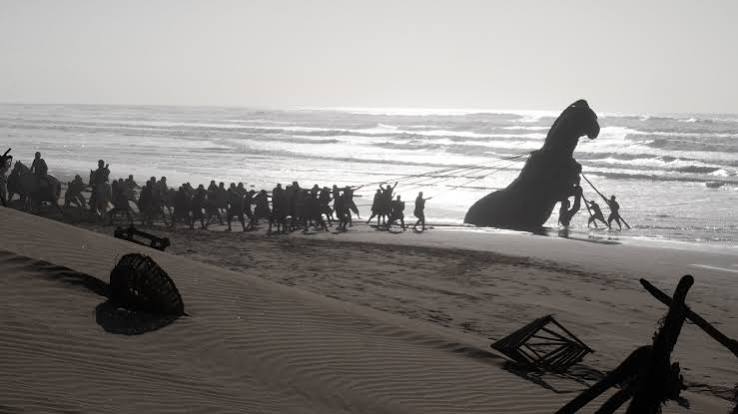

Christopher Nolan’s adaptation of Homer’s ancient Greek story, The Odyssey, is nothing short of a cinematic miracle. This is not a sterile, classicized myth preserved in amber; it is a raw, dirt-under-the-fingernails epic that operates on a scale so colossally bold and visionary that it leaves you momentarily breathless. Nolan has created a film of immense, tactile visual grandeur—the kind of pure cinema that demands to be experienced on the largest format possible. By utilizing native 70mm IMAX cameras to capture landscapes spanning from the rocky crags of Italy to the unforgiving coasts of Iceland, the production achieves an uncanny, almost overwhelming sense of physical reality. You can practically smell the sea salt, the ash, and the copper of congealing blood on screen.
This breathtaking direction masterfully balances massive scope with excruciatingly intimate character drama, structuring the narrative around Odysseus’s harrowing, decade-long attempt to return home to Ithaca after the fall of Troy. Rather than treating Odysseus’s long journey as a series of triumphant action sequences, the film becomes a haunting, psychological descent into the trauma of war and the agonizing weight of survival.
The narrative structure gracefully juggles parallel timelines before colliding in a blood-soaked finale. The film opens in the immediate, ash-choked aftermath of the Battle of Troy, a sequence captured with apocalyptic ferocity. Nolan stages the infiltration of the city not as a grand fantasy, but as a terrifying stealth operation centered around the black Trojan Horse—a towering, charred monolith of wood and iron that looms over the burning city like a monument to death. From its hollow belly, the Greek warriors pour into the streets, triggering a relentless, bone-crushing onslaught. The combat here is fiercely physical; Nolan emphasizes the sickening reality of ancient warfare in an intense sequence where armored men are crushed under the weight of collapsing fortifications and bronze weaponry. The sound design catches every sickening crunch of bone against metal, a visceral reminder of the human cost of Agamemnon’s war.

Courtesy of Universal
As the fleet is blown wildly off course by vengeful gods, the crew’s journey turns into a psychological horror. The centerpiece of this maritime nightmare is the terrifying Cyclops sequence, which plays out like a claustrophobic survival film inside a pitch-black cavern. Polyphemus—portrayed with a towering, deeply unsettling physical presence by Benny Safdie —is an absolute force of nature. Safdie infuses the monster with a volatile, unpredictable cruelty, his single eye tracked by shifting anamorphic lenses that make his scale feel genuinely overwhelming. The sequence is a masterclass in tension, utilizing practical trickery and harrowing camera angles to make the audience feel trapped alongside the desperate crew.
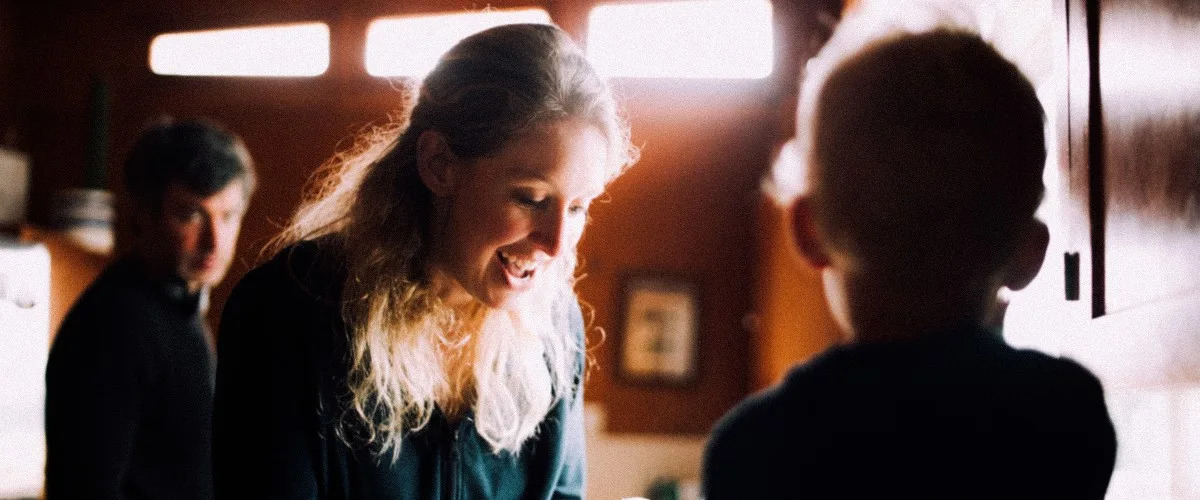
The immense ensemble cast brings an astonishing gravity to this classic saga, grounding the mythic archetypes in raw humanity. Matt Damon (The Martian) delivers a career-best performance, stripping away traditional Hollywood heroism to present an Odysseus who is a stoic, cunning strategist hollowed out by the horrors of Troy. His Odysseus is brilliant but profoundly broken, a man whose famous “wiles” are used as a desperate survival mechanism against cosmic indifference. Alongside him, Anne Hathaway (Interstellar) is magnificent as the Ithacan Queen Penelope, commanding the screen with a quiet, simmering fury. She plays Penelope not as a helpless damsel, but as a master politician fending off a den of wolves with psychological warfare, famously spinning and unweaving a burial shroud to buy precious time.
The younger generation and the suitors bring a sharp friction to the court. Tom Holland completely sheds his blockbusting charm to play Telemachus as a vulnerable, raw prince desperate to find a father he has never truly known, perfectly capturing the transition from a sheltered youth to a hardened defender of his house. In stark contrast, Robert Pattinson plays the lead suitor Antinous with a delicious, sneering malice. Pattinson is terrifyingly charismatic, transforming the chief antagonist into a sociopathic political opportunist who views the Ithacan throne as his birthright.
/elle-india/media/media_files/2026/07/16/feature-publive-80-2026-07-16-15-19-42.png)
Courtesy Universal Pictures
Meanwhile, the supernatural elements are anchored by haunting performances that bridge the mortal and divine worlds. In a stroke of absolute casting genius, Lupita Nyong’o pulls double duty in brilliant dual roles. She portrays both the goddess Calypso, radiating an intoxicating, melancholic loneliness on her isolated paradise of Ogygia, and the tragic prophetess Cassandra in the film’s burning Trojan flashbacks, delivering a performance of wide-eyed, frantic terror that contrasts sharply with Calypso’s serene captivity. Charlize Theron brings a chilling, ethereal grace to Athena, acting as a calculated, chess-playing deity who manipulates mortal fates from the shadows with cold, architectural precision. Samantha Morton complements this cosmic coldness by radiating an ancient, menacing mysticism in an unforgettable cameo as the sorceress Circe, turning men into beasts not with a magic wand, but through pure, hypnotic psychological dominance. Joining the voyage as Eurylochus, Odysseus’s fiercely loyal yet increasingly skeptical second-in-command, Elliot Page provides a crucial emotional anchor, grounding the crew’s escalating panic with a gritty, hyper-focused survival instinct.
The film’s visual language, captured by cinematographer Hoyte van Hoytema, is a masterclass in scale contrast. Van Hoytema juxtaposes the terrifying infinity of the open ocean with claustrophobic, ultra-shallow depth-of-field close-ups of human faces. The daylight scenes are harsh and exposed—the Mediterranean sun is treated not as a postcard luxury, but as a blinding, oppressive force that bleaches the landscape. Using custom-engineered IMAX rigs, Van Hoytema captures the maritime sequences with a sickeningly visceral handheld motion, making the audience feel the violent lurch of the wooden triremes. His night work is equally staggering, relying on natural firelight and silver-tinted moonlight that makes the Mediterranean Sea look like a vast ocean of liquid mercury.
 Courtesy Universal Pictures
Ludwig Göransson’s musical score avoids the predictable brass fanfares of traditional Hollywood swords-and-sandals epics. Instead, Göransson constructs a deeply unsettling, microtonal soundscape. He blends ancient Mediterranean instrumentation—like primitive bone flutes and distorted lyres—with his signature pulsing, mechanical synthesizers. The Sirens’ sequence features a haunting, layered vocal motif that feels structurally discordant, mimicking auditory hallucinations that induce genuine dread in the listener. For the Ithacan segments, the music shifts to low, rhythmic percussion that mimics a ticking clock, building an unbearable, slow-burn tension that mirrors Penelope’s dwindling time.
The journey to the underworld of Hades, where shades drink sacrificial blood from the mud to speak their truths, is a nightmarish, Goya-inspired sequence that rattles you to the core. These moments are balanced by the pure, adrenaline-pumping bravura of the final act in Ithaca. The slaughter of the suitors plays out with operatic precision, as Odysseus and Telemachus lock the palace doors to exact a feral, claustrophobic vengeance.
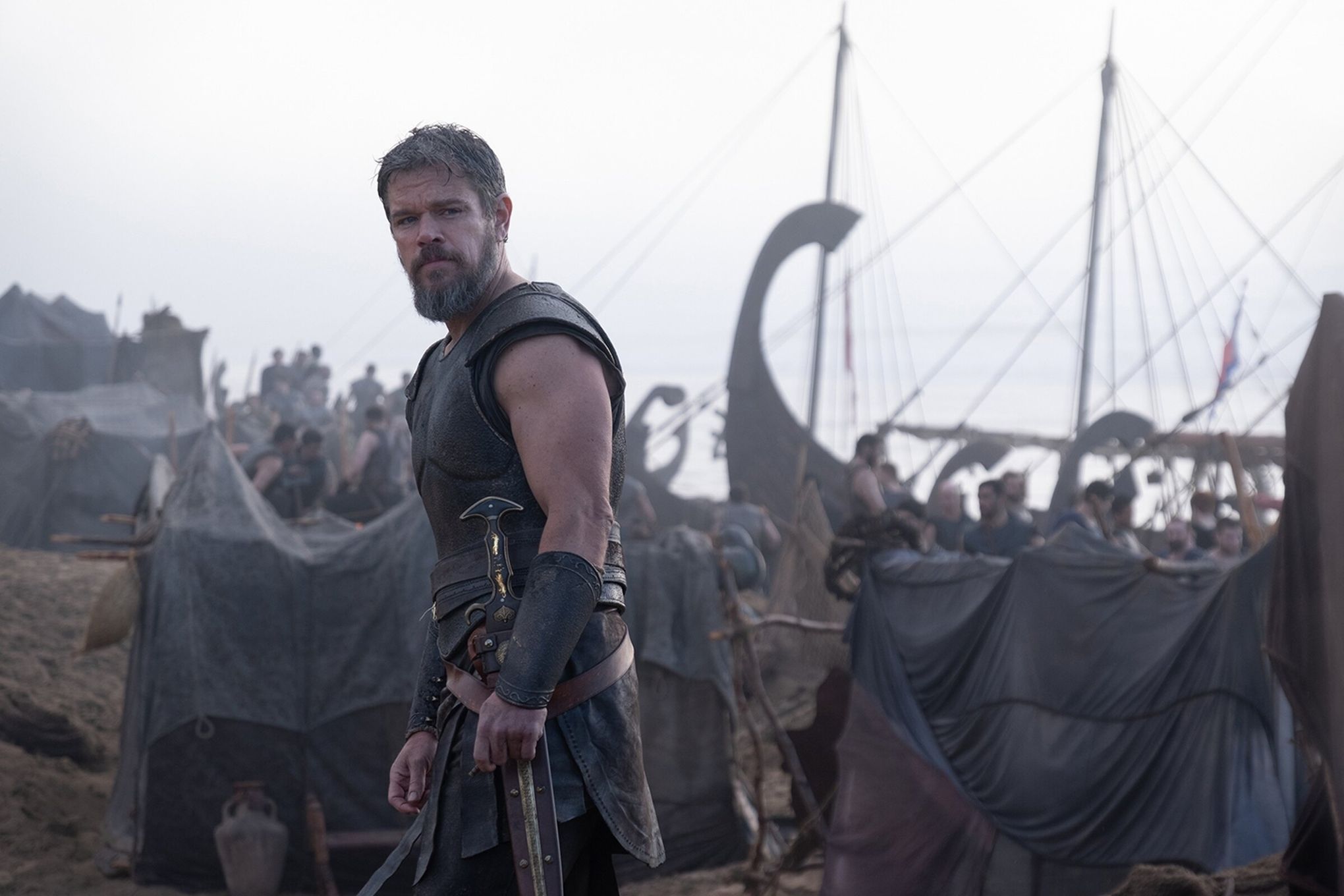 Courtesy Universal Pictures
With The Odyssey, Nolan enters a sacred tier of cinematic risk-taking. This belongs on the short, legendary list of films that pushed the medium to its absolute, chaotic limits. It holds the decadent, visceral madness of Fellini’s Satyricon, the staggering, ground-shaking scale of Ben-Hur, the obsessive, madman-under-a-sun-baked-sky energy of Fitzcarraldo, the grime and primal street-level violence of Scorsese’s Gangs of New York, and the dizzying, war-torn psychological decay of Coppola’s Apocalypse Now, with the technical bravura of The Lord of the Rings. It is a monument to the sheer power of filmmaking. By refusing to dilute the ancient text into a modern, sanitized spectacle, Nolan has delivered a classic for the ages.

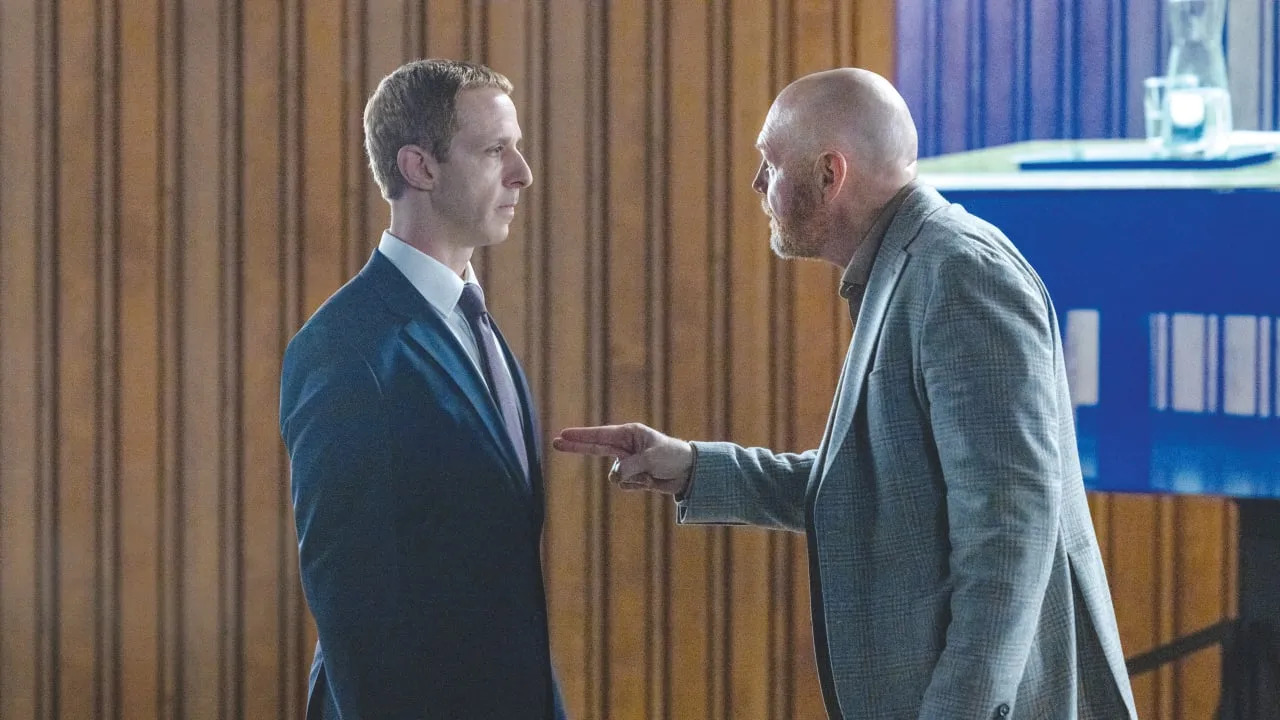

Definitely a must see film. Some striking visuals and great set pieces. Technically excellent. Many standouts in the large cast- my favorite was John Leguizamo. Make sure you see it in the right format
3.5 of 4 stars
This is a truly amazing film! Probably Christopher Nolan’s best
The mythology was adversely affected by modern slang, curse words, and non-Mediterranean Hollywood actors who, frankly, rang false as they played themselves. The pacing was sometimes torturous. The modern lens deprived this Homeric masterpiece of authenticity. The action sequences were altered from the original and wore on endlessly.
The most overrated and insubstantial film in a generation and further proof that Nolan (I did like Interstellar and Dunkirk) is a commercial-minded stud. I consider this film one of his absolute worst.
I commend you for supporting your position eloquently.
The siren song feels discordant not structurally, but rather because it dispenses of the 12 tone equal temperament system and instead uses microtonal intervals more common in ancient times, as well as non western classical music. It sounds ‘out of tune’ and uneasy to our ears because of it, like something is very wrong but we can’t quite put our finger on what. Absolutely genius