

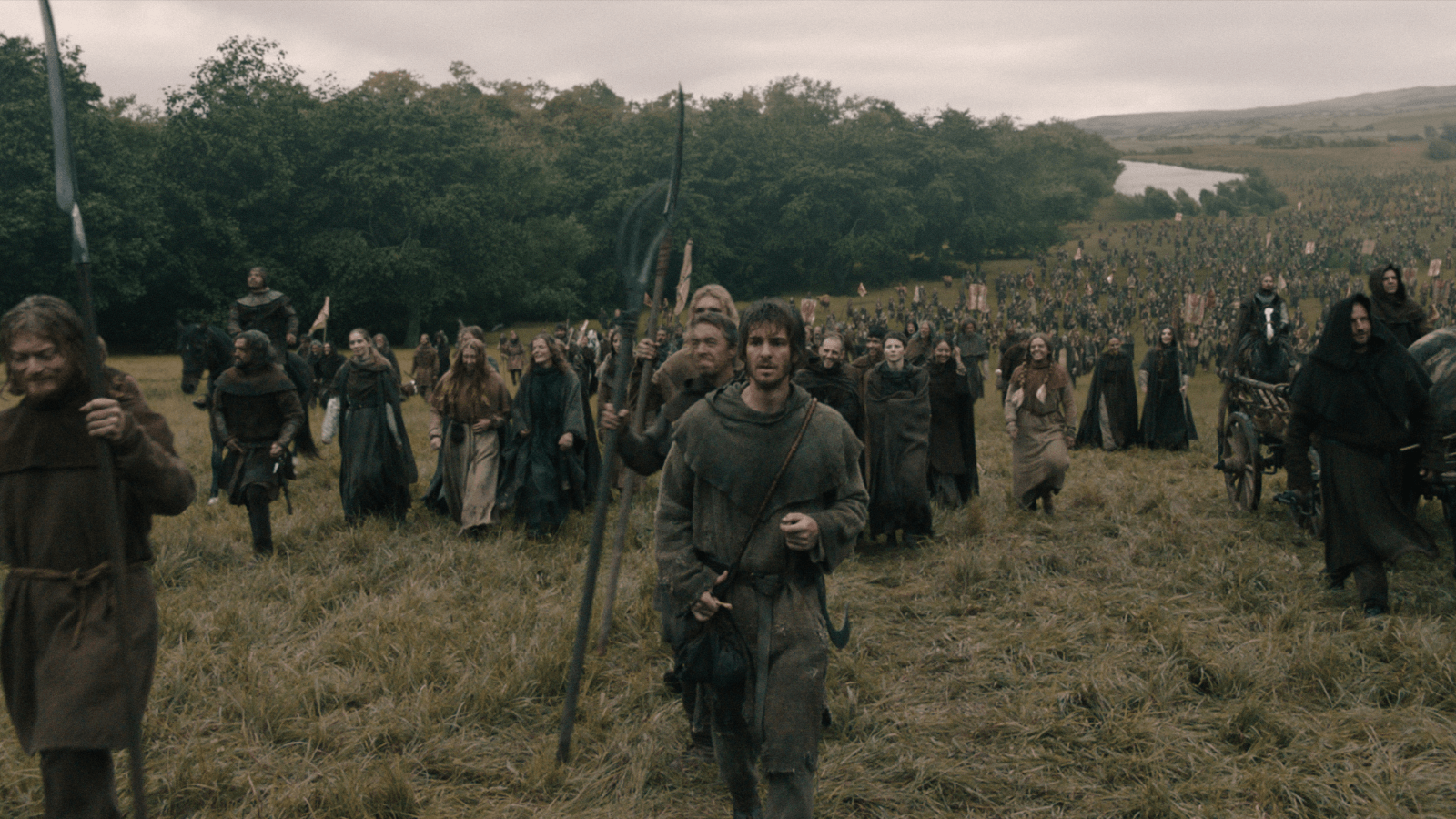

Paul Greengrass returns to historical conflict with The Uprising, delivering yet another iteration of the legend of Robin Hood, though he notably avoids ever uttering the iconic hero’s name. Instead, the narrative focuses broadly on the brutalized, sick peasants reaching their breaking point after being relentlessly tax-burdened and exploited by a ruthless elite. Despite this classic premise, the film stands as a very minor work in Greengrass’s filmography due to how dramatically inert the whole affair ultimately proves to be. It is surprising just how dull the execution turns out, especially considering Greengrass has previously helmed such deeply satisfying and tense cinema, including his 2006 masterpiece United 93 and 2013’s gripping Captain Phillips. While his landmark work Bloody Sunday was always a film to admire more than outright like, even that project possessed a distinct weight that fails to materialize here, leaving The Uprising far less memorable than his career highlights.
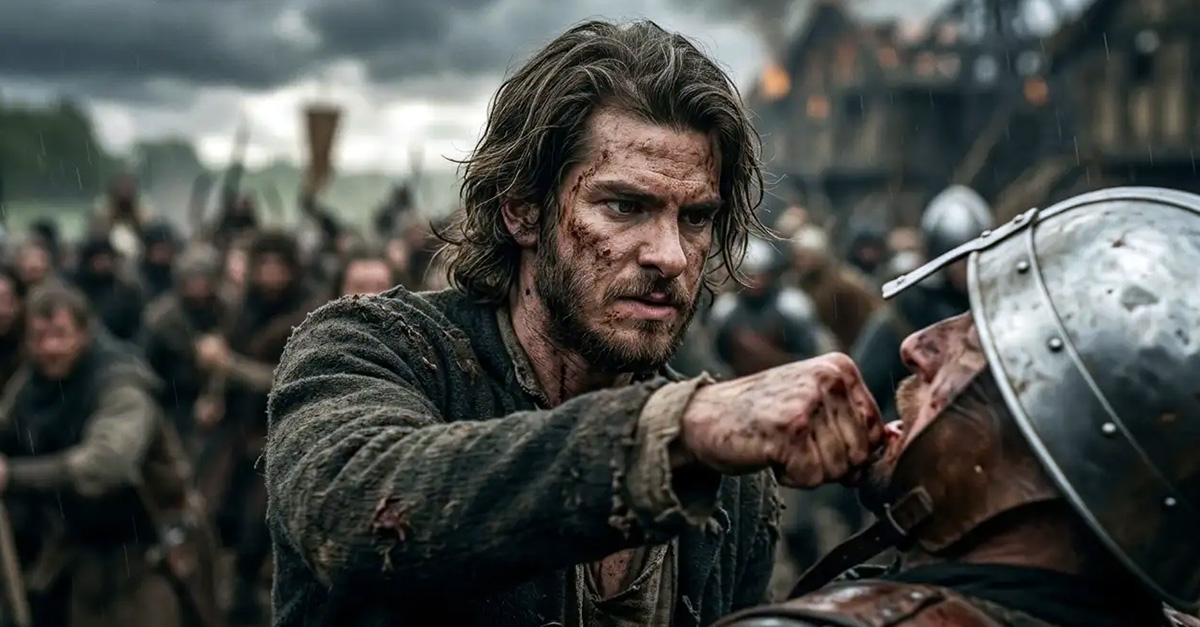
At the center of the conflict is Andrew Garfield playing The Ploughman, a grief-stricken farmer who serves as the central surrogate for the Robin Hood mythos. Garfield certainly gives a committed performance in the role, yet his character is written so thinly that he comes off as little more than a revenge mannequin. Greengrass fails to inject any meaningful emotional depth into his journey, leaving his motivations feeling mechanical. The narrative itself struggles to capture interest, failing to build a seamless flow as it retreads overly familiar ground. Greengrass is clearly attempting to draw parallels to modern sociopolitical dynamics—specifically how modern elites and those in power hoard wealth across every fraction of society—but these thematic parallels land in a heavy-handed, ham-fisted manner.
 Courtesy Focus Features
The mechanics of the plot revolve around the boiling point of the peasant rebellion, sparked by systematic extortion, revenge, and a greedy monarchy. The dynamic of the central power structure features a surprisingly young King Richard II, played by Woody Norman. While Norman brings a genuinely menacing bite to the role, his distinctly teenage physical features make him feel crazy and noticeably miscast for the weight of the crown. Surrounding this central authority is a sprawling political web that drives the conflict. Jamie Bell plays the radical excommunicated priest John Ball, whose fiery ideological sermons fuel the uprising, while Cosmo Jarvis steps in as Wat Tyler, the battle-hardened military strategist leading the peasant forces. On the civilian side, Thomasin McKenzie plays Alyce, a devoted follower of Ball who forms a human connection with Garfield’s Ploughman, anchoring the tragic heart of the masses. Meanwhile, the oppressive royal infrastructure is maintained by Stephen Dillane as Archbishop Simon Sudbury and Tom Hollander as the King’s Treasurer Sir Robert Hales, both enforcing the ruthless tax levies. Tasked with defending the capital as the rebels march is Jonny Lee Miller as Mayor William Walworth, while Katherine Waterston plays Joan of Kent, the King’s mother navigating palace politics to protect her young son. Despite the formidable talent on display, the dynamics between these characters feel underbaked, leaving the cast with very little subtext or narrative friction to operate within as the plot plods forward.
Technically, the film suffers from an approach that feels increasingly sloppy. While Greengrass has long been famous for his kinetic, handheld camera style, the technique here feels tedious rather than immersive, disorienting the viewer without adding any true urgency. While there are sporadic moments of visual vigor or dramatic clarity that recall his best instincts, they are far too brief to salvage the picture. The overall experience quickly devolves into a drab, exhausting endeavor that lacks genuine emotional weight. When measured against other historical epics or re-examinations of similar lore, it completely lacks the visual grandeur and narrative impact of The Odyssey, or even the dramatically satisfying payoff found in The Death of Robin Hood.
Courtesy Focus Features
Ultimately, The Uprising is a thoroughly messy film burdened by a disjointed narrative, making it frustratingly easy for the audience to check out long before the final act. It stands as a surprisingly uneventful and deeply disappointing entry from a director capable of far greater craft. While the film manages to offer a committed lead performance from Andrew Garfield and occasional flickers of visceral, ground-level tension, these meager pros are entirely swallowed up by sloppy technical choices, a miscast antagonist, ham-fisted modern allegory, and a complete absence of dramatic momentum, rendering the entire effort a drab and exhausting misfire.
The Uprising is now playing in theaters


Alas, the grass is not greener on the other side of history.