

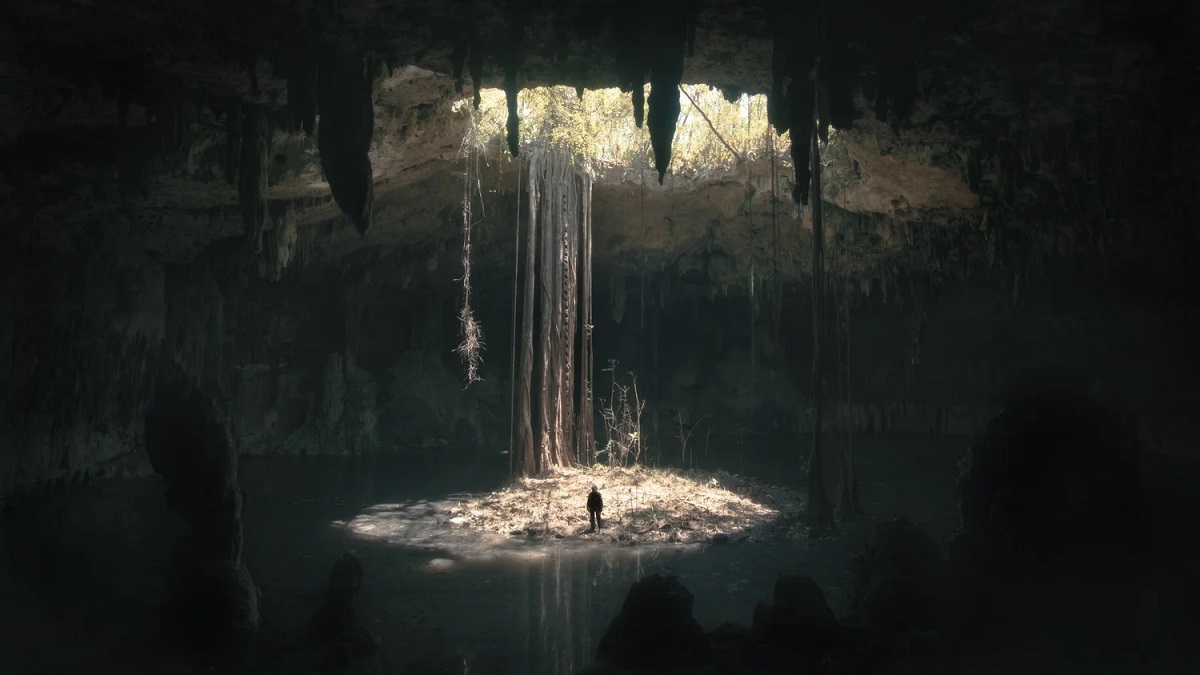

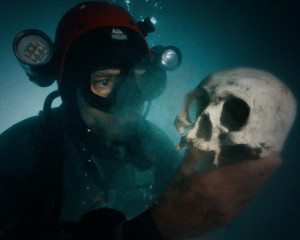
Director Rob Petit proved with his short films, Blackbird and Upstream, that he could create interesting images and hold the attention of an audience. In his debut feature, a documentary called Upland, based on the book by Robert Macfarlane, he only burnishes that growing reputation. Narrated by Sandra Huller and produced by Darren Aronofsky, this documentary tracks three threads. One about a female scientist working on dark matter in a remote, underground laboratory in Canada. Another is about a cave diving archaeologist and her team as they explore a sunken tomb in Mexico. The final story is about a man who considers himself an urban archaeologist, and who spends his life visiting abandoned stations and tunnels deep underground.
Courtesy Oscilloscope Laboratories
There are themes and threads in common with each story, and within. This is a film with a lot of mirrors. It is a deceptively simple film that offers a lot to think about without offering a lot of answers. That, though, could be one of the film’s problems. In philosophical works such as this, it is perfectly fine to beg question after question, but when there are nothing but questions and ultimately, we feel no closer to understanding person, place, thing or time, what was the point?
The point, it would appear, is to get us involved in asking, in wondering and in yearning for answers to that which is hidden. Fine. Simple enough. Powerful enough. But why did this film need to be made? Is it because of the excellent editing, fine photography and ambient music, or was there a deeper purpose? Other than being made aware of how these three individuals see their work, what is going on?
Courtesy Oscilloscope Laboratories
Indeed, the story with the most brilliant photography, the story set in Mexico, is perhaps the least compelling in terms of what happens. We watch a team descend into a cave, forge through some tight and watery passages, carrying equipment, until they find what they are looking for and then, it ends. While it ends on a set of dreamlike images that create a certain incredible scope, there is nothing beyond the personal validation and hoped for future findings, to be had.
The film, here, sets up for a more profound conclusion but fails to deliver, unless you consider that this person has found what they are looking for and can continue their research to be anyways profound. The other two stories here, given relatively short shrift by comparison, are both more profound and more satisfying in the ways they tantalize the audience.
In the case of the scientist, you have someone literally submerge in their work, which happens to be looking for the tiniest sparks of life or existence, at a sub-sub atomic level. The urban explorer, meanwhile, asks questions about how people see themselves. About how we live and interact, often hiding away. Yes, it is obvious that the film wants a Birth-Life-Death cycle, but the death cycle is simply devoid of any narrative energy beyond that provided visually. The other two stories allow the audience to track what is happening much more clearly.
Courtesy Oscilloscope Laboratories
A followup work tracking the other two cases and allowing us, finally, to see what conclusions the third story has drawn, would be interesting, but is not in the domain of this film. The fact the film makes you want to know more is a positive, but this is ultimately just an introduction that perhaps bites off more than it can chew. Even at a lean seventy-nine minutes, the film sometimes drags because it fills gaps with images that look so amazing that the “story” between them cannot compare.
Underland is now playing in select theaters.

Leave A Comment