

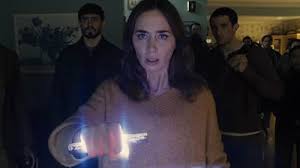

As Steven Spielberg’s sixth feature film involving extraterrestrials—and his first since War of the Worlds (or arguably, Indiana Jones and the Kingdom of the Crystal Skull)—his latest project titled Disclosure Day offers brilliant ideas on what defines humanism and empathy. It provides a rich subtext on how we treat the unknown. Though Spielberg first explored these concepts nearly five decades ago in Close Encounters of the Third Kind and E.T., his latest work still evokes a sense of wonder, backed by breathtaking filmmaking.
The story centers on Margaret Fairchild (Emily Blunt), a Kansas City television meteorologist whose mundane life is upended when a strange encounter with a cardinal inside her home awakens latent psychic abilities. Suddenly, Margaret can intuitively understand the deep emotions of those around her and begins unconsciously speaking in an unlearned, alien tongue—even doing so unexpectedly during a live weather broadcast. Her bizarre television incident catches the attention of a rogue group of whistleblowers led by Hugo Wakefield (Colman Domingo). They shelter her in a secure warehouse containing a meticulous reconstruction of her childhood home, urging her to unlock suppressed childhood memories that tightly connect her to a larger extraterrestrial phenomenon.
Simultaneously, tech expert Dr. Daniel Kellner (Josh O’Connor) pulls off an Edward Snowden-style heist from Wardex, a powerful private organization with shadowy military contracts that has weaponized alien technology and covered up the existence of UFOs for over seventy years. Daniel escapes with a highly classified extraterrestrial device and decades of damning evidence, prompting Wardex’s ruthless, mercenary corporate chief Noah Scanlon (Colin Firth) to deploy lethal force to retrieve the asset and bury the truth. Needing a way to safely expose the files, Daniel connects with his girlfriend Jane (Eve Hewson) and eventually aligns with Margaret and Hugo’s group, realizing that Margaret’s awakening is the missing piece to understanding the stolen alien device.
 Courtesy
In a tense, high-stakes climax, the whistleblowers and Margaret launch a desperate infiltration of her former television studio to override the network airwaves. Despite an aggressive pursuit by Wardex agents, Scanlon experiences a late crisis of conscience, choosing to watch the broadcast unfold rather than forcefully shutting it down. Dubbed “Disclosure Day,” the global transmission successfully broadcasts historical footage of alien encounters and grotesque government cover-ups to a stunned world, ultimately averting an imminent geopolitical conflict. As humanity unites under the gravity of this new reality, the final moments reveal an even deeper truth.
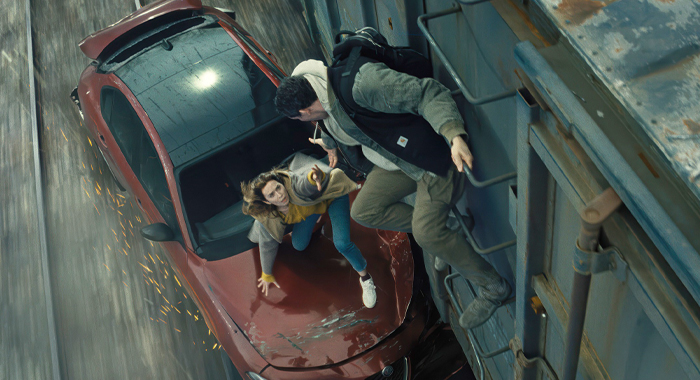
At age 80, Steven Spielberg retains his astounding mastery as both a pristine visual craftsman and a gifted storyteller. Working from his own original story concept—sharply scripted by frequent collaborator David Koepp—Spielberg opens Disclosure Day with a potent, genre-blending cocktail of the supernatural, propulsive action, and intimate human drama. Beneath the spectacle, the film offers a scathing subtext on modern human rights violations born from institutional corruption and unchecked corporatism. Spielberg ratchets up the tension across the first two acts, anchoring the suspense with an incredible, train-centered set-piece that easily ranks among the most superbly staged action sequences of his legendary career. Blunt’s brilliant performance in Disclosure Day anchors the film, offering a layered, emotionally resonant portrayal that embodies a fresh perspective. As her character, Margaret, begins to literally feel and absorb the emotions of everyone around her, Blunt becomes the literal embodiment of the film’s theme. She carries the heavy lifting of the movie’s emotional climax—moving effortlessly from terror and confusion to a state of enlightened, open-hearted wonder. She grounds a very dizzying, chase-heavy film that happens to be grounded in human reality.

As with Spielberg’s seminal sci-fi triumphs—most notably Close Encounters of the Third Kind—a grand, atmospheric mystery shrouds the extraterrestrial presence. Here, the human condition is laid bare, serving as a mirror to the unknown and the indescribable. The narrative also echoes the paranoid energy of Minority Report, tracking Daniel’s desperate flight to protect a world-altering truth from the corporate and government forces weaponized to suppress it. In doing so, the film brilliantly interrogates the existential questions that have captivated humanity for generations.
Spielberg once again delivers an immersive visual design, sharply interrogating how authority exploits the vulnerable. This dynamic draws chilling parallels to historical human nature and mirrors the ongoing crises in our modern immigration policies, all while maintaining a propulsive narrative pace packed with thrilling action. Yet, the film’s true strength lies in its searing commentary on the darker facets of human nature and our inherent propensity for cruelty. Ultimately, Disclosure Day transcends standard blockbuster fare by holding up a mirror to the collective soul of the human race, forcing us to confront our history and learn a vital lesson about who we truly are.
Disclosure Day reaches a spellbinding, emotionally resonant crescendo in its third act. The narrative sophistication elevates dramatically, delivering a wondrous climax that evokes the profound, bittersweet closure of Close Encounters and A.I. Artificial Intelligence. Balancing intellectual depth with pure blockbuster thrills, the film possesses a deliberate, deeply personal energy, feeling like a passion project Spielberg has been orchestrating for decades. Ultimately, Disclosure Day proves that Hollywood’s greatest populist auteur has not forgotten how to deliver an awe-inspiring spectacle—one that once again possesses both a massive heart and a formidable brain.

Love the review. Can’t wait to see it in theaters this weekend.
Loved the film. Spielberg back making the kind of film you can watch and feel as a story of wonder is unfolding before you. The last 45 minutes are magnificent. Josh o Connor and Colman Domingo are great, 4 of 4 stars