



Undeniably sweet and amusing, though overly formulaic. The latest Apatow Company film, titled Bros, is a gay rom-com that offers a retake on all the rom-com tropes and the interplay between two lonely souls that are ultimately meant for each other. This comical, well-scripted gay mainstream romance blends first-rate comedic performances across the board from its mostly all LGBTQ+ cast with some witty writing by actor-co-writer Bill Eichner and director-co-writer Nicholas Stoller (Forgetting Sarah Marshell, Neighbors).
Taking satirical aim at corporations and Hollywood for frequently co-opting and watering down gay culture for heterosexual appeasement, it eventually becomes exactly what it satirizes and unravels as the formulaic straight romantic comedy that has come before it. Despite these familiar trappings, Bros is still a pleasure and a film worth celebrating for being a gay romantic film where the actors aren’t straight actors playing gay roles. With its humor, sweetness, and charismatic leads, the film will certainly appeal and reach broader audiences.

Produced by Judd Apatow, the film offers all the Apatow formulas as well. You get all the pop culture humor, the flawed loner yearning for romantic love, the near two-hour running time, and, of course, the celebrity cameos. While the film will undoubtedly be celebrated for its representation, it would have been even more eventful, if not memorable, had it taken a more uncompromising and unusual approach.
Despite some of these quibbles, the real joy in the film here is Eichner. With both his dialogue and onscreen charisma, he has what it takes to be a leading man. He plays Bobby Leiber, a gay podcaster who is very passionate about LGBTQ representation and he’s very well-versed in gay history, which has been whitewashed over the years by heterosexuals who write the mainstream history books. Bobby ends up getting a job at a LGBTQ+ historical museum as the chair of the board of directors. During these scenes, Eichner and Stoller script some very hilarious satire on identity politics, colliding with everyone on the board worried that their sexual orientation and gender identity will not be represented properly in the museum.
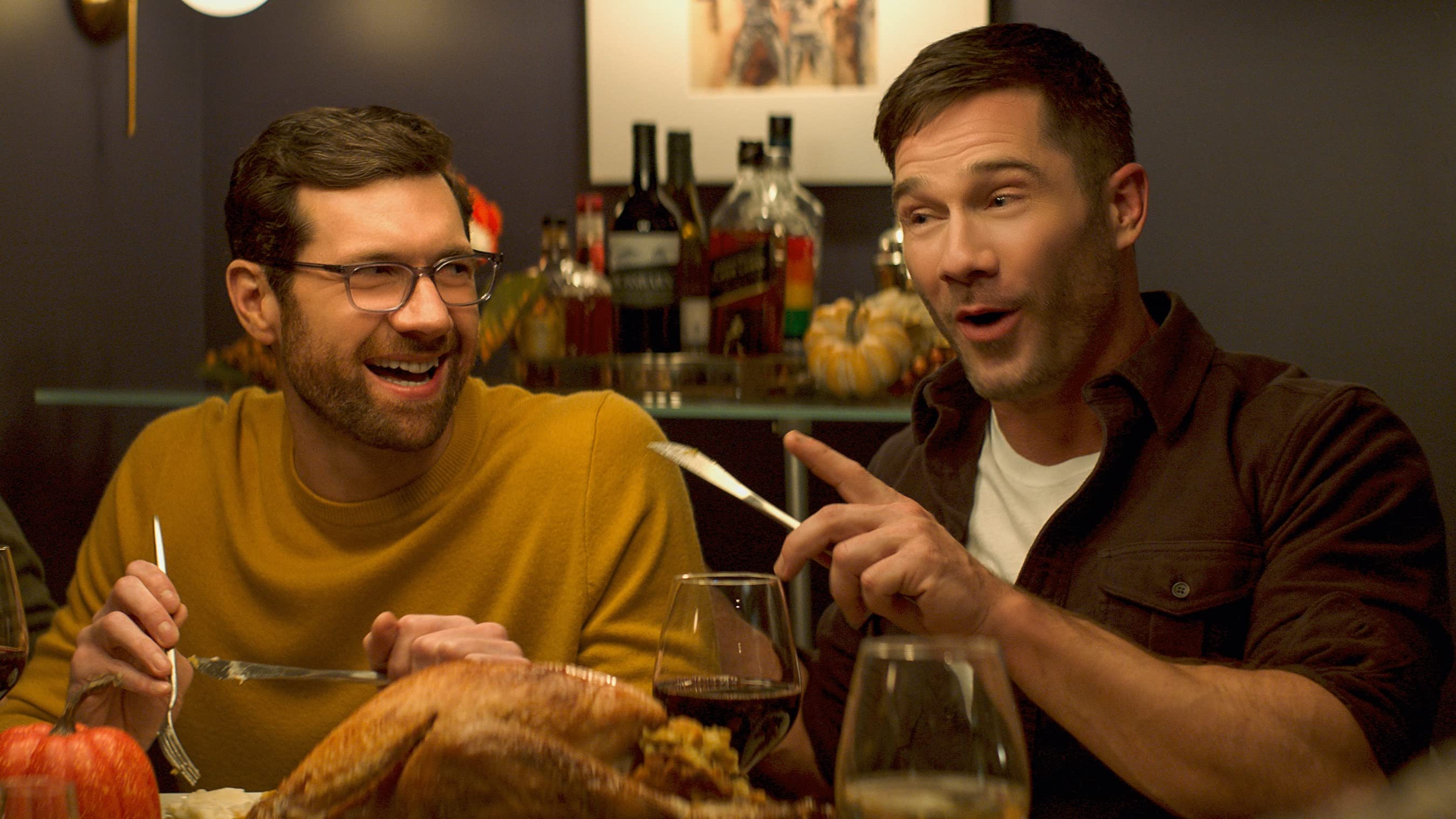
Bobby is also a born and raised New Yorker who is also a celebrity for his popular gay history podcast that he hosts, titled 11th Brick. He has a lot going for him at this point in his life after years of enduring homophobia, mostly on a passive-aggressive level. Now, at age 40, he has 1 million subscribers and is on the cusp of getting the history museum open. However, his dating and love lives are very empty, which leads to very cold encounters on gay dating apps where the guys he meets are only interested in sex. He sees love all around him. His gay friends have all found love, and his sister is happily married with a child. Bobby’s night life often consists of eating pizza and watching 90s romantic comedies like You’ve Got Mail. Bobby even claims to enjoy being single and alone, despite the fact that deep down inside he longs for romance and human connection that extends beyond one-night flings.
Following the traditional rom-com structure, Bobby’s life alters once he locks eyes with Aaron (Luke Macfarlane) at a gay night club. After their first awkward encounter that leaves Bobby accidently insulting Aaron as “boring” and putting down Aaron’s taste in country music and enjoying Garth Brooks, Bobby eventually dismisses himself from the conversation in which they both keep running into each other at the bar. We find out that Aaron is an active listener to Bobby’s podcast, and they eventually find a romantic spark, which leads to them joking around how gay people are either too smart or too ditzy to even comprehend a joke. After having a genuine kiss on the dance floor, Aaron distances himself, and both men come to a mutual understanding that they are both emotionally unavailable to one another. The two men exchange numbers, and the script offers some well-rounded character depth along their romantic journey.

The film certainly has the “opposite attracts” type of rom-com conventions. For Bobby, his loneliness and longing for a companion is certainly characterized well enough that you can’t help but root for him during his journey. Both men are also polar opposites in terms of personality and sexuality. For Bobby, it’s all about expression and not always being proud of who you are. Personality-wise, Bobby is also insecure about his looks. And for Aaron, it certainly isn’t as expressionistic as Bobby about being as open in front of others. While his parents and brother are supportive of his sexuality, it’s a topic he doesn’t openly discuss or embrace in front of them. This is in contrast to Bobby, who is very extroverted and is never ashamed of who he truly is. Aaron is also more of the “Bro” type. He was at one point a high school hockey player, and Bobby can easily sense that he’s attractive to the more “bro” and muscular types of guys. Aaron doesn’t partake in gay activism or culture wars, and he tends to enjoy movies and music that Bobby claims, “only straight people would enjoy. Eventually, both men allow each other to expand their horizons and break out of their own comfortable norms.
Aaron’s sexual lifestyle often consists of one-night stands and hook-ups, but his job as executor, where he assists people’s money and wills before they die. After one encounter with a gay man who is about to die, it’s quite clear he is going to die alone as he insists on giving his fortune to Cher. This allows Aaron to believe that if he continues at the rate of being a bachelor, he could end up single and alone. These sharp character depths, along with the razor-sharp humor, are what makes the film more sincere than just collapsing into something overly pat and trite.

There is a refreshing divergence to the relationship that explores the anxieties that still exist in society. Even with marriage equality being passed along with much progress made in the last few decades—the film does examine just how far gay people can go around certain family members—even ones that are “accepting” and don’t disown their family members for being gay, can’t fully embrace all lifestyle choices or even children learning about gay people at a young age. While Bobby is certainly a social justice warrior who has a grand vision of having a more inclusive and supportive society, which leads to him debating others to understand his perspective. This ends up causing tension between Bobby and Aaron, in which Aaron asks Bobby to tone things down as his family visits the city for Christmas. Clea Duvall’s 2020 Happiest Season also captured some of these themes.
Outside of the film’s genre familiarity, the film’s writing and sympathetic performances are essential to the film’s charm. Having spent years in Hollywood as a writer, comedian, and actor, there is a genuineness to the characters, and you can sense that Eichner knows these characters well. There is a beautifully scripted monologue of Bobby sharing some very personal experiences of how he was turned down for opportunities and denied ambitions in writing and showmanship for being openly gay, even by fellow gay people. It’s one of the most poignantly scripted exchanges you will see this year. The resulting onscreen chemistry between Luke MacFarlane and Billy Eicher is also dynamic, aptly directed by Stoller’s appreciation for character work. He allows these actors to feel wholly naturalistic. This is able to work so well because both leads bring an honesty to their characters that holds great joy and convictions. While there are certainly compromises and limits in the film, the movie knows what it’s aiming for, and it delivers its charms quite consistently.





This seems very sweet natured and has a positive message. I think I will see it.
Jud apatow is usually very reliable at delivering comedy. Saw the trailer recently as well that had the audience chuckling so one to see.
Not a fan of romantic comedies at all. Hard pass on this film.
I’ve heard nothing but great things about this one! Billy Eichner doesn’t get as much appreciation as he deserves. I’m usually not one for romantic comedies, but I will definitely give this a chance!
A great review of a groundbreaking rom com, Robert. Will def watch this one.
I loved it! It was wonderful. Definitely going to have to see it again soon.
Billy Eichner is hilarious, definitely will check this out.
Who else thinks that the information reported in the article is a bit out of date? Don’t we have absolutely different figures now? I googled several comparing sites and all of them provided different details. Best of all was COMPACOM review. Only verified information, references to trusted sources, examples, and case studies really attracted my attention.
Idk. Movies like this talk about representation but fall into the same issues. The sesson eitherstory seems quite cliche. I didn’t enjoy happiest season either
This seems really good. Looking forward to seeing it. Thanks for the review
Been seeing billboards everywhere for this one
Can’t wait to see it. Hopefully it lives up to my expectations.
A movie you definitely want to see with a packed audience. Laugh out loud humor throughout as well as a great message.
Great review and I agree to most all of it. My partner and I just saw it last night with 3 other gay friends in an almost empty theater, not sure if due to the Covid or the topic. Being in a mostly “lets not talk about it” homophobic mid west/east region, I chose the latter but thoroughly enjoyed it. I laughed, I cried and knew all the references having lived a lot of them in my life. Hats off to Bobby taking on the Hallmark take on rom coms and bringing in a real take on life than just watering it down. The sex scenes were a bit more graphic than I thought they were going to show not total nudity but very realistic hook ups and love scenes. that were were both funny and caring. We need more like this!
Great review! I actually liked MacFarlanes performance the best but then together was very magnetic. Their chemistry was extremely strong. Hope the lousy box office doesn’t caput more rom coms in this vein. Besides it’s complete ass kissing of the Democratic establishment I really loved the films politics and how it showed the inter working between all the different groups in the LGBTQ+ community. I wish they didn’t show so much in the trailer, honestly. I thought some of the editing was strange and made some scenes feel out of place a little bit but that may be more on the script than anything probably. Just how I felt around a few scenes going into the last portion of the movie. The second half is noticeably better imo too.
Hello defactofilmreviews.com administrator, Keep sharing your knowledge!
Dear defactofilmreviews.com admin, Keep the good content coming!
To the defactofilmreviews.com webmaster, You always provide clear explanations and step-by-step instructions.
Hello defactofilmreviews.com admin, You always provide great information and insights.
Dear defactofilmreviews.com webmaster, Thanks for the informative and well-written post!
Hi defactofilmreviews.com admin, Your posts are always informative and up-to-date.
Hi defactofilmreviews.com owner, Thanks for the well-presented post!
Hi defactofilmreviews.com owner, You always provide helpful information.
To the defactofilmreviews.com admin, You always provide in-depth analysis and understanding.
To the defactofilmreviews.com administrator, Thanks for the valuable information!
Hi defactofilmreviews.com admin, Your posts are always well-supported by research and data.
To the defactofilmreviews.com admin, Your posts are always interesting.
To the defactofilmreviews.com admin, Your posts are always well researched.
Hi defactofilmreviews.com administrator, Your posts are always well-formatted and easy to read.
Hi defactofilmreviews.com administrator, Your posts are always well-referenced and credible.
To the defactofilmreviews.com administrator, Your posts are always thought-provoking and inspiring.
Hello defactofilmreviews.com administrator, Your posts are always well-written and easy to understand.
Hello defactofilmreviews.com admin, Your posts are always a great source of knowledge.
Dear defactofilmreviews.com owner, Your posts are always informative and well-explained.
Hello defactofilmreviews.com admin, Thanks for the well-researched and well-written post!
I am very impressed with the information that you have presented. SLOTXO the number 1 online gambling website, can play anywhere, get 100% real money.
Explore how Ledger helps you manage your crypto assets securely and with ease [url=https://ledgerlive.fr]ledger live[/url]
Thank you for your sharing. I am worried that I lack creative ideas. It is your article that makes me full of hope. Thank you. But, I have a question, can you help me?
Эффективное программирование контроллеров Siemens, для опытных специалистов.
Лучшие практики программирования контроллеров Siemens, оптимизации процессов.
Преимущества TIA Portal в программировании контроллеров Siemens, для комфортной работы.
Типичные ошибки в программировании, распространенные проблемы.
Как спроектировать систему автоматизации с Siemens, для эффективной работы.
Сравнение контроллеров Siemens, для оптимальной работы.
Использование языков программирования в Siemens, для разработки.
Как контроллеры Siemens помогают в автоматизации, реальные решения.
Тренды в автоматизации с контроллерами Siemens, какие изменения произойдут.
Создание интерфейсов для управления с помощью Siemens, основные шаги.
Запрограммировать сименс [url=http://programmirovanie-kontroller.ru/#Запрограммировать-сименс]http://programmirovanie-kontroller.ru/[/url] .
Finest news for all us